
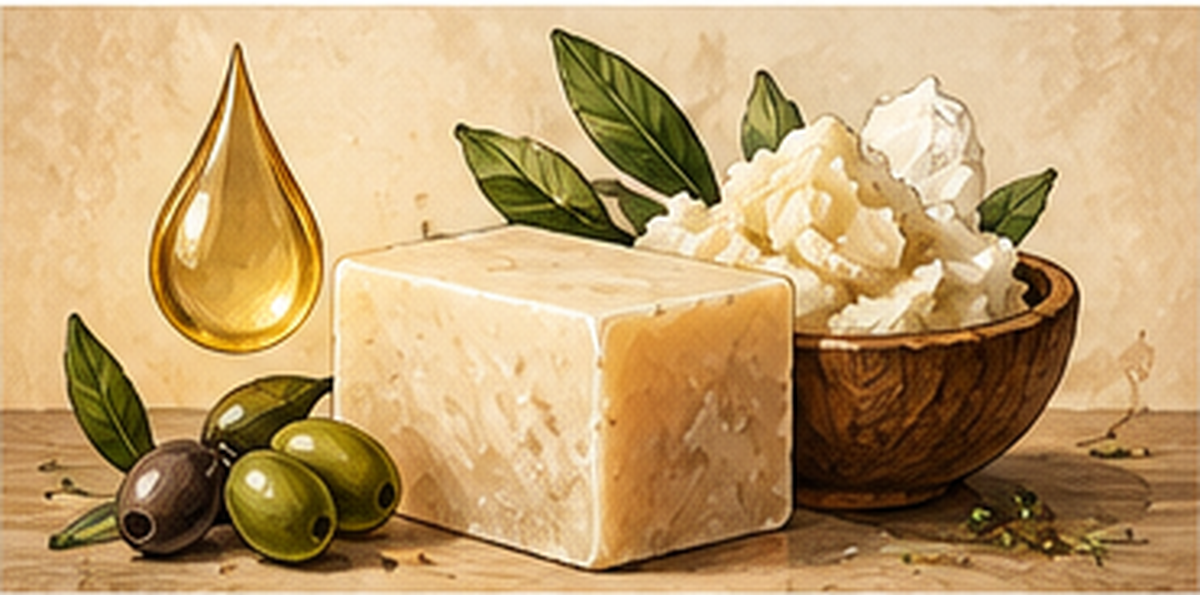
Superfat is a way of thinking about how much oil remains unconverted into soap. Instead of every bit of oil being converted, a small portion is left as oil in the finished bar.
A useful analogy is adding a little coconut oil to bath water when the skin feels dry. That small amount can change how the skin feels without making the entire bath greasy. In soap, leaving some oil unconverted serves a similar conceptual purpose.
How this relates to skin type
The amount of residual oil can be considered when designing soap for different skin needs. Less residual oil may be more appropriate when formulating for oily skin, while comparatively more can be considered for dry skin. A middle approach can be used for a more general-purpose soap.
This matters because skin-type customization does not have to begin with herbs, clays or fashionable additives. It can begin with the underlying formulation.
For dry skin, richer oils and butters can also be considered. Olive and almond oils are discussed as thicker, more nourishing oils, while butters can contribute to richer formulations.
A useful distinction
It is easy to assume that a soap becomes suitable for a particular skin type simply because a well-known botanical ingredient has been added. But the balance of the soap itself matters.
I prefer to think directly in terms of oily and dry skin requirements rather than expecting one bar to behave differently on separate areas of so-called combination skin. The practical takeaway is that skin feel is designed into the soap at a fundamental level. Additives may change the character of a bar, but they are not the only way to think about who the soap is for.