
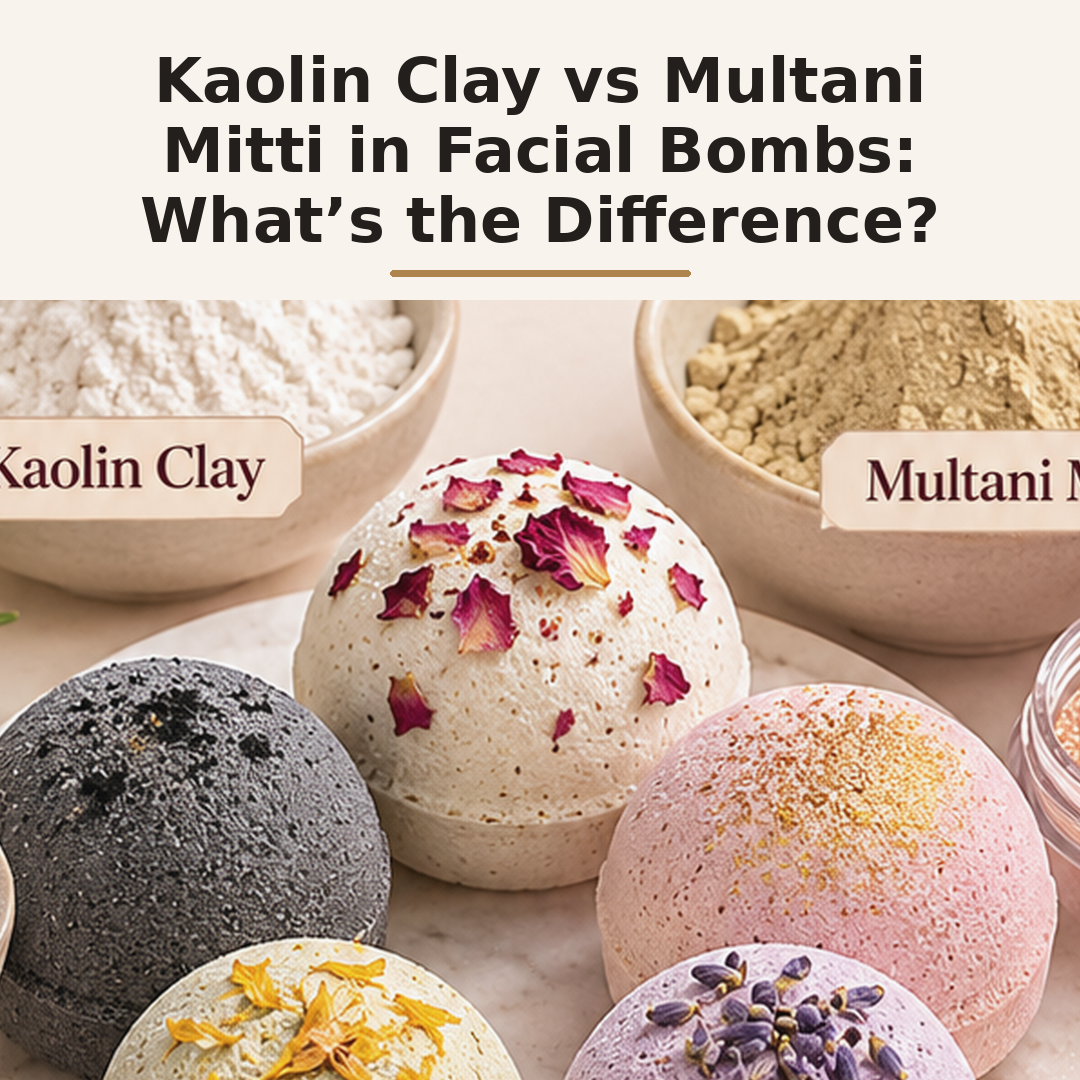
Kaolin clay and Multani Mitti are both used in facial-bomb concepts, but I do not treat them as interchangeable in every situation.
Kaolin is used as a mineral-rich clay that can also absorb excess sebum. Multani Mitti is the stronger oil-absorbing choice in the way I teach these products, so it is especially useful when oily skin is the main concern.
That difference matters when choosing a facial bomb for different skin types.
What Role Does Kaolin Clay Play?
Kaolin appears in several facial-bomb concepts in the workshop.
I use it for its mineral/clay contribution and its ability to absorb excess sebum.
Sebum is the oil produced by the skin.
People with oily skin produce enough for the oiliness to be very visible, but dry skin also has sebum.
Kaolin therefore fits into several different facial-bomb styles rather than belonging only to one strongly oily-skin formula.
It is used in concepts ranging from charcoal and sensitive-skin products to richer moisturizing variations.
How Is Multani Mitti Different?
Multani Mitti is used when stronger oil absorption is wanted.
I describe it as capable of pulling a great deal of oil from the skin.
That is a useful property when excess oil is the main concern.
But every useful property can become unsuitable when applied to the wrong skin type.
If the skin is already dry, removing too much oil can make it feel even drier.
That is why I do not treat a strongly Multani-Mitti-based facial bomb as an all-skin-type product.
Does That Mean Multani Mitti Is Only for Oily Skin?
Not necessarily.
The workshop also uses Multani Mitti in a glow-focused concept, but there it is not being used to turn the product into an intensely drying oily-skin treatment.
The product is balanced around an instant-glow objective.
This demonstrates an important principle: the role of an ingredient also depends on the overall product concept.
The same clay may play a supporting role in one facial bomb and a much more dominant oil-absorbing role in another.
Why Is Kaolin Used More Broadly?
Kaolin is used across several variations because I treat it as giving both a clay/mineral effect and some sebum absorption without making every product primarily about removing oil.
For example, it can be present in a moisturizing facial bomb while other ingredients determine the main character of that product.
That would be very different from building an oily-skin facial bomb around strong oil absorption.
Which One Should You Choose?
Think first about the user’s skin.
If the main problem is strong oiliness, Multani Mitti is the more targeted clay in the way I teach these products.
If the purpose is to include a mineral clay with some oil-absorbing function inside a broader facial-bomb concept, kaolin is used more widely.
The choice should come from the purpose of the facial bomb rather than from the idea that one clay is universally “better.”
What Is the Common Mistake?
The common mistake is choosing a powerful oil-absorbing ingredient because it sounds effective without asking whether the skin actually has excess oil.
A person with dry skin does not benefit from making the skin unnecessarily drier.
The right ingredient is the one whose function matches the skin concern.
Practical Takeaway
Kaolin clay and Multani Mitti can both absorb oil, but they play different roles in these facial-bomb concepts.
Kaolin is used more broadly as a mineral clay with sebum-absorbing properties. Multani Mitti is the stronger oil-absorbing choice and needs more careful matching to skin type.
Choose the clay according to the goal of the product and the condition of the skin.
Related Topics
Which Facial Bomb Is Best for Dry, Oily, Sensitive or Acne-Prone Skin?

