
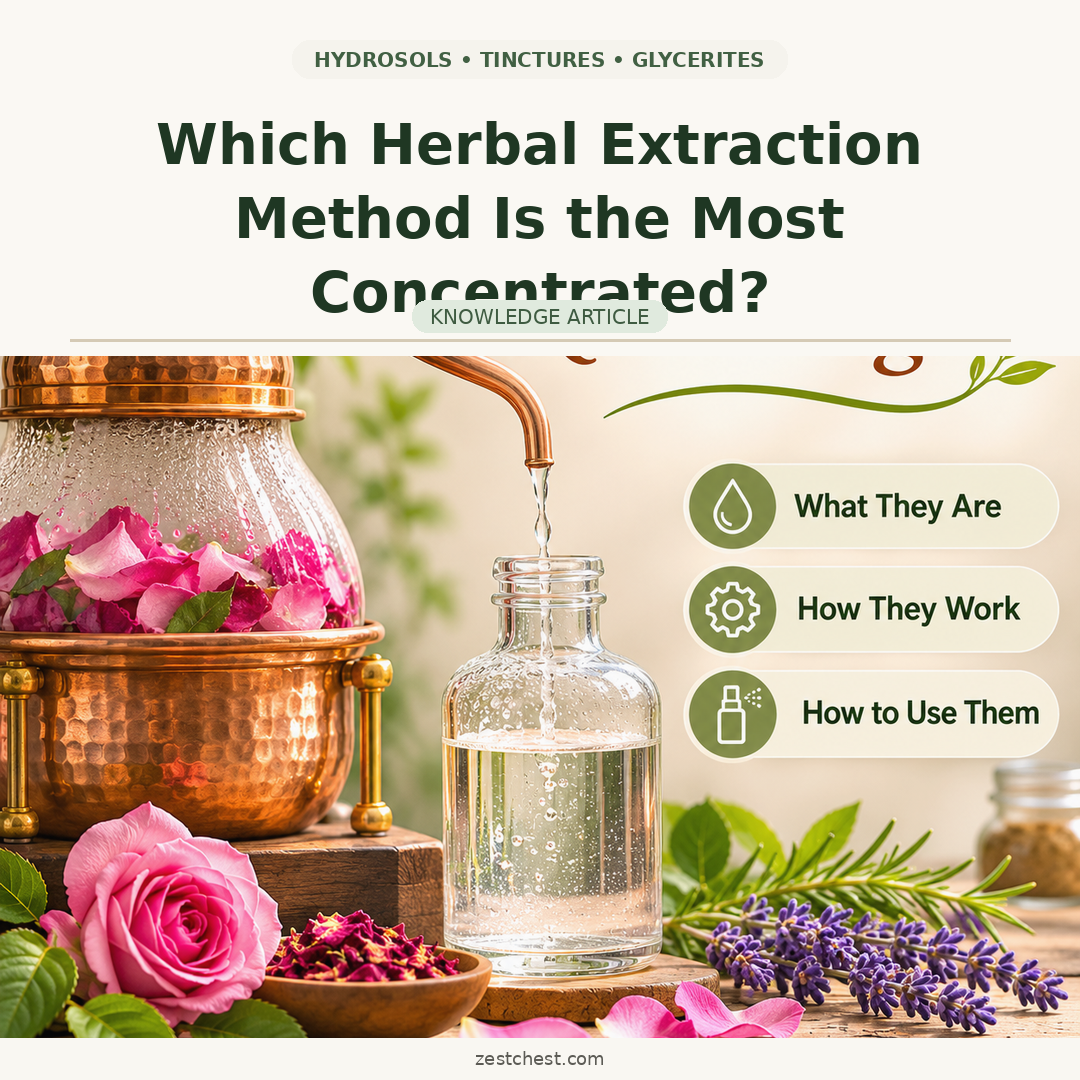
In the extraction system taught here, alcohol extraction is the most concentrated, followed by glycerin, direct water extraction, oil extraction and finally hydrosol as the mildest form.
The important point is that this is an extraction-strength comparison, not a ranking from best to worst.
A more concentrated extract is not automatically more suitable for every cosmetic.
The Extraction-Strength Order
The final corrected order taught is:
- Alcohol extraction
- Glycerin extraction
- Direct water extraction
- Oil extraction
- Hydrosol
An earlier spoken sequence briefly placed oil and water in the opposite order, but the order was then corrected to direct water extraction before oil extraction.
Why Is Alcohol Considered the Strongest?
Alcohol is described as being particularly effective at macerating plant material and pulling botanical components from the plant cells.
This is why an alcohol extract, or tincture, is treated as a concentrated botanical ingredient.
Because it is concentrated, it is not used in the same way as a hydrosol.
A little concentrated extract may be used where a much larger amount of mild botanical water would otherwise fit.
Where Does Glycerin Fit?
Glycerin is placed second.
It also creates a concentrated botanical extract, but maceration is slower than with alcohol.
The resulting glycerite brings both the botanical material and glycerin into the final cosmetic.
That makes concentration only one part of the decision.
The formulator also has to consider the moisturizing and potentially sticky character of glycerin.
Why Is Direct Water Extraction Stronger Than Hydrosol?
In a direct water extraction, the botanical material stays in contact with the water that becomes the finished extract.
Think about tea.
When tea leaves are heated in water, colour and flavour move directly into the liquid.
A hydrosol works differently.
Its final liquid is condensed steam rather than the same water in which the botanical was sitting.
For this reason, direct water extracts and hydrosols should not be treated as identical.
Where Do Oil Extracts Fit?
Oil extraction is useful when the final botanical ingredient needs to belong in an oil-based product.
Oil is not ranked as highly as alcohol or glycerin for extraction strength in this workshop, but that does not make it unnecessary.
If the final product is a face oil, body oil or hair oil, an oil-soluble botanical extract may be exactly the form needed.
A highly concentrated water-based ingredient is not automatically useful if it does not belong in the product.
Why Is Hydrosol the Mildest?
Hydrosol is the mildest form because only the material carried through the distillation process is collected.
That mildness gives hydrosols their own advantage.
They can be used as botanical waters and can make up a large portion of the aqueous side of a cosmetic.
They may also be used directly as mists.
Does Strongest Mean Best?
No.
This is the most important distinction.
A student asked whether a rose tincture or glycerite is better than rose hydrosol because the first two are more concentrated.
The answer is that concentration alone does not settle the question.
A concentrated tincture is used in a small amount.
A mild hydrosol can be used in a much larger amount.
Depending on the finished formulation, both can make meaningful botanical contributions.
Choose the Extraction Method Backward
A useful way to make the decision is to begin with the final product.
Ask:
Is it water-based or oil-based?
Do I need a mild botanical water or a concentrated extract?
Will glycerin support or interfere with the desired texture?
Is an oil-soluble ingredient required?
Once those questions are answered, the “strongest” extraction method may no longer be the most useful one.
Practical Takeaway
Alcohol is taught as the strongest extraction medium and hydrosol as the mildest, but extraction strength should never be confused with formulation suitability.
The best extraction method is not necessarily the one that pulls out the most material.
It is the one that produces the type of ingredient your finished product actually needs.
Related Topics
What Is a Tincture in Cosmetic Formulation?
Hydrosol vs Tincture vs Glycerite: What’s the Difference?
Oil-Soluble vs Water-Soluble Herbal Extracts: What’s the Difference?

