
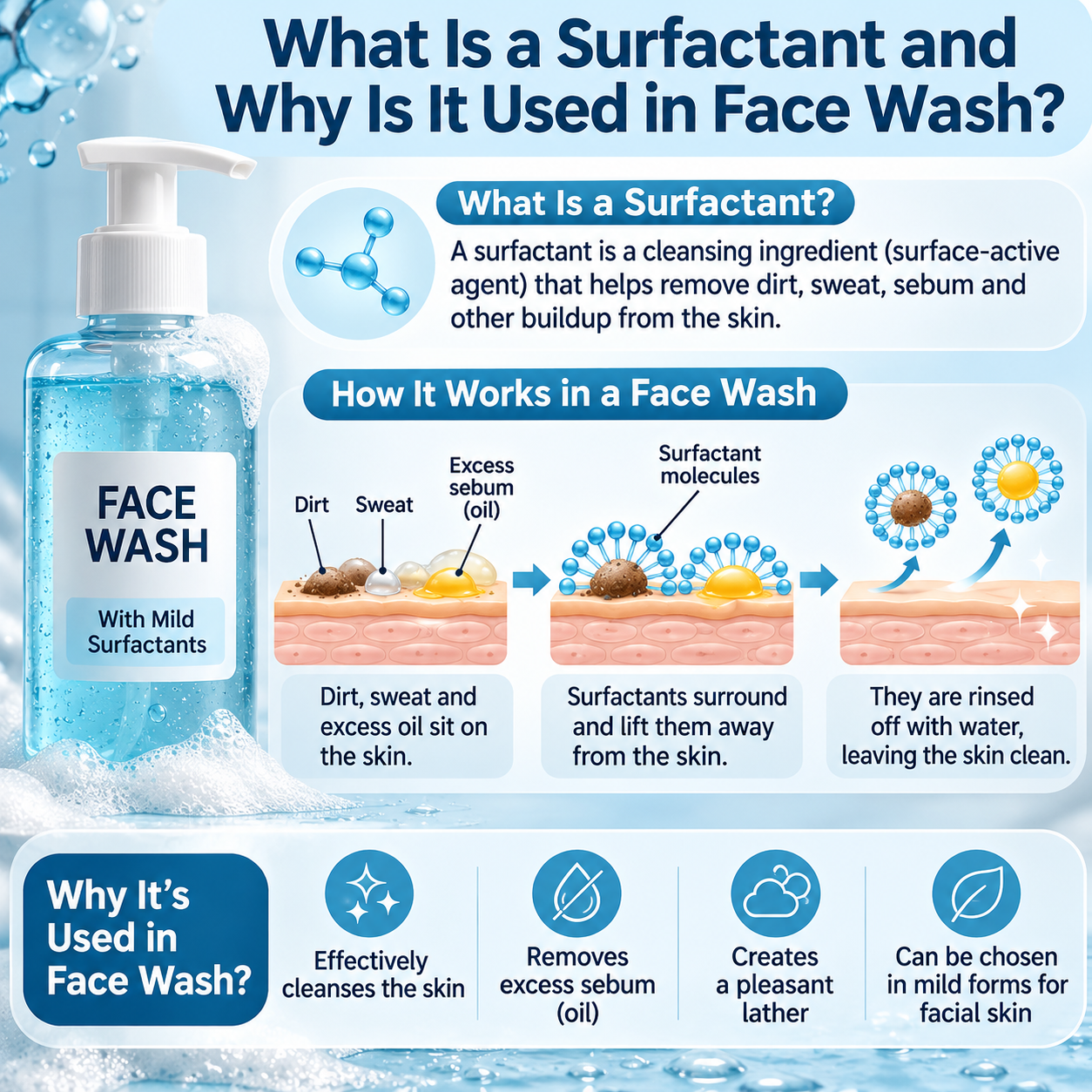
A surfactant is the cleansing ingredient in a face wash. The word comes from surface-active agent, and its main job is to help remove dirt, sweat, sebum and other material from the surface being cleaned.
Surfactants are not unique to face wash. They are also found in shampoos, body washes, hand washes and detergents. What changes from product to product is the type of surfactant used, the strength of the complete cleansing system and how the ingredients are combined.
That distinction matters because facial skin should not be cleansed in exactly the same way as hands, hair or clothes.
What Does a Surfactant Actually Do?
A useful way to think about a surfactant is as the part of the cleanser responsible for lifting away material that water alone may not remove efficiently.
When you wash your face, you are not only removing visible dust.
You are also removing:
- sweat;
- excess sebum;
- environmental dirt;
- material that has accumulated on the skin during the day.
The face wash needs enough cleansing ability to remove these materials while still feeling appropriate for facial skin.
This is why a face wash cannot be judged simply by whether it contains a surfactant. Almost every wash product contains surfactants.
The more important question is what kind of surfactant system has been created.
Are All Surfactants Equally Strong?
No.
Different cleansing products are designed for different levels of cleaning.
In the framework I use, shampoo is treated as the mildest of the personal-care washes discussed in the workshop. Face wash comes next, followed by body wash and then hand wash.
Household detergents require stronger cleansing again because they have to remove heavy grease, stains and soil from dishes or fabrics.
This is why a surfactant that makes sense in one type of product cannot automatically be treated as appropriate in exactly the same way in another.
The complete formulation matters.
Why Does Face Wash Need a Mild Surfactant System?
Facial skin is treated as more delicate than the skin of the body or hands.
At the same time, the face is exposed to dust, sweat and sebum and still needs thorough cleansing.
The goal is therefore not to create the weakest cleanser possible.
The goal is to create effective but mild cleansing.
A cleanser that is too weak may not give the desired clean feeling. A cleanser that is unnecessarily strong may leave the skin feeling dry or stretched.
What Is a Primary Surfactant?
A primary surfactant carries most of the cleansing work.
In the face-wash systems discussed here, Sodium Cocoyl Isethionate, commonly called SCI, is used as an important cleansing and lathering surfactant.
I describe SCI as coconut-derived.
An ingredient such as SCI can give the cleanser substantial cleansing and foam, but the final product is not built around one ingredient alone.
Supporting surfactants are also used to modify how the complete system behaves.
What Is a Co-Surfactant?
A co-surfactant supports the main surfactant rather than carrying the entire cleansing job by itself.
Cocamidopropyl Betaine, or CAPB, is discussed in this role.
On its own, CAPB produces relatively little cleansing and lather compared with a primary cleansing surfactant.
When combined with another surfactant, however, it can help support:
- lather;
- mildness;
- texture;
- product thickness.
This is why looking only at the quantity of one ingredient can be misleading.
Two surfactants may appear in the same cleanser but perform very different jobs.
Why Are Glucosides Used?
Coco glucoside, decyl glucoside and lauryl glucoside are also discussed as mild surfactants.
In these particular face-wash concepts, their usefulness goes beyond cleansing.
A glucoside can help incorporate ingredients such as essential oils that might otherwise separate, float on top or make a clear cleanser look cloudy.
The workshop also uses a glucoside to support salicylic acid in the oily-skin cleanser system.
This shows why ingredients should be understood by function rather than simply by category.
An ingredient may be called a surfactant and still be included mainly because of another useful role it performs in the finished product.
Does More Surfactant Mean Better Cleansing?
Not automatically.
A stronger cleansing system may remove material more aggressively, but stronger does not always mean more suitable.
Think about using hand wash on the face.
It can certainly remove dirt.
The problem is that it is designed around a stronger cleaning requirement. Used regularly on the face, it may leave the skin feeling much drier or tighter.
The correct goal is not maximum cleansing strength.
It is the appropriate cleansing strength for the area being washed.
Does Surfactant Determine How Much a Face Wash Lathers?
Surfactants are responsible for the cleansing and lathering system, but the amount and type of foam depend on the complete formulation.
Supporting surfactants can improve lather.
Other ingredients may reduce it.
Oil, for example, can interfere with the amount of foam produced when too much is introduced into a moisturizing cleanser.
This is why two face washes can both clean effectively but produce different foam experiences.
The Practical Takeaway
A surfactant is the foundation of a face wash because it provides the actual cleansing action.
But the word surfactant does not tell you whether a cleanser will be mild, strong, highly foaming or suitable for facial skin.
Those characteristics depend on the complete surfactant system.
The useful question is therefore not simply, “Does this face wash contain surfactants?”
It is:
“Has the surfactant system been designed for the type of cleansing the face actually needs?”
Related Topics
Face Wash vs Body Wash vs Hand Wash vs Shampoo: What’s the Difference?

