
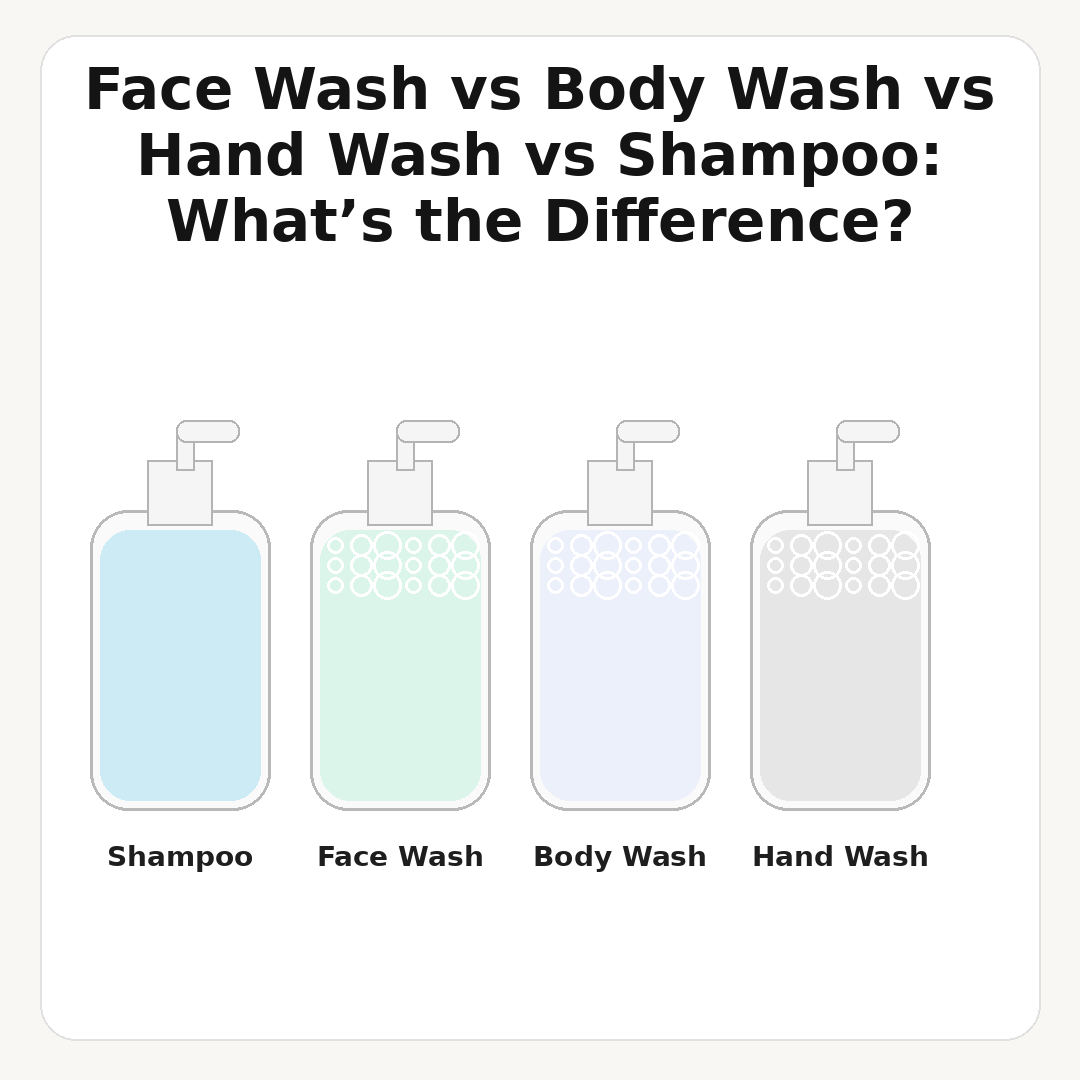
Face wash, body wash, hand wash and shampoo are all cleansing products, but they are not designed to provide the same strength of cleansing.
In the framework used here, the general order is:
Shampoo → Face Wash → Body Wash → Hand Wash
Shampoo is treated as the mildest of these cleansers, while hand wash is designed for the strongest cleansing.
The difference is not simply the product name on the bottle. It comes from the complete surfactant system and the level of cleansing the product is expected to provide.
Why Are These Cleansers Different?
Different parts of the body have different cleansing requirements.
Hair strands are treated as very delicate.
Facial skin also requires relatively mild cleansing.
The body can generally take somewhat stronger cleansing, while the hands are frequently exposed to dirt, surfaces, oils and other material and therefore need a more powerful washing product.
So even when two cleansers contain some related ingredients, their overall formulations should not automatically be identical.
Why Is Shampoo Treated as the Mildest?
An individual hair strand is extremely fine and delicate.
A cleanser used regularly on hair therefore needs to remove dirt and oil without leaving the hair excessively rough, dry or tangled.
This is why shampoo is placed at the mild end of the cleansing scale discussed in the workshop.
Why Is Face Wash Stronger Than Shampoo?
Facial skin is exposed directly to the environment.
Dust, sweat and sebum accumulate on the surface.
The face therefore needs thorough cleansing, but it still needs a milder system than the stronger cleansers intended for hands or heavily soiled surfaces.
A face wash sits between these requirements: enough cleansing to remove surface material, but not the aggressive cleansing expected from a hand wash.
Why Is Hand Wash Stronger?
Hands come into contact with more surfaces than most other parts of the body.
They may pick up dirt, grease and other material throughout the day.
A hand wash is therefore designed around deeper cleansing than a facial cleanser.
This becomes easy to understand with a simple example.
Imagine your hands are covered with oil from preparing food.
A very mild shampoo may eventually remove the oil, but you may need to wash repeatedly.
A hand wash is designed to remove that type of material more efficiently.
Can Shampoo Be Used as Face Wash?
Occasionally, yes.
If shampoo is the only cleanser available, it can still remove dirt from the face because shampoo is fundamentally a cleanser.
The same shampoo could also be used on the body or hands in an unusual situation.
The limitation is cleansing strength.
A very mild cleanser may need more effort to remove heavy dirt or grease from an area that normally requires stronger washing.
Can Hand Wash Be Used on the Face?
It will clean the face, but regular use is not the same as occasional emergency use.
Because hand wash is designed for stronger cleansing, repeated facial use may leave the skin feeling very dry or stretched.
The fact that a product can technically clean an area does not mean it is the best product for continuous use there.
Can Hand Wash Be Used as Shampoo?
Again, it can technically remove dirt and oil from the hair.
But because the cleansing system is stronger, repeated use can leave the hair feeling:
- rough;
- tangled;
- frizzy;
- dry.
The problem is not failure to cleanse.
The problem is too much cleansing strength for a delicate material.
What Happens in the Opposite Direction?
Using a milder cleanser on an area that requires stronger cleansing usually creates the opposite problem.
It may not clean thoroughly enough in one wash.
For example, shampoo used on very dirty or oily hands may need to be applied again.
So there are two different mismatches:
Too strong for the area: cleansing occurs, but the result may feel unnecessarily harsh.
Too mild for the area: the product may feel gentle, but heavy dirt or grease may not be removed efficiently.
Do These Products Always Use Completely Different Surfactants?
No.
Some surfactants may appear in more than one product type.
What changes is the complete formula:
- surfactant combination;
- relative cleansing strength;
- supporting ingredients;
- texture;
- intended use.
This is why seeing one familiar ingredient on two labels does not mean the two products are identical.
What About Body Wash?
Body wash is positioned between facial cleanser and hand wash in the strength framework used here.
The skin of the body generally needs stronger cleansing than the face, particularly because of sweat, but it does not require exactly the same aggressive cleaning approach as the hands.
This makes body wash another distinct formulation category rather than simply a larger bottle of face wash.
Why Does This Distinction Matter?
When choosing a cleanser, it is tempting to think only about whether the product creates foam and removes dirt.
But almost any sufficiently strong cleanser can remove dirt.
The better question is whether the amount of cleansing is appropriate for repeated use on that particular area.
That is the real reason we have separate shampoos, face washes, body washes and hand washes.
The Practical Takeaway
These products all belong to the same broad family of cleansers, but they are designed for different levels of cleansing.
A milder product can often do the job of a stronger one if you use enough of it.
A stronger product can also clean a more delicate area.
But for regular use, the best cleanser is the one designed around the needs of the area being washed.
Effective cleansing is not about using the strongest product. It is about using the appropriate strength.
Related Topics
What Is a Surfactant and Why Is It Used in Face Wash?
Do Sulfate-Free Face Washes Still Lather?
Oily Skin vs Acne-Prone Skin: Do They Need the Same Face Wash?

