
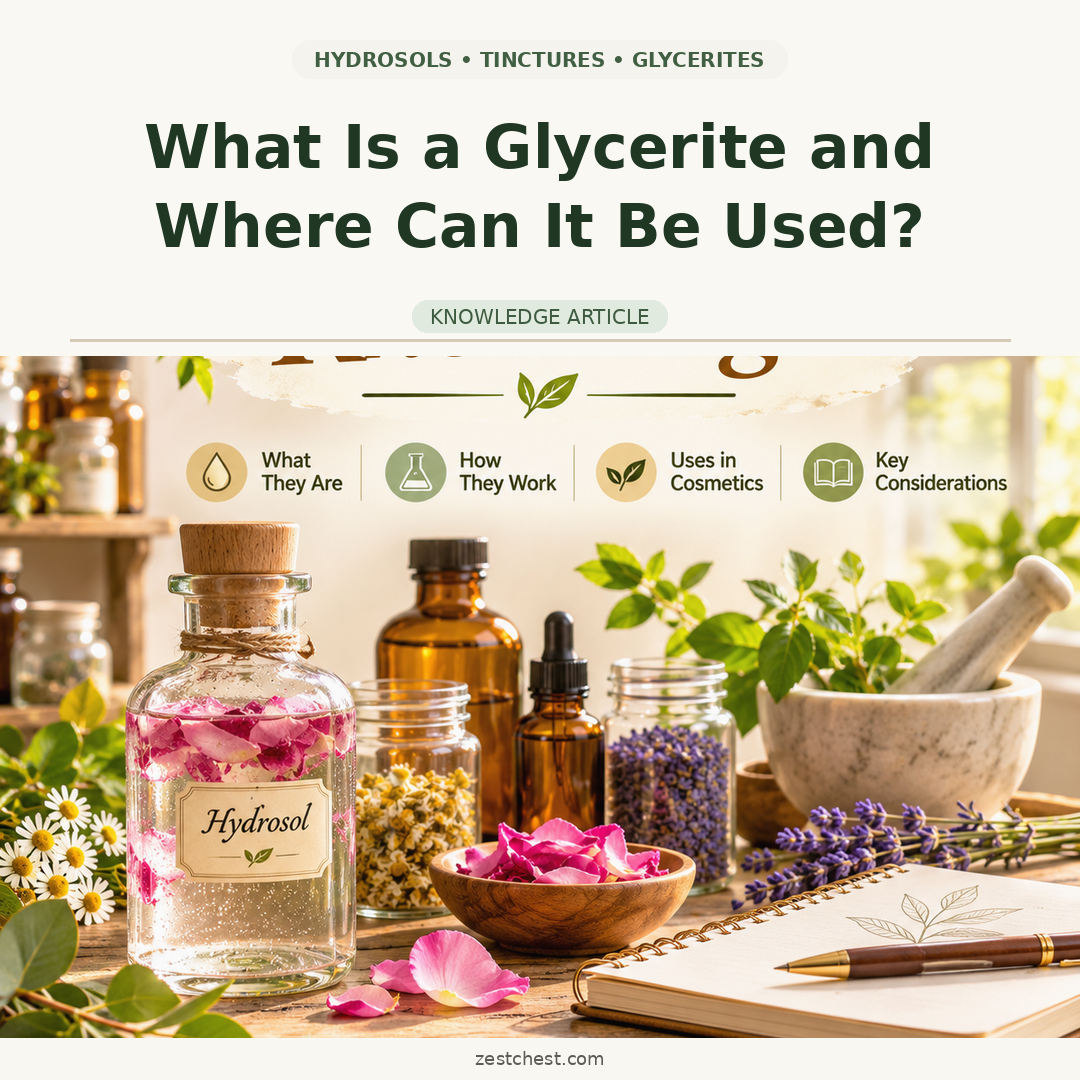
A glycerite is a botanical extract made using vegetable glycerin as the extraction medium.
It provides two things at the same time: the botanical material extracted from the plant and the characteristics of glycerin itself.
That is why a glycerite should not be treated as though it were simply a neutral herbal concentrate.
Why Use Glycerin for Herbal Extraction?
Glycerin can act as a menstruum, meaning it is the liquid into which the botanical material is extracted.
In the extraction-strength comparison used here, glycerin is treated as one of the stronger extraction media, below alcohol but above the milder extraction forms.
It is slower than alcohol at macerating plant material, but it provides a useful concentrated botanical extract.
What Does Glycerin Add to the Finished Cosmetic?
Glycerin is described as moisturizing and humectant in character.
So when you add a glycerite to a cosmetic, you are not only adding the herb.
You are also increasing the glycerin content of the finished product.
This is an important practical distinction.
A formulator may want the botanical benefit of a particular herb, but the texture of the final cosmetic still matters.
If a large amount of glycerin is introduced, the product may begin to feel sticky.
So the correct question is not simply:
“How much botanical benefit do I want?”
It is also:
“How much glycerin suits this type of product?”
Where Do Glycerites Fit Best?
Glycerites fit naturally into cosmetics that contain a water phase.
Examples discussed include:
- creams;
- lotions;
- facial mists;
- toners;
- shampoos;
- conditioners;
- water-based serums.
In these products, the glycerin-based extract can be incorporated without fighting against the basic structure of the product.
Where Are Glycerites Less Suitable?
A glycerite is not the natural choice for a purely oil-based product.
Glycerin does not simply blend into oil as though the two are the same type of material.
For that reason, an oil-soluble botanical extract is usually the more natural match for a body oil, face oil or similar anhydrous oil product.
Glycerites are also not ideal for dry powders.
Unlike alcohol, glycerin does not simply evaporate away. Adding it to a dry powder can make the powder damp, sticky or lumpy.
This illustrates a broader formulation principle:
The extraction medium must be compatible with the finished product.
Glycerite vs Tincture
Both can provide concentrated botanical material.
The difference is their medium.
A tincture uses alcohol.
A glycerite uses glycerin.
That means the final cosmetic feels and behaves differently depending on which one is selected.
If additional glycerin supports the product, a glycerite may be useful.
If glycerin would create an unwanted sticky feel, another extraction form may be more practical.
Glycerite vs Hydrosol
A hydrosol is much milder.
A glycerite is concentrated.
This does not mean the glycerite is automatically the better choice.
If you want a botanical mist or want the botanical water to form a substantial part of the aqueous portion of a cosmetic, a hydrosol may be more practical.
If you want a concentrated botanical addition, a glycerite becomes more useful.
Again, the final product determines the choice.
Can Fresh Ingredients Be Used in Glycerites?
The workshop discusses glycerites made from a variety of botanical materials, including fresh and pulpy ingredients such as papaya and aloe vera as well as other herbs.
The important conceptual issue is that different raw materials contain different amounts of water and fibre.
A fresh fruit pulp is not handled exactly like a dried herb.
For public understanding, the useful principle is simply that the condition of the botanical matters. Fresh, dry, leafy and pulpy materials behave differently during extraction.
Why Are Glycerites Useful for Customization?
One cream cannot contain every botanical ingredient a customer might want.
A formulator may already have a finished cream and offer a separate botanical extract for additional customization.
A glycerite can serve this kind of role because it concentrates the botanical into a small separate ingredient instead of requiring a completely new base product every time.
Practical Takeaway
A glycerite is not just “an extract made without alcohol.”
It is a glycerin-based botanical ingredient, and the glycerin remains part of the final cosmetic.
Choose a glycerite when both the botanical extract and the glycerin medium make sense for the product.
That one distinction prevents many formulation mistakes.
Related Topics
Hydrosol vs Tincture vs Glycerite: What’s the Difference?
Oil-Soluble vs Water-Soluble Herbal Extracts: What’s the Difference?

