
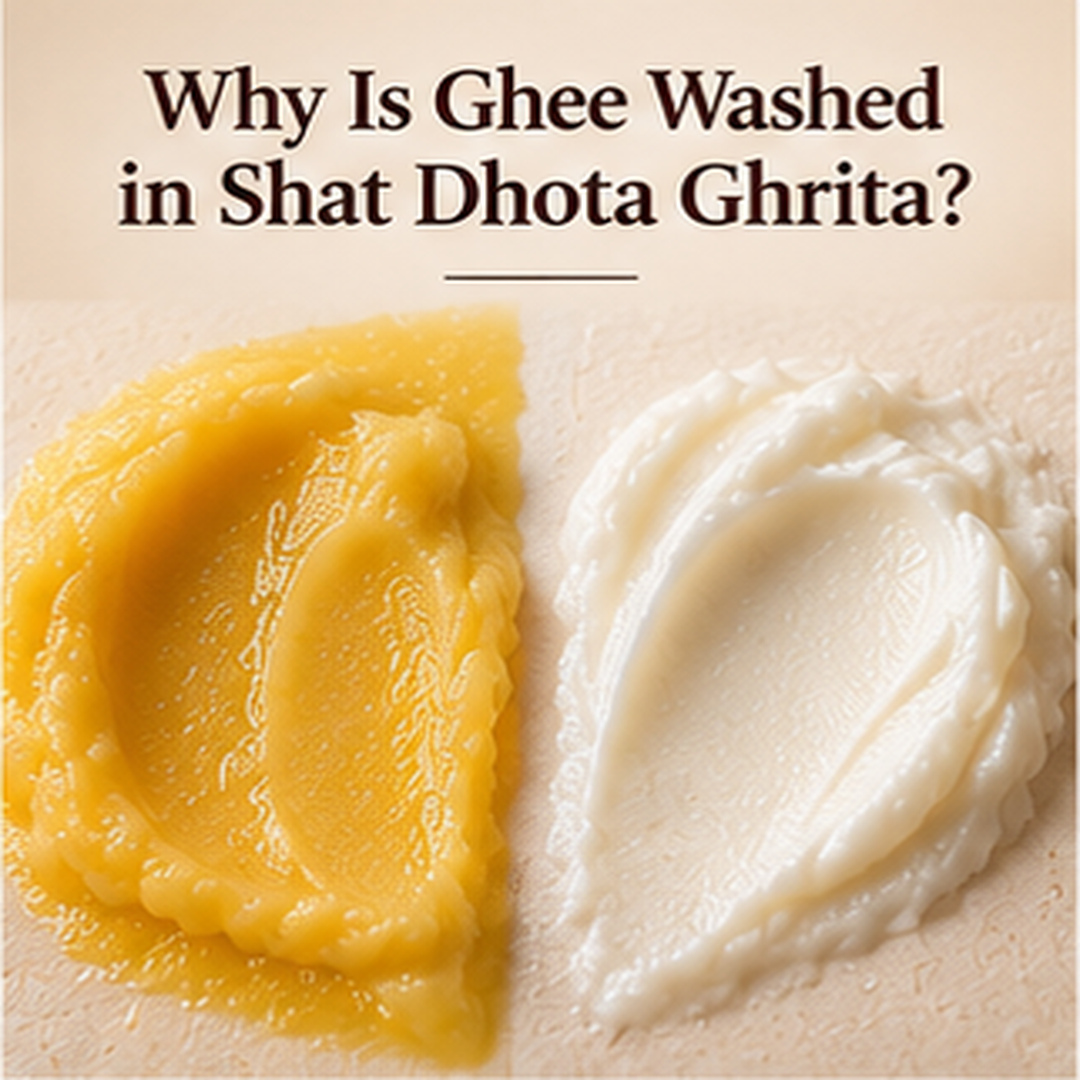
Ghee is washed repeatedly in Shat Dhota Ghrita mainly to transform its texture.
Ordinary ghee can be oily, heavy and grainy. Repeated washing and grinding make it softer, smoother, fluffier and more cream-like.
Traditional teaching also associates the washing process with cleansing the ghee.
Washing Helps Reduce Graininess
Graininess is one of the most noticeable differences between ordinary ghee and properly washed ghrita.
When ghee is repeatedly worked with water, the grainy structure gradually breaks down.
The result feels smoother when spread across the skin.
For me, this is one of the easiest ways to judge whether the physical transformation has occurred: the finished preparation should no longer feel like ordinary grainy ghee.
Washing Makes the Ghee Softer and Fluffier
Another visible change is the texture.
As the ghee is repeatedly worked, it becomes lighter and more voluminous.
Instead of remaining a dense greasy fat, it develops a softer cream-like character.
This increase in fluffiness is part of what gives Shat Dhota Ghrita its distinctive feel.
Water and Fat Come Into Closer Contact
Oil and water do not naturally stay mixed.
However, repeated grinding forces them into much closer physical contact.
I describe the resulting texture as emulsion-like.
This does not mean that traditional washed ghrita becomes identical to a modern stabilized cosmetic emulsion. Some water may still separate later.
But the repeated working changes the product enough to give it a visibly creamier consistency.
Washing Is Also Part of the Traditional Cleansing Concept
Traditional explanations also associate repeated washing with cleansing the ghee.
The idea is that repeated rinsing and removal of the wash water help remove unwanted material or impurities from the ghee.
A useful analogy is repeated rinsing.
The more something is repeatedly washed and the used water removed, the more material is carried away with that water.
That is the traditional reasoning behind this aspect of the process.
Is the Purpose Simply to Reach a Certain Number?
The traditional name emphasizes repeated washing, but the physical change is important to understand.
A good preparation should show a real transformation.
The ghee should become smoother, softer and more cream-like rather than remaining essentially unchanged.
This is why texture is such an important practical observation when evaluating washed ghrita.
Key Takeaway
Ghee is washed in Shat Dhota Ghrita to transform its texture from oily and grainy into something softer, fluffier and more cream-like. Traditional teaching also connects repeated washing with cleansing the ghee.