
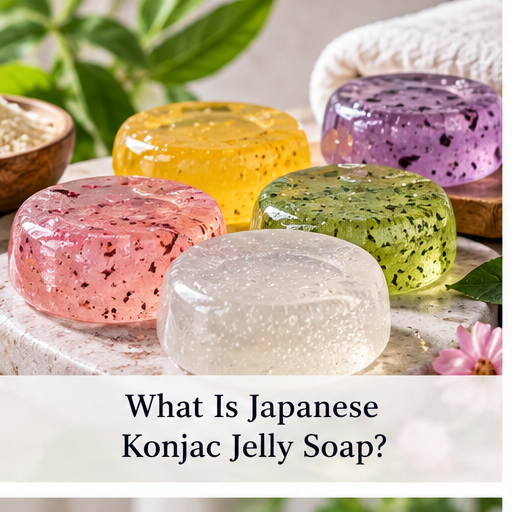
What Is Japanese Konjac Jelly Soap?
Japanese konjac jelly soap is a cleansing product with a soft, wobbly, jelly-like structure rather than the conventional solid structure of an ordinary soap bar.
It is designed to combine cleansing and lather with moisturising skin feel, gentle exfoliation and a distinctive tactile experience. The jelly format can also be adapted for different skin-care purposes.
What Makes It Different From an Ordinary Soap Bar?
The most obvious difference is texture.
Japanese konjac jelly soap is soft, squishy and flexible rather than hard and rigid. This makes it particularly interesting as a sensory product and is one reason the format can appeal to children.
But the jelly texture is only one part of the product.
A properly designed jelly soap also needs:
- an effective cleansing system;
- ingredients that provide lather;
- moisturising ingredients;
- ingredients that create and support the jelly structure; and
- skin-focused ingredients where a particular product benefit is intended.
So it is more useful to think of jelly soap as a complete cleansing system in a different physical format rather than simply as ordinary soap made soft.
What Role Does Konjac Play?
Konjac root powder is an important part of the product concept.
I use konjac for its hydrating character and its ability to absorb a large amount of water. It is particularly interesting when thinking about dry or aged skin, where moisture retention is useful.
Konjac also contributes gentle exfoliation.
Unlike a conventional scrub, it does not provide a gritty particle that you can feel rubbing against the skin. It is described instead as helping remove dead skin without creating a typical scrub sensation.
Konjac also has gelling properties and contributes to the physical character of the product.
Does Konjac Alone Create the Jelly Texture?
No.
This is an important distinction.
Konjac contributes to the gelling and thickening character, but the independent jelly structure depends on other structural ingredients too.
Kappa carrageenan is particularly important because it helps create the soft solid structure that allows the finished product to behave like a piece of jelly rather than merely a thick liquid.
Different thickening and gelling ingredients therefore have different jobs.
An ingredient can contribute body without necessarily producing the final jelly structure on its own.
Is Jelly Soap Only a Novelty Product?
The unusual texture certainly makes it fun and visually interesting, but the format can do more than provide novelty.
A jelly soap can combine:
- cleansing;
- abundant lather;
- moisturising skin feel;
- gentle exfoliation;
- fragrance and colour;
- and skin-focused ingredients.
Different versions can then be designed around different skin-care purposes.
The important idea is that the jelly format is only the delivery experience. The real product is defined by what it is intended to do for the person using it.
The Practical Takeaway
Japanese konjac jelly soap is best understood as a cleansing and skin-care product presented in an unusual jelly format.
The wobble may be what first attracts attention, but a good product depends on much more: how it cleanses, how it feels on the skin, how the jelly structure behaves and what skin-care purpose the particular version is designed to provide.
Related Jelly Soap guides
→ Why Is Konjac Root Powder Used in Jelly Soap?
→ What Makes Japanese Konjac Jelly Soap Jelly-Like?
For a broader introduction to Japanese konjac jelly soap, its ingredients, structure, variations and formulation principles, read our complete guide: Japanese Konjac Jelly Soap: Benefits, Ingredients & How It Works.