
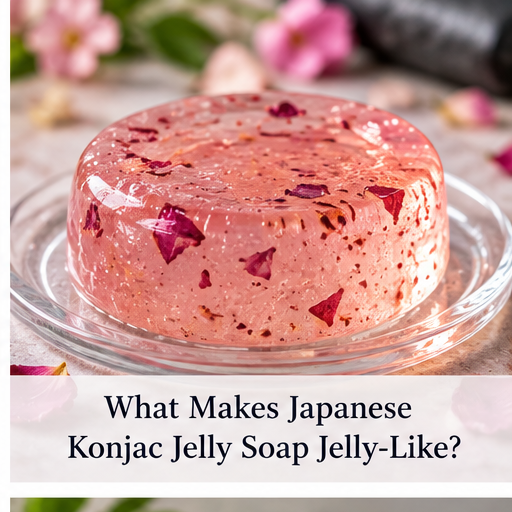
The characteristic jelly texture does not come from one ingredient alone.
Several ingredients can contribute thickness and body, but kappa carrageenan is particularly important because it helps create the independent jelly-like structure that allows the product to behave as a soft solid rather than simply a thick liquid.
Kappa Carrageenan Has a Specific Structural Role
Carrageenan comes in different forms.
The form used for this type of jelly structure is specifically kappa carrageenan.
“Kappa” is not a brand name. It identifies the type of carrageenan being used.
This distinction matters because different forms of carrageenan do not necessarily behave in exactly the same way.
For this product, kappa carrageenan is used to create the characteristic independent jelly structure.
Thickening and Jelly Formation Are Not the Same Thing
This is one of the most useful distinctions to understand.
A product can become very thick without becoming a true jelly.
Ingredients such as konjac root powder and gum acacia contribute thickening and gelling characteristics, but they do not necessarily perform the same job as the structural ingredient responsible for the finished jelly.
So when we describe several ingredients as “gelling” or “thickening” ingredients, that does not mean they are interchangeable.
One may increase viscosity.
Another may contribute body.
Another may be responsible for the more defined soft-solid structure.
Why Measurement Matters
The jelly structure is sensitive to the balance of the structural ingredients.
Simply adding more because you want a harder jelly, or less because you want a softer one, does not necessarily give the desired result.
The workshop also discusses acidity as important to formation of the jelly structure.
That means even ingredients used in very small amounts can have an important effect on whether the finished product develops the intended wobble and firmness.
Why the Product Changes as It Cools
Jelly soap does not necessarily look fully formed while it is still warm.
When warm, the mixture remains relatively fluid.
As it cools, the jelly structure develops and the product becomes progressively firmer.
This is why a warm sample should not be judged as though it already represents the final product.
A soap may already appear jelly-like while still remaining too soft to handle properly.
The Practical Takeaway
The jelly texture is the result of a deliberately balanced structural system.
Kappa carrageenan plays a particularly important role, while konjac and gum acacia contribute additional body and gelling character.
The key lesson is that thickness and jelly structure are not the same thing. A successful jelly soap needs the ingredients responsible for each function to work together.
Related Jelly Soap guides
→ Why Is Konjac Root Powder Used?
→ Why Does Japanese Konjac Jelly Soap Change as It Cools?
For a broader introduction to Japanese konjac jelly soap, its ingredients, structure, variations and formulation principles, read our complete guide: Japanese Konjac Jelly Soap: Benefits, Ingredients & How It Works.