
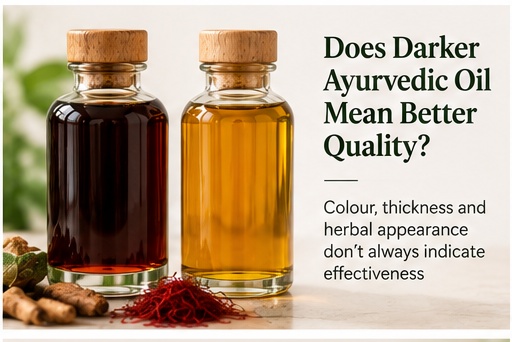
No. A darker, thicker or more visibly herbal Ayurvedic oil does not automatically mean a better or more effective oil. The workshop demonstrates that processing choices can create oils with different appearances while the intended skin benefit remains the same.
Why appearance can be persuasive
When people buy a herbal product, visible cues can strongly influence how authentic they think it is. A dark colour, a thicker texture, herbal sediment or even visible saffron strands can make a product look richer or more convincing. But what reassures the buyer visually is not necessarily what determines how the product functions.
The saffron example
Saffron provides a useful illustration. Seeing strands of saffron left in an oil can reassure a customer that saffron was actually used. Yet once its useful constituents have already been released into the oil, leaving visible strands in the bottle is largely an aesthetic choice. The visible ingredient becomes evidence for the eye rather than necessarily adding further function.
Dark and thick versus clean and light
Different processing choices can produce one oil that appears darker and thicker and another that looks cleaner and lighter. The teaching is that these visual differences do not necessarily mean a difference in the intended skin benefit. This is why colour and thickness should not be used as stand-alone measures of quality.
Greasy does not mean potent either
The same misunderstanding can happen with skin feel. A potent herbal oil does not have to feel excessively greasy. During the demonstration, a dark reddish Nalpamaradi could still be spread in a sensible amount without feeling excessively heavy. Applying too much to a small area immediately changed the experience and made it feel much greasier.
What should you pay attention to instead?
The useful principle is to separate product function from product theatre. Appearance can help communicate that a product is herbal, traditional or ingredient-rich, but it should not be treated as proof that the product is stronger. Concentration, application quantity and effectiveness are not interchangeable concepts.
The useful takeaway
Do not judge an Ayurvedic oil simply by how dark, thick or visibly herbal it looks. Those characteristics can affect perception, but appearance alone is not the same thing as function.
Related Nalpamaradi & Eladi Oil guides
→ How Much Ayurvedic Body Oil Should You Apply?
→ Sesame Oil vs Coconut Oil for Ayurvedic Skin Oils: What’s the Difference?
For a broader look at how traditional herbal oils are formulated, used and evaluated, read our complete guide to Nalpamaradi and Eladi oils.