The short answer is: not in the same way that a colour applied after bleaching can.
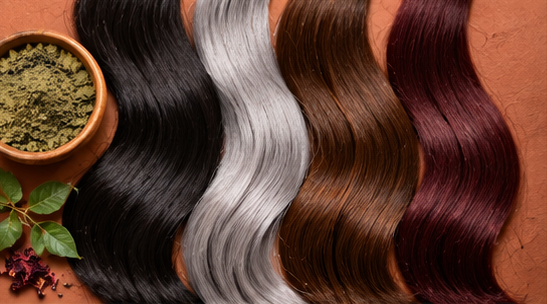
The most important distinction is between covering grey or white hair and changing naturally black hair into a lighter or brighter shade. Herbal hair colour works particularly well when there are white or grey strands available to take the new colour. Naturally black hair already has strong dark pigment, so applying a brown or burgundy herbal colour over it does not make that underlying black disappear.
Why the same dye can look different on different people
Hair contains natural pigment. As that pigment is lost, hair becomes white. A useful way to think about naturally black hair is as a surface that is already strongly coloured. Putting another colour over that surface does not automatically remove the colour underneath.
This is why a brown or burgundy herbal colour can be clearly visible on white strands while making much less visible difference to surrounding black hair.
The proportion of white hair therefore matters. Someone with many white strands can see a much brighter brown or burgundy effect than someone with only a few white strands, even when both use the same colour.
Grey coverage and colour transformation are different jobs
If your objective is to cover white hair, herbal colouring can deposit colour where natural pigment has been lost.
If your objective is to turn naturally black hair into a visibly lighter brown, burgundy, red or another bright colour, that is a different process. In the colouring examples discussed here, making bright colours visible on black hair involves first removing the natural dark pigment through bleaching and then introducing the new colour.
This also explains something people sometimes notice after salon colouring. When dark hair has been lightened before being coloured brown, the hair may not return to its original black when the applied brown fades. A dull yellowish or golden underlying shade may remain visible because the original dark pigment was removed during the lightening process.
What should you expect from brown or burgundy herbal colour?
Start by looking at the hair you actually have rather than only at the shade name on the product.
If the hair is predominantly black, do not expect a bright brown or burgundy transformation without bleaching. If there is a mixture of black and white hair, the lighter strands can show the new shade much more clearly. The more white hair there is, the more visible the overall brown or burgundy effect can become.
That means two people can use the same herbal colour and get visually different results without either application necessarily having failed. The practical takeaway is simple: judge a herbal colour by whether it is suitable for your starting hair colour and your objective. Grey coverage and lightening naturally black hair are not the same task.
Related Herbal Hair Dye Guides
- What Is the Difference Between Temporary, Semi-Permanent and Permanent Hair Colour?
- Is Herbal Hair Dye the Same as 100% Natural Hair Dye?
- Why Do Grey Roots Reappear After Permanent Hair Colour?
Main guide: Herbal Hair Dye Explained: Natural Colour, Grey Coverage, Ingredients and Common Problems
Explore the complete topic: Herbal Hair Dye Learning Hub