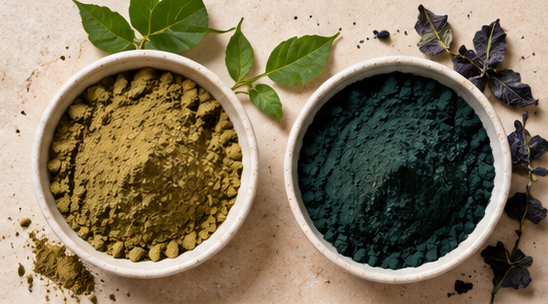
A 100% natural henna-and-indigo colouring system is used in two separate stages because henna and indigo do not behave in the same way. Trying to treat them as one interchangeable mixture can make the result unreliable and allow henna’s orange-red colour to dominate.
Henna and indigo have different colouring behaviour
Henna is the stronger natural dye in this system. It produces a deep orange-red colour and can be prepared in advance so that its colour develops before application.
Indigo behaves differently. Once prepared for use, it oxidizes much more quickly. Its colouring action is also weaker than henna’s in the way the two ingredients are discussed here.
That creates a problem when the two are simply mixed together. Henna can dominate the colouring process, while indigo may contribute inconsistently. The result can show much more orange or red than the darker colour the user expected.
Why separating the stages helps
The purpose of a two-step system is to allow the two natural colourants to perform their jobs separately rather than compete under conditions that suit one of them better than the other.
The first stage establishes the henna colour. The second stage then uses indigo to move the result towards a much darker appearance.
The important principle is not the detailed making procedure, but the difference in behaviour: henna can be given preparation time, while prepared indigo cannot simply be left for the same period and expected to retain the same colouring power.
Does two-step mean two days?
No. “Two-step” describes two separate colouring stages; it does not necessarily mean that the process has to be spread over two days.
For somebody who wants a genuinely natural henna-and-indigo system, the inconvenience is therefore not necessarily as great as the phrase “two-step” might suggest. What should not be done is to assume that combining the two components into a single preparation will produce the same reliable result.
Why one-step natural products can disappoint
The attraction of a one-step product is obvious: it sounds simpler. But convenience does not change the way the two natural pigments behave.
If henna and indigo are mixed and treated identically, henna’s stronger colouring action and indigo’s faster oxidation can work against the intended result. Orange or reddish hair can become much more noticeable, while the darker effect can be patchy or weak. The practical takeaway is that the two-step format is not merely an unnecessary complication. It exists because the two natural colourants need different treatment to give a dependable combined colour.
Related Herbal Hair Dye Guides
- Why Can Hair Look Green After Using Indigo?
- Is Herbal Hair Dye the Same as 100% Natural Hair Dye?
- Why Do Herbal Hair Dye Ingredients Have Different Roles?
Main guide: Herbal Hair Dye Explained: Natural Colour, Grey Coverage, Ingredients and Common Problems
Explore the complete topic: Herbal Hair Dye Learning Hub