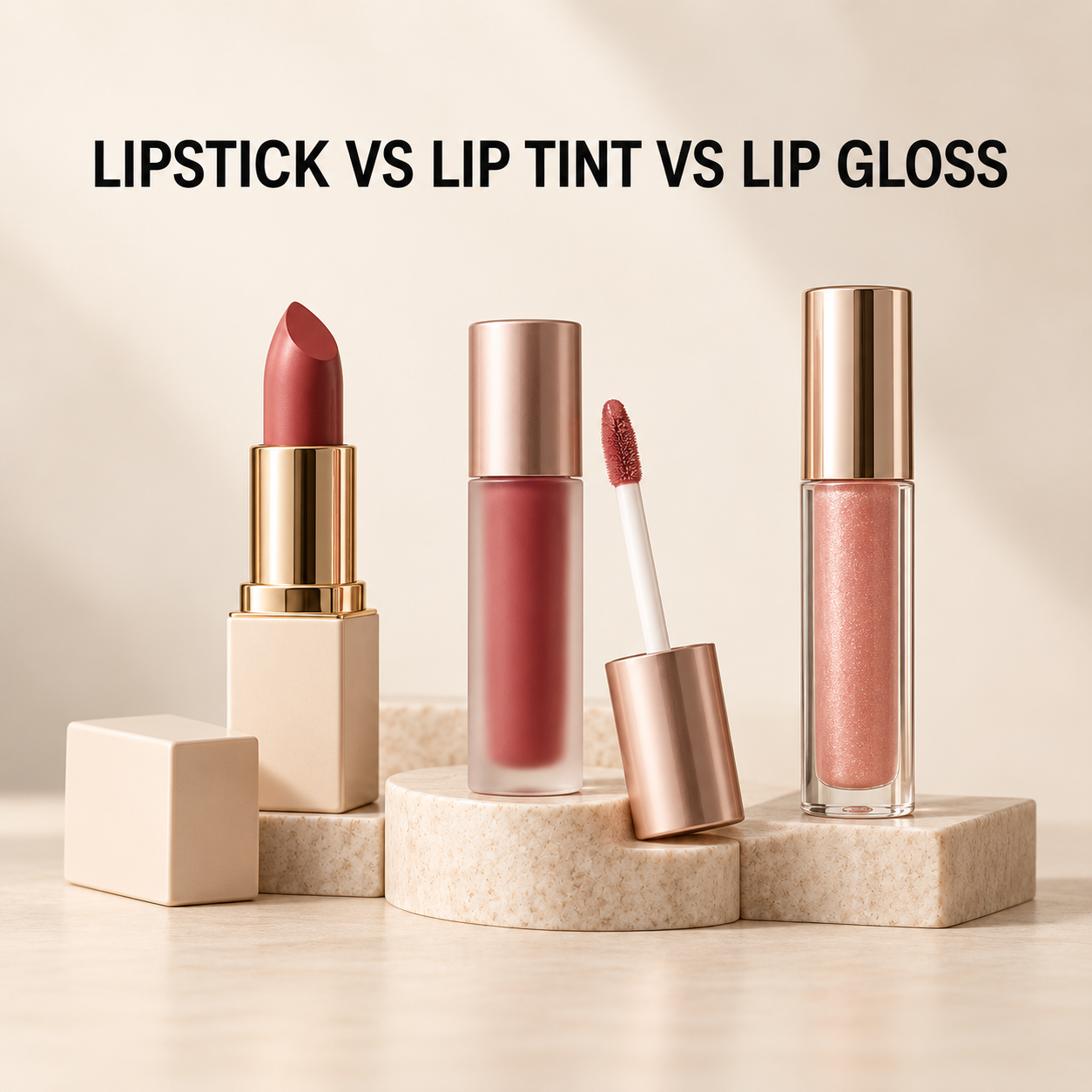
Lipstick, lip tint and lip gloss can look like completely different categories on a shop shelf, but there can be considerable overlap between them.
The biggest differences are often colour intensity, shine and texture.
What Is Lipstick?
Lipstick generally provides more obvious colour.
It can be:
- matte
- creamy
- glossy
- nude
- highly pigmented
- lightly pigmented
The word “lipstick” therefore describes a broad family of coloured lip products rather than one single finish.
What Is a Lip Tint?
A lip tint gives much lighter colour.
Instead of creating an intense lipstick look, it creates a subtle wash or stain.
The idea is essentially to reduce the intensity of the colour.
A light tint can also be dabbed on the cheeks and blended to create a blush-like effect.
What Is Lip Gloss?
A gloss emphasizes shine rather than strong colour.
A glossy lipstick-style base without strong pigment can function like a lip gloss.
Mica can be introduced when a little pearliness or mild colour is wanted without producing the intensity of a conventional pigmented lipstick.
Can One Product Sit Between Categories?
Yes.
A product with:
- very little colour and high shine may behave like a gloss
- a small amount of colour may behave like a tint
- stronger pigment may behave more like traditional lipstick
This is why product names are not always enough to tell you exactly how a lip product will behave.
Can a Tint Be Used on the Cheeks?
A lightly coloured product can be dabbed onto the cheeks and blended as a cheek tint or blush effect.
Only a small amount is needed because strong lip pigments can be very intense.
Key Takeaway
The difference between lipstick, tint and gloss is often a spectrum.
Think about three things:
How much colour?
How much shine?
What type of texture and application?