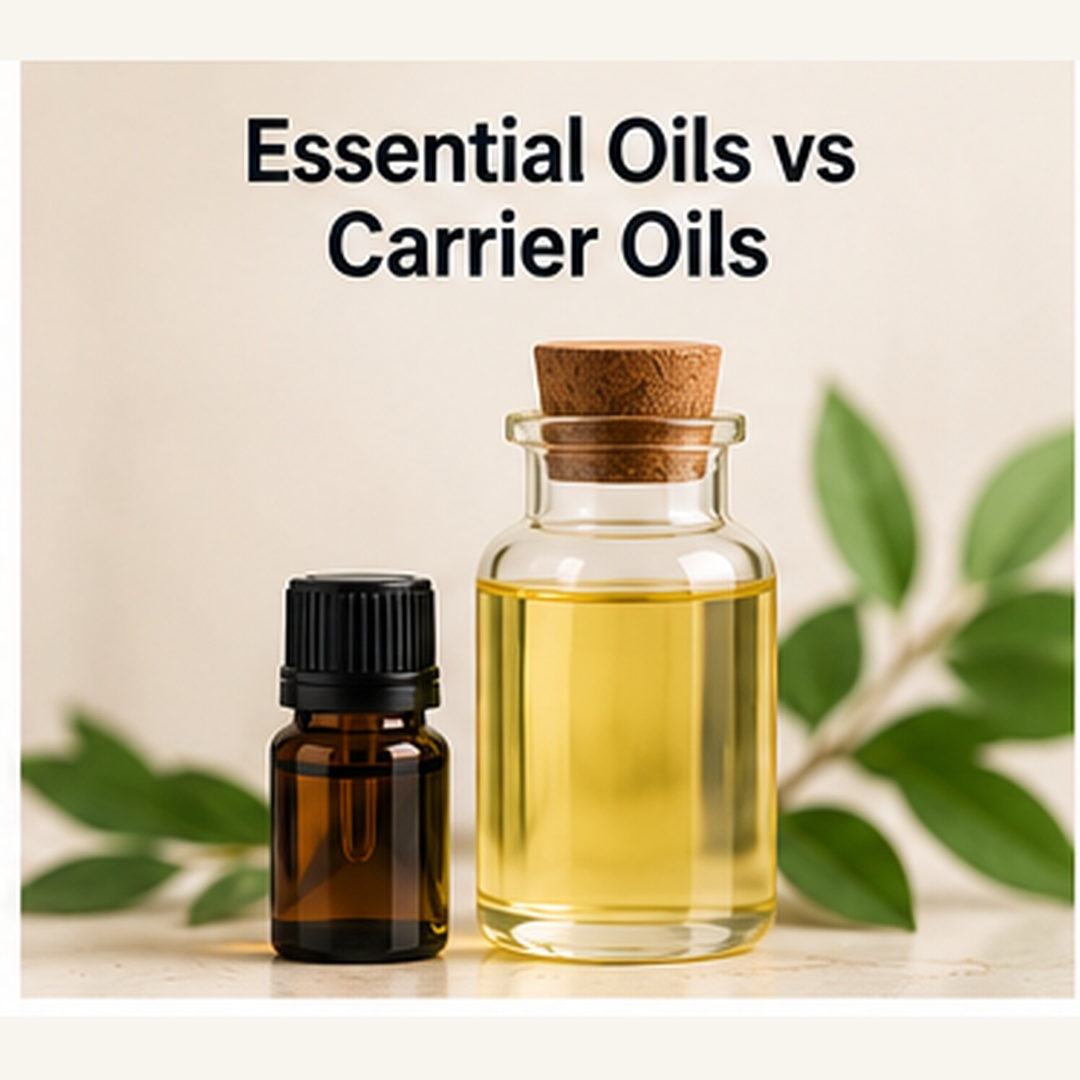
Essential oils and carrier oils may both be called oils, but they perform very different jobs.
An essential oil is a concentrated aromatic material.
A carrier oil forms the base that helps dilute and distribute the essential oil over the skin or scalp.
Understanding this difference is fundamental to using aromatherapy properly.
What Is an Essential Oil?
Essential oils have a strong characteristic aroma.
Examples include:
- lavender;
- peppermint;
- rosemary;
- sandalwood;
- jasmine;
- rose;
- tea tree;
- citrus oils.
Their aromas may be floral, woody, citrusy, herbal or minty.
Essential oils are concentrated, so they are not used in the same way as an ordinary body or massage oil.
What Is a Carrier Oil?
Carrier oils are used as a base.
Examples discussed include:
- sunflower oil;
- olive oil;
- almond oil;
- jojoba oil;
- argan oil;
- coconut oil;
- flaxseed oil;
- canola oil.
The name carrier oil describes the job very well: it carries the essential oil.
Once the essential oil is incorporated into a larger base, it can be distributed more comfortably across the required area.
Why Do Essential Oils Need a Carrier?
A useful analogy is chilli.
A small amount of chilli distributed through food can be enjoyable. That does not mean you would want to take a large quantity of concentrated chilli paste and consume it directly.
Essential oils follow a similar principle.
They are concentrated materials. Dilution allows a small amount of essential oil to be distributed through a much larger amount of base.
This is also why I do not recommend treating concentrated essential oil as though it were a normal facial or massage oil.
Do Carrier Oils Have to Be Expensive?
No.
Price alone does not determine whether a carrier oil is useful.
Sunflower oil, for example, is one of my preferred carrier oils because I find it light, quick absorbing, easily available and economical.
Argan and jojoba are more expensive choices and can be useful when a lighter or more premium carrier is desired.
The decision should be based on the purpose of the product rather than the assumption that the most expensive oil is automatically the best.
Can the Carrier Oil Affect the Product?
Absolutely.
The carrier influences:
- how heavy or light the product feels;
- how quickly it absorbs;
- whether it suits oily or dry skin;
- whether it is appropriate for acne-prone facial skin;
- the cost of the finished product.
This means two aromatherapy products containing similar essential oils may still feel completely different if they use different carrier oils.
The Important Distinction
Think of the essential oil as the concentrated aromatic component and the carrier oil as the vehicle that helps deliver it in a usable form.
You need to understand both.
Choosing the right essential oil but ignoring the carrier can still result in a product that feels unsuitable for the person using it.