
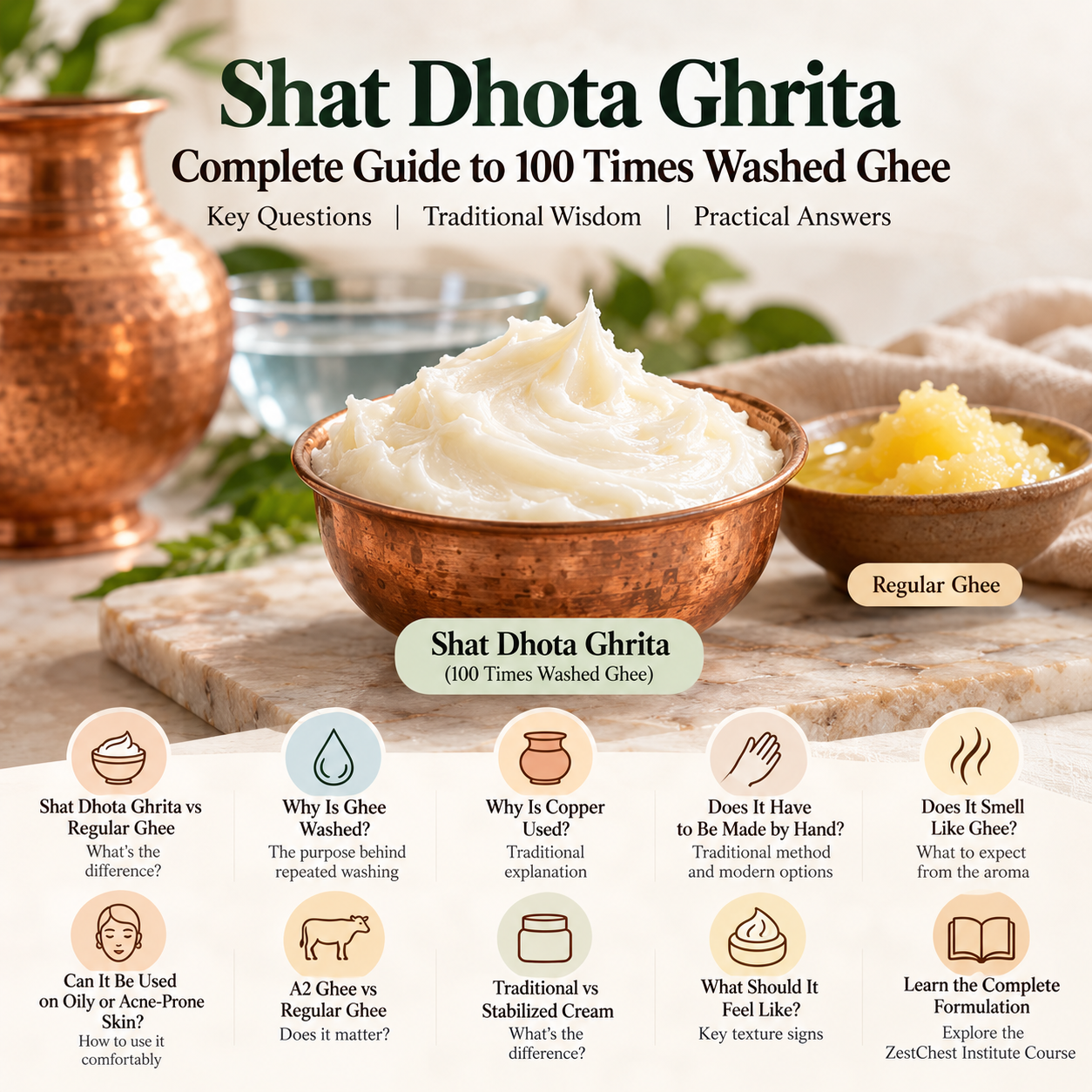
Shat Dhota Ghrita, also known as hundred-times-washed ghee, is a traditional preparation in which ghee is repeatedly worked with water until its original oily, grainy character changes into something softer, smoother, lighter and more cream-like.
The name itself explains the concept:
Shat means hundred.
Dhota means washed.
Ghrita means ghee.
But understanding Shat Dhota Ghrita involves more than knowing what the name means. Questions often arise about why the ghee is washed, why copper is traditionally used, whether it has to be handmade, what type of ghee can be used, how a good preparation should feel and how traditional washed ghrita differs from a modern stabilized cream.
This guide brings together the complete Shat Dhota Ghrita learning series so you can explore each topic in detail.
Shat Dhota Ghrita vs Regular Ghee
Regular ghee and Shat Dhota Ghrita may begin with the same basic ingredient, but they feel very different on the skin.
Plain ghee can feel oily, greasy, heavy and grainy. Repeated washing and physical working reduce the graininess and transform the texture into something softer, fluffier and more cream-like.
If you are new to the subject, this is the best place to start.
Read: Shat Dhota Ghrita vs Regular Ghee – What’s the Difference?
Why Is Ghee Washed in Shat Dhota Ghrita?
Repeated washing is responsible for much of the characteristic texture change.
As the ghee is continually worked with water, its graininess reduces and the preparation becomes smoother and lighter.
Traditional teaching also associates the repeated washing and removal of the wash water with cleansing the ghee.
Read: Why Is Ghee Washed in Shat Dhota Ghrita?
Why Is Copper Traditionally Used?
Traditional Shat Dhota Ghrita preparation is associated with a reddish copper vessel, traditionally called tamba.
The traditional explanation connects contact between the water and copper with a copper-ion concept associated with cleansing and preservation.
Copper is part of the traditional preparation philosophy, while repeated physical working is responsible for the major texture transformation.
Read: Why Is Copper Traditionally Used for Shat Dhota Ghrita?
Does Shat Dhota Ghrita Have to Be Made by Hand?
Traditional preparation was performed manually, but hand processing is not the only way to create the desired physical transformation.
The important question is whether the ghee has been repeatedly washed and worked sufficiently to become smoother, softer and less grainy.
Modern mixing equipment can create a stronger grinding action and may produce a smoother texture more efficiently.
Read: Does Shat Dhota Ghrita Have to Be Made by Hand?
Does Shat Dhota Ghrita Smell Like Ghee?
Repeated washing can significantly reduce the characteristic smell of ordinary ghee.
However, Shat Dhota Ghrita does not necessarily become completely odourless.
A mild natural ghee character may remain, particularly in an unfragranced traditional-style preparation.
Read: Does Shat Dhota Ghrita Smell Like Ghee?
Can Shat Dhota Ghrita Be Used on Oily or Acne-Prone Skin?
Shat Dhota Ghrita is a rich ghee-based preparation, so oily skin may not always feel comfortable with a heavy full-face application.
The approach can instead be adjusted through smaller quantities, targeted application or shorter-contact use.
Different skin types do not necessarily need to use a rich product in exactly the same way.
Read: Can Shat Dhota Ghrita Be Used on Oily or Acne-Prone Skin?
A2 Ghee vs Regular Ghee: Which Is Better?
A2 cow ghee is not compulsory for creating Shat Dhota Ghrita.
I prefer good-quality A2 ghee when creating a premium product, but good regular ghee can also be used and can still develop the characteristic creamy washed-ghrita texture.
The choice therefore depends partly on quality, cost and product positioning.
Read: A2 Ghee vs Regular Ghee for Shat Dhota Ghrita – Does It Matter?
Traditional Shat Dhota Ghrita vs Stabilized Ghrita Cream
Traditional washed ghrita and a modern stabilized ghrita cream are related, but they are not exactly the same.
Traditional washed ghrita stays closer to the original preparation and may release some water.
A stabilized cream uses modern formulation principles to keep the fat and retained water more uniformly combined, resulting in a smoother and more consistent cosmetic product.
Read: Traditional Shat Dhota Ghrita vs Stabilized Ghrita Cream – What’s the Difference?
What Should Good Shat Dhota Ghrita Feel Like?
Texture is one of the most useful ways to evaluate Shat Dhota Ghrita.
A well-prepared product should feel noticeably different from plain ghee.
It should generally feel smoother, softer, creamier and lighter, with greatly reduced graininess. It should also soften and spread readily with the warmth of the skin.
Read: What Should Good Shat Dhota Ghrita Feel Like?
Learn Shat Dhota Ghrita Formulation in Detail
These Knowledge Articles explain the principles, texture, traditional concepts and practical distinctions behind Shat Dhota Ghrita.
If you want to learn the complete formulation and practical preparation methods, including the course formulations and product variations, you can explore the dedicated ZestChest Institute course.
Explore the Shata Dhauta Ghrita – Ghee Cream Course
Explore the Complete Shat Dhota Ghrita Knowledge Series
Use this page as your central reference point whenever you want to understand a specific part of Shat Dhota Ghrita.
Start with the difference between regular ghee and washed ghrita, then explore the washing process, traditional copper use, preparation method, smell, skin-type considerations, ghee selection, stability and final texture.
The most important idea throughout the series is simple: Shat Dhota Ghrita is defined not merely by using ghee, but by the transformation that takes place when the ghee is repeatedly washed and physically worked.