
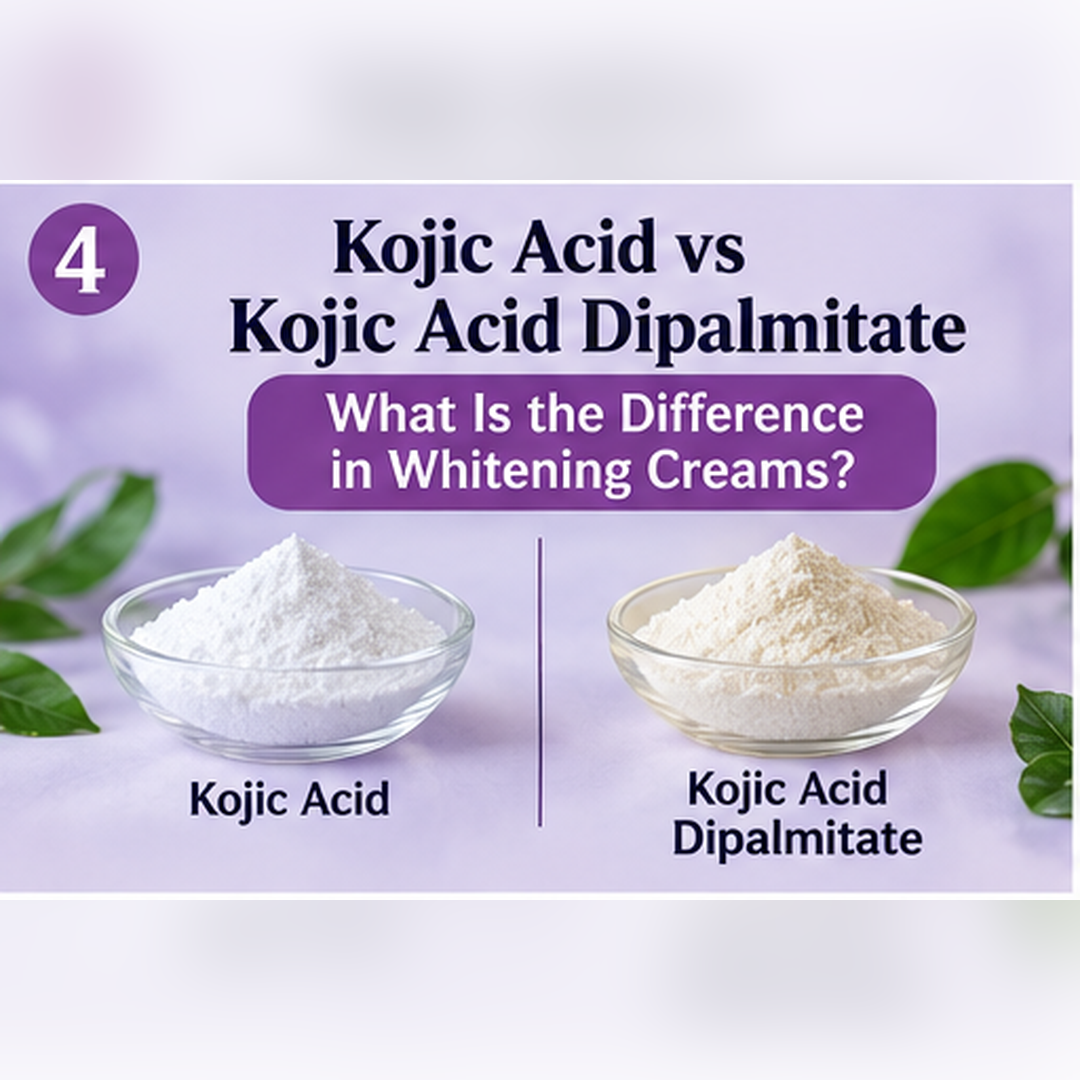
The most important practical difference discussed in the workshop is stability.
For these whitening cream concepts, I prefer kojic acid dipalmitate over ordinary kojic acid because ordinary kojic acid is described as becoming discoloured very quickly, while kojic acid dipalmitate is treated as the more stable choice.
Why Ordinary Kojic Acid Can Be Difficult in a Cream
A pigmentation ingredient may work well on paper but still create a poor commercial product if the finished cream changes colour rapidly.
That is the problem discussed with ordinary kojic acid.
The workshop describes kojic acid powder as unstable in this type of application and says that it can turn brown or dark very quickly.
For a customer, that creates an obvious problem.
A cream intended to look clean and premium becomes unattractive even though the ingredient was added for a completely different purpose.
Why Kojic Acid Dipalmitate Is Preferred
Kojic acid dipalmitate is also supplied as a powder, but it behaves differently in the formulation.
The workshop describes it as oil-soluble rather than water-soluble and, more importantly for the finished product, as a much more stable form for these cream systems.
The reason I prefer it here is therefore not simply because the word “kojic” appears on the ingredient.
The choice is being made because pigmentation performance has to be combined with acceptable product stability.
Ingredient Performance Is Only Part of Formulation
This distinction teaches a broader lesson.
When choosing an active, I do not look only at the benefit being claimed for the skin.
I also need to ask what that ingredient does to the product itself.
Does the colour remain acceptable?
Does the product still look good after storage?
Does the ingredient fit the type of cream being made?
A whitening cream that performs well but quickly becomes visually unattractive is still a poor commercial product.
Does Kojic Acid Dipalmitate Have the Same Role?
Within the workshop, both are discussed within the same broad skin-lightening context.
The reason for using the dipalmitate form is to obtain that role in a form considered more suitable and stable for the cream concept being taught.
That is the practical distinction that matters most.
The useful takeaway is: when choosing between kojic acid and kojic acid dipalmitate for this type of whitening cream, the workshop preference is driven strongly by stability and the risk of discoloration in the finished product.