
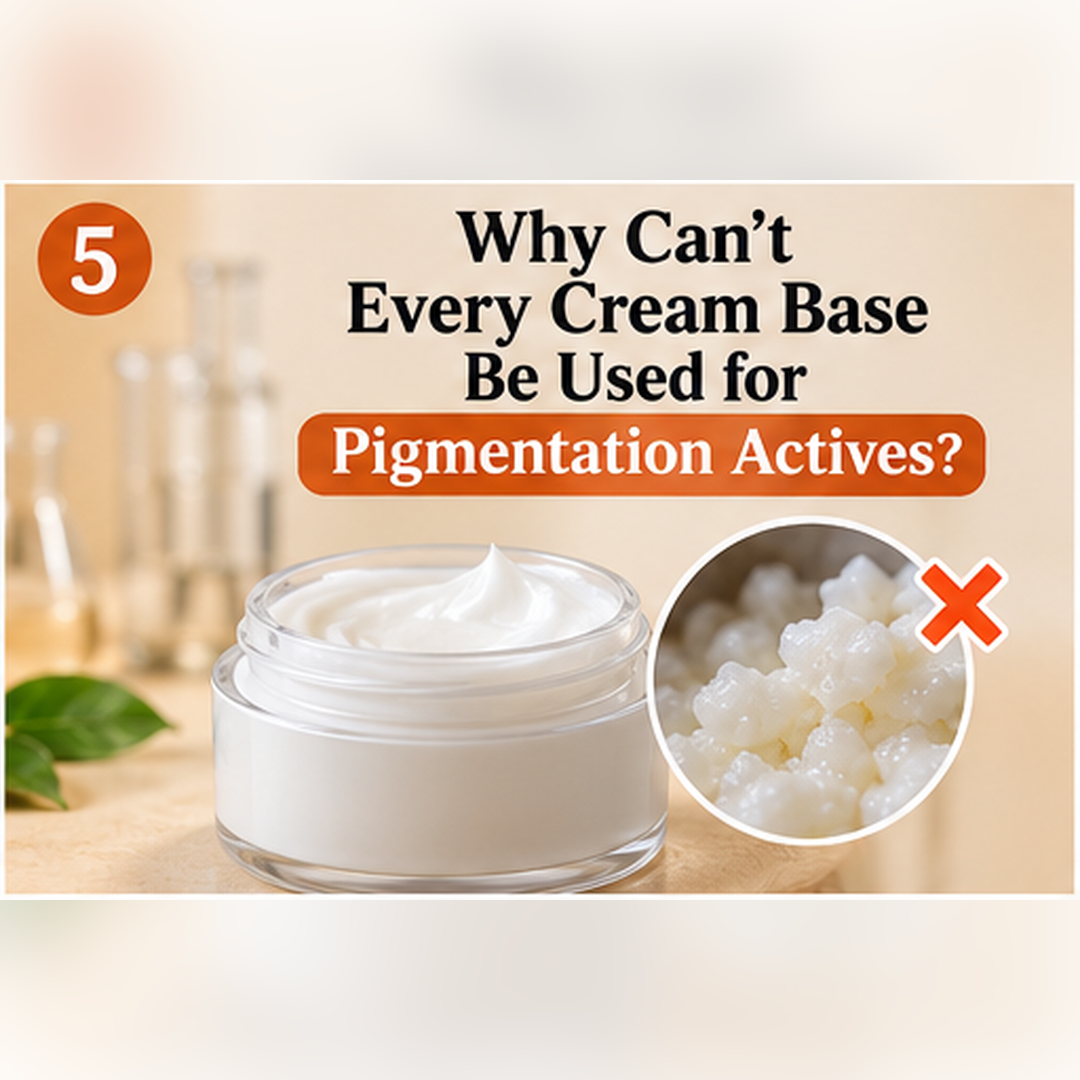
Because not every cream base can tolerate the same active ingredients.
A normal moisturizer base may work perfectly well on its own and still split when a stronger pigmentation system is added.
This is one of the most important formulation principles in the workshop.
Why a Ready-Made Base Can Fail
It is tempting to prepare one cream base in bulk and then turn it into many different products by adding different actives later.
That can work only when the base is compatible with the ingredients being added.
Pigmentation products may contain acidic actives.
The workshop specifically discusses ingredients such as glycolic acid, lactic acid and vitamin C when explaining why an ordinary cream base may not remain stable.
Some emulsifiers can tolerate that environment better than others.
If the emulsifier is not suitable, the cream can break.
What Does It Mean When a Cream “Bursts”?
In the workshop, a failed emulsion is described very practically.
Water can begin separating from the product.
The cream may become lumpy.
The smooth texture disappears and the product can begin to look almost like curdled milk.
This is not simply a cosmetic appearance problem.
It tells you that the structure of the cream is no longer being held properly.
Why the Day Base and Night Base May Differ
The daytime cream is milder in terms of the acidic active system.
The night cream is stronger.
Because of that difference, a base that is suitable for the daytime product is not automatically suitable for the night product.
The workshop makes this distinction explicitly.
A stronger acidic system needs a base capable of supporting it.
Can a Stronger Base Be Used for a Milder Product?
The workshop indicates that a base designed to tolerate the stronger night product can work for the day concept more easily than assuming the reverse.
That makes sense within the way the formulations are taught because the stronger base has been selected to tolerate the more demanding active environment.
However, this should not be turned into a universal “one base for everything” rule.
The main principle remains compatibility.
Why This Matters Even If You Are Not Manufacturing the Product Yourself
This concept is useful for consumers too.
When a product separates, releases water or becomes curdled and lumpy, it is not simply because “cream is cream.”
Different active systems require different formulation structures.
The takeaway is: choose or design the cream base around the active system it has to support. A stable ordinary moisturizer base does not automatically become a stable pigmentation cream when strong actives are added to it.