
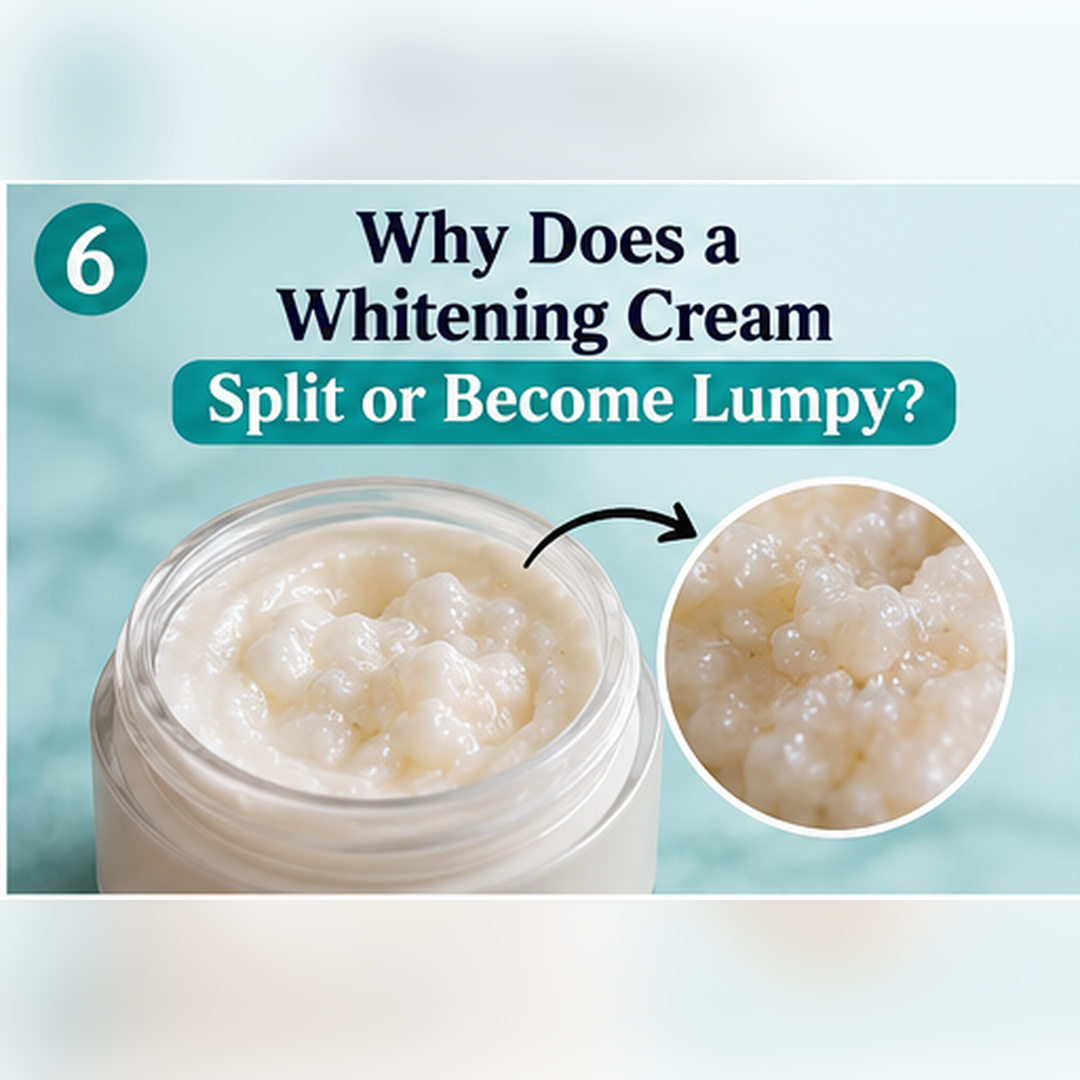
A whitening cream can split or become lumpy when the cream structure is no longer able to hold the formulation together properly.
In the workshop, two important causes are discussed: using a base that cannot tolerate the active system and problems with how waxy materials integrate into the cream.
When the Base Cannot Support the Actives
Pigmentation creams can contain acidic active ingredients.
Not every emulsifier is equally suitable for those conditions.
If a normal cream base is used with a much stronger acidic system than it was designed for, the emulsion may fail.
The workshop describes the result very clearly: water can separate, the cream can become lumpy and the texture can resemble split or curdled milk.
This is why simply adding strong pigmentation actives to any available moisturizer base is not a reliable approach.
Lumps Can Also Come From Waxy Materials
The workshop demonstration also discusses another type of texture problem.
Some of the materials used in the cream are waxy or solid at lower temperatures.
If they do not integrate properly, small hardened particles can remain in the finished product.
The cream may look mostly smooth while still feeling grainy when rubbed on the skin.
This is not the intended texture.
A properly made cream should feel smooth and uniform.
Why Cooling Behaviour Matters
The practical demonstration emphasizes that the cream should not simply be rushed into cooling as quickly as possible.
If waxy ingredients begin hardening before they have been incorporated properly, the finished product can develop particles rather than a smooth texture.
The important public formulation principle is not a specific temperature or production sequence.
It is that emulsification and cooling have to allow the waxy materials to remain properly integrated instead of crystallizing separately.
Why a Lumpy Cream Is Not “Normal Whitening Cream Texture”
Some commercial whitening creams are intentionally thick and hard.
That is different from being grainy, separated or curdled.
A thick cream can still be perfectly smooth.
So when evaluating texture, do not confuse firmness with instability.
A hard cream may simply contain a structure designed for a dense texture.
A split cream shows loss of emulsion stability.
A grainy cream contains particles that have not remained properly integrated.
Those are three different things.
What Is the Most Useful Diagnostic Question?
If a pigmentation cream splits, first ask whether its base was actually designed to tolerate the active system.
If the product is stable but grainy, then the way the solid or waxy materials integrated during processing becomes more relevant.
The key takeaway is: splitting and graininess are formulation problems, not expected characteristics of a good whitening cream. A successful product should remain smooth, uniform and structurally stable even when it contains a strong pigmentation-active system.