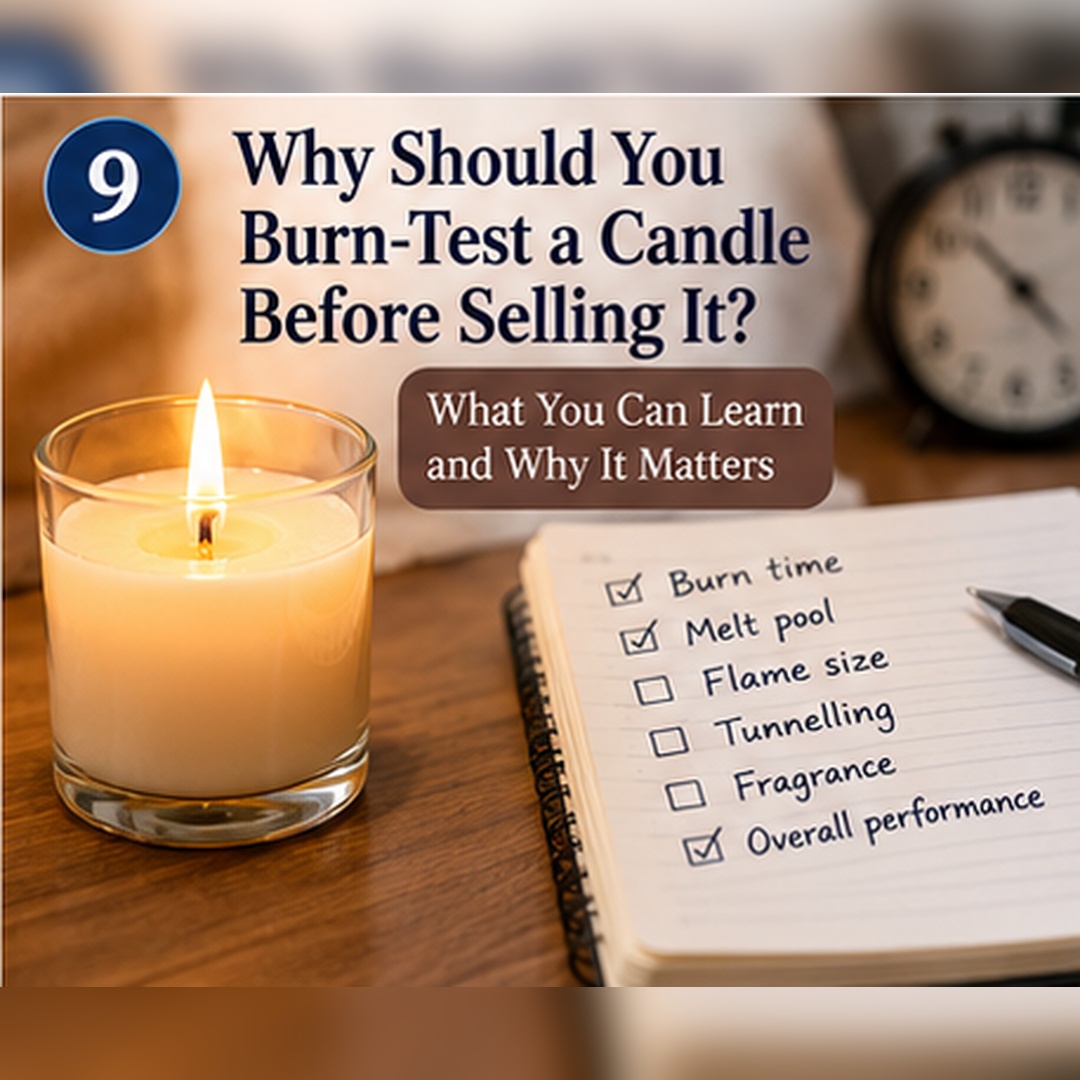
A candle should be burn-tested before you give customers confident information about its burn time and performance.
You cannot determine exact burn time reliably from wax weight alone because candle shape, width, wax type and wick behaviour also influence how the candle burns.
Two Candles of the Same Weight Can Behave Differently
Imagine two candles containing a similar amount of wax.
One is narrow and tall.
The other is broad.
They do not necessarily burn for exactly the same length of time because their shapes expose and melt the wax differently.
The type of wax also affects burn behaviour.
This is why I prefer testing an actual candle from the product rather than relying entirely on an estimate.
Burn Testing Shows More Than Burn Time
The test is not useful only because you can count how long the candle lasts.
You can also observe:
- whether the wick produces an appropriate flame;
- whether the candle develops a useful melt pool;
- whether the centre begins tunnelling;
- whether the wick becomes overwhelmed by melted wax;
- whether the fragrance develops properly during burning.
These are qualities that cannot be judged accurately from the unlit finished candle.
Why This Matters When Selling in Quantity
If you are selling one occasional handmade candle, a precise burn-time statement may not feel essential.
But when you are producing the same candle repeatedly or fulfilling larger orders, customers need more reliable information.
If the candle burns much faster than they expected, they may judge the product poorly even when premium materials were used.
Testing gives you information specific to your candle rather than a generic assumption about candles of a similar weight.
Burn Instructions Also Matter
The customer’s use can change the way the candle behaves after purchase.
The workshop discusses wick maintenance because a wick that becomes excessively long can create a larger flame and more heat.
This means good product information should not stop with fragrance name and candle weight.
Usage guidance helps the buyer maintain the candle more appropriately over repeated burns.
Test the Product You Actually Plan to Sell
If you eventually standardise a particular container, wax system and wick arrangement, that is the candle you should evaluate.
Do not assume that the performance of a small test candle automatically tells you how a wider or differently shaped candle will behave.
The most useful principle is straightforward:
Before promising how a candle will perform, burn the actual candle and observe it.
A candle is a functional product. Its real quality becomes clear once the flame is lit.