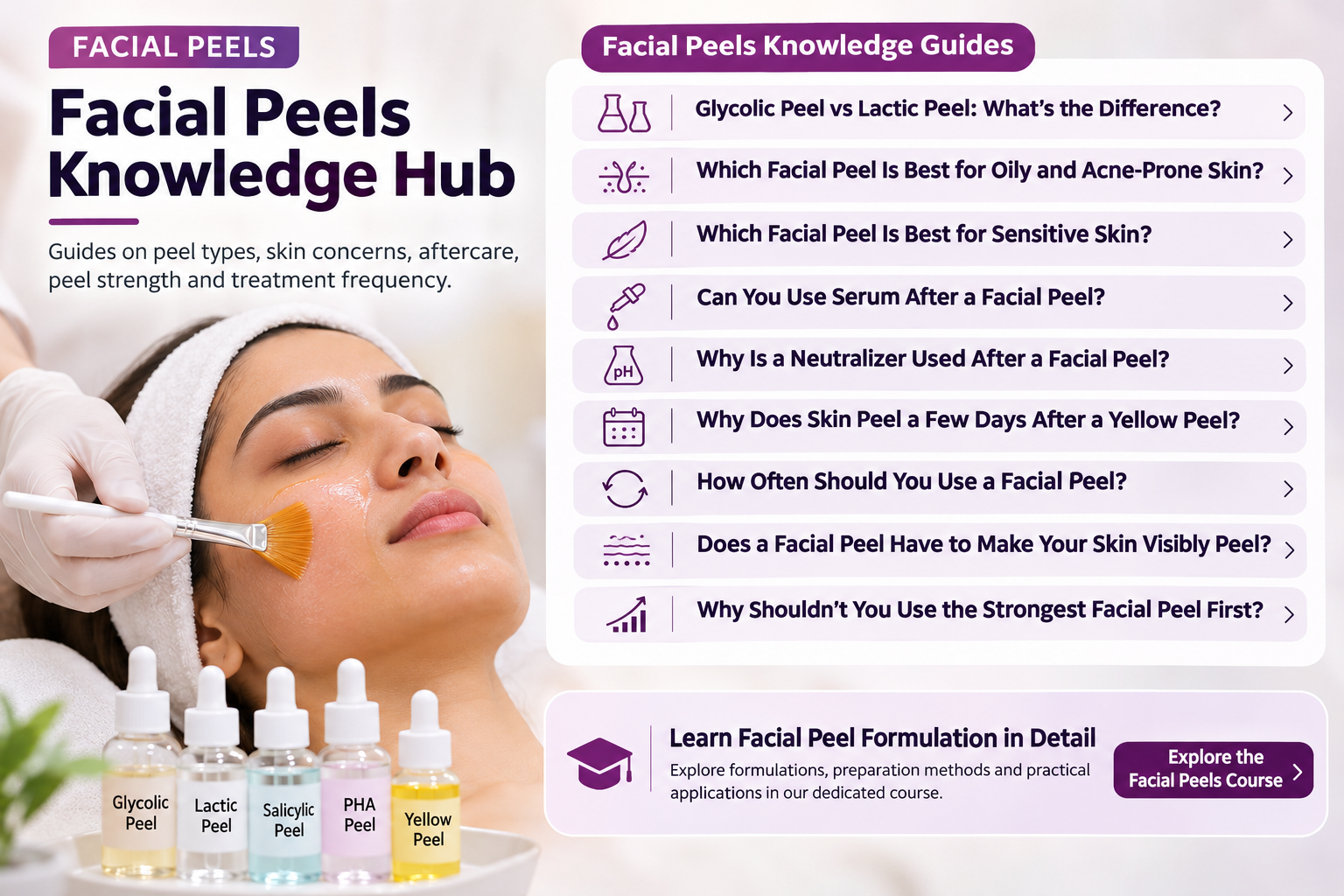
Learn about facial peels through our educational guides covering glycolic, lactic, salicylic, PHA and yellow peels, along with peel strength, skin type, aftercare, neutralization and treatment frequency.
Whether you are trying to understand which peel may suit a particular skin concern or what to expect before and after a peel, start with the individual guides below.
Facial Peels Knowledge Guides
Glycolic Peel vs Lactic Peel: What’s the Difference?
Glycolic and lactic peels are used for many similar surface concerns, but they differ in strength and treatment character.
Learn how the two compare for tanning, mild pigmentation, fresh acne marks and skin glow.
Read: Glycolic Peel vs Lactic Peel: What’s the Difference?
Which Facial Peel Is Best for Oily and Acne-Prone Skin?
Different peels are better suited to different skin conditions.
Learn why salicylic acid peel is particularly associated with oily and acne-prone skin and how localized treatment may sometimes be more appropriate than treating the entire face.
Read: Which Facial Peel Is Best for Oily and Acne-Prone Skin?
Which Facial Peel Is Best for Sensitive Skin?
Sensitive skin requires a milder approach to exfoliation.
Learn why PHA peel is discussed as a gentler option and how it differs from stronger glycolic, lactic and salicylic peels.
Read: Which Facial Peel Is Best for Sensitive Skin?
Can You Use Serum After a Facial Peel?
Freshly peeled skin can be more sensitive than usual, so skincare immediately after a peel should be kept simple.
Learn when serum can be restarted and why it is better to allow post-peel sensitivity to settle first.
Read: Can You Use Serum After a Facial Peel?
Why Is a Neutralizer Used After a Facial Peel?
Many acidic facial peels are followed by a neutralizer to bring the acidic treatment action to a controlled end.
Learn what a neutralizer does, why it is used and why it also needs to be removed after completing its role.
Read: Why Is a Neutralizer Used After a Facial Peel?
Why Does Skin Peel a Few Days After a Yellow Peel?
Yellow peel behaves differently from many milder surface peels because its visible peeling effect can be delayed.
Learn why the skin may first feel soft, then rough and begin visibly peeling only a few days later.
Read: Why Does Skin Peel a Few Days After a Yellow Peel?
How Often Should You Use a Facial Peel?
There is no single facial-peel schedule that suits everyone.
Learn how peel strength, peel type and individual skin response influence how frequently a treatment should be repeated.
Read: How Often Should You Use a Facial Peel?
Does a Facial Peel Have to Make Your Skin Visibly Peel?
Visible flaking is not required for every facial peel.
Learn why some mild peels can work on accumulated dead surface skin without producing obvious sheets or flakes of peeling skin.
Read: Does a Facial Peel Have to Make Your Skin Visibly Peel?
Why Shouldn’t You Use the Strongest Facial Peel First?
A stronger peel does not automatically mean a better treatment.
Learn why peel strength should begin mild, how individual skin responses can differ and why stronger treatments should only be considered when necessary.
Read: Why Shouldn’t You Use the Strongest Facial Peel First?
How the Facial Peel Guides Connect
If you are choosing between different peel types, start with the guides on glycolic vs lactic peel, peels for oily and acne-prone skin, and peels for sensitive skin.
Once you understand peel selection, explore the guides on peel strength and how often facial peels should be used.
For treatment expectations and aftercare, read about visible peeling, yellow-peel peeling, neutralizers, and serum use after a facial peel.
Together, these guides help explain an important principle: the right facial peel is not simply the strongest one. Peel type, strength, skin condition, sensitivity, frequency and aftercare all need to be considered together.
Learn Facial Peel Formulation in Detail
These Knowledge Articles explain the principles, differences, usage considerations and aftercare concepts behind facial peels.
Use up and down arrow keys to resize the meta box pane.
If you want to learn the complete formulations and practical preparation methods in a structured format, explore the dedicated ZestChest Institute course.
Use up and down arrow keys to resize the meta box pane.