
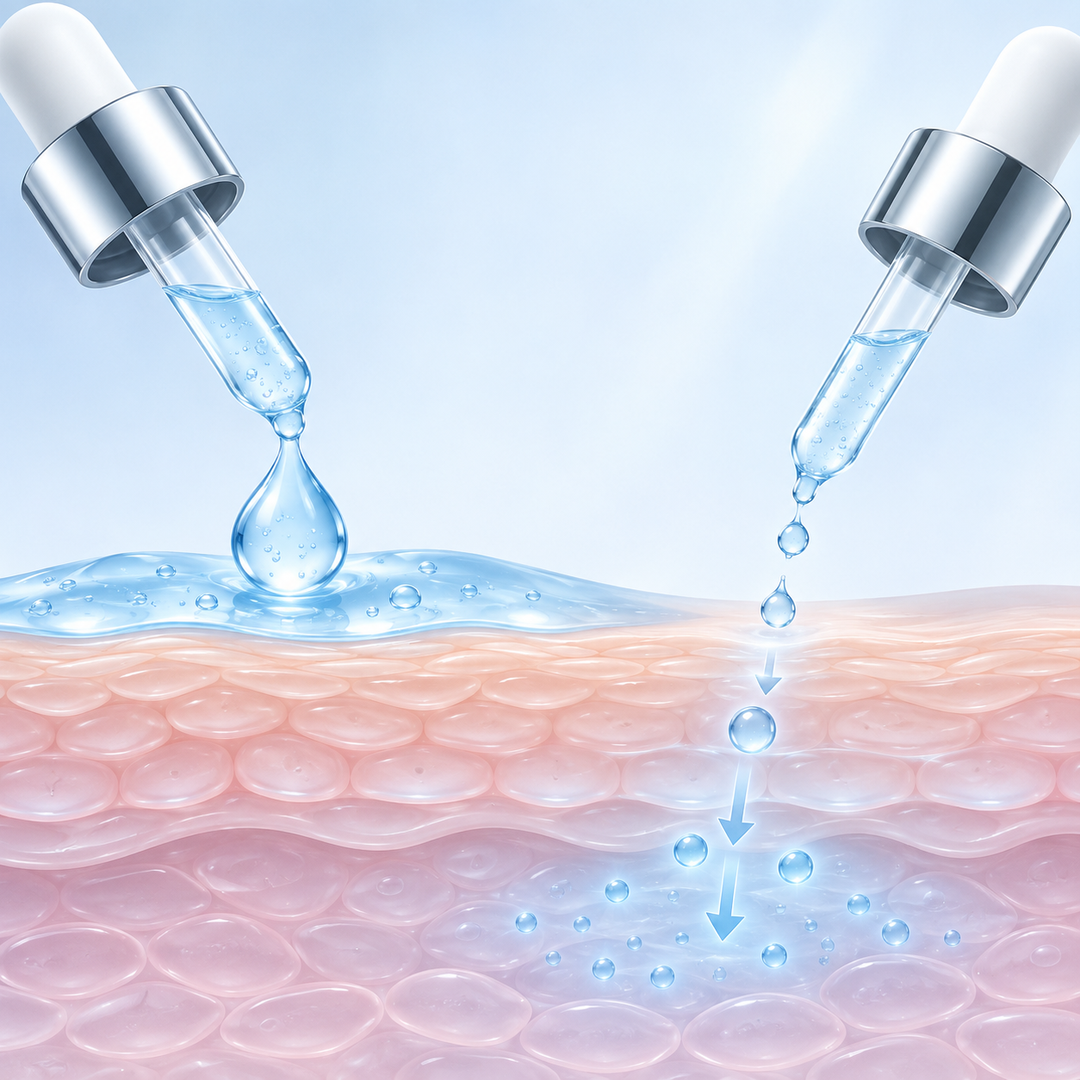
The main difference between high and low molecular weight hyaluronic acid is the size of their molecules and how they are intended to help the skin retain moisture.
High molecular weight hyaluronic acid primarily works on the skin’s surface, while low molecular weight hyaluronic acid is used for hydration beneath the immediate surface.
Both are associated with improving the appearance of hydrated, plump skin.
Why Is Hyaluronic Acid Important for Skin?
Hyaluronic acid is an important moisturising ingredient because of its ability to hold moisture.
A useful way to understand its function is to imagine two sponges.
One sponge is thick and the other is thin. If you pour water into both, the thicker sponge can hold more water.
The same analogy helps explain why younger skin often appears plumper and why moisture retention becomes increasingly important as skin ages.
As we grow older, the skin’s ability to retain moisture can decrease, contributing to dryness and a less plump appearance.
Hyaluronic acid is included in skincare products to improve moisture retention.
What Is High Molecular Weight Hyaluronic Acid?
High molecular weight hyaluronic acid, commonly abbreviated as HMW, has relatively large molecules.
Because of their size, these molecules are described as remaining primarily at the skin’s surface.
Their purpose is to form a moisture-retaining layer that helps reduce moisture loss.
This makes high molecular weight hyaluronic acid particularly relevant to products focused on surface hydration.
What Is Low Molecular Weight Hyaluronic Acid?
Low molecular weight hyaluronic acid, or LMW, has smaller molecules.
It is selected when hydration beneath the immediate surface is desired.
The intention is to support moisture retention at a different level from high molecular weight hyaluronic acid.
Is Medium Molecular Weight Hyaluronic Acid Also Available?
Yes. Hyaluronic acid is discussed in three molecular-weight categories: high, medium and low.
The distinction is based on molecular size.
The selection depends on the hydration characteristics intended for the finished product.
Which Type Is Better?
Neither form should automatically be considered superior.
High molecular weight hyaluronic acid is useful when surface hydration is the main objective.
Low molecular weight hyaluronic acid is selected when hydration beneath the immediate surface is important.
A useful practical observation is that hyaluronic acid can also influence serum texture. Higher levels may produce a more jelly-like consistency.
However, a thicker serum is not necessarily a better serum.
The most important consideration is the kind of hydration the product is designed to provide, rather than simply the molecular weight listed on the ingredient description.
Related Articles
- What Is the Difference Between a Face Serum and a Moisturiser?
- Why Do Some Face Serums Feel Sticky?
- How Do You Choose the Right Serum for Your Skin Type?

