
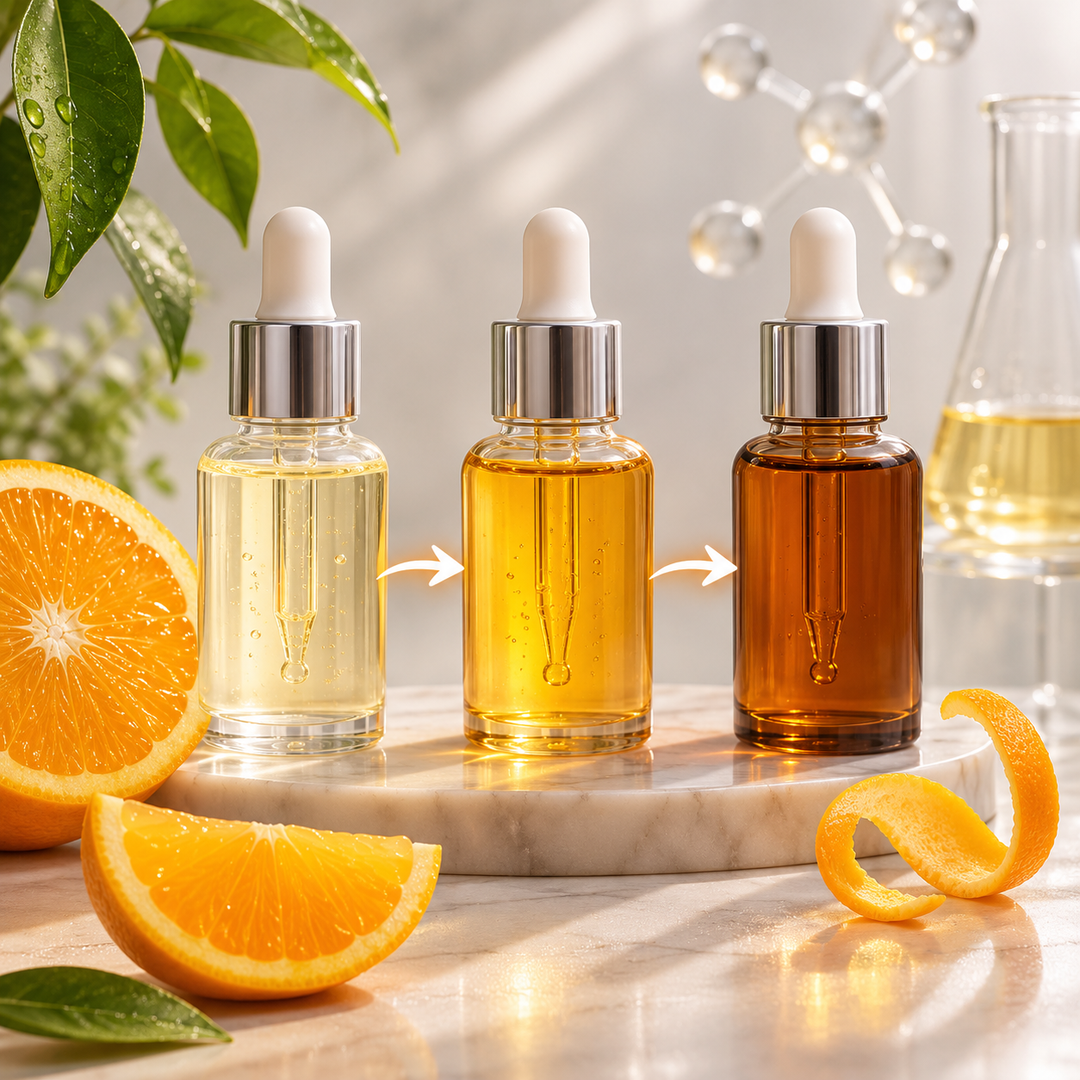
Some vitamin C serums change colour because certain forms of vitamin C are unstable when they come into contact with water.
L-ascorbic acid is discussed as an effective but particularly unstable form that can develop a darker colour relatively quickly.
This is one reason the specific form of vitamin C matters when evaluating a serum.
Are All Forms of Vitamin C the Same?
No.
Vitamin C is available in different forms, and those forms do not necessarily behave identically in a finished skincare product.
L-ascorbic acid is one form discussed in the workshop.
Ethyl ascorbic acid and magnesium ascorbyl phosphate are also discussed as alternatives used in serum development.
The important difference is not simply the name of the ingredient but its stability in the type of product being developed.
Why Does L-Ascorbic Acid Change Colour?
L-ascorbic acid is discussed as a form of vitamin C that can be very effective but unstable in water-based preparations.
When it comes into contact with water, a visible colour change may occur.
The change can happen relatively quickly, with the product developing a brown appearance.
This makes L-ascorbic acid challenging in preparations intended to remain stored and used over time.
Why Is Stability Important in a Face Serum?
A commercial serum is not necessarily used immediately after it is made.
It may be stored, transported and used repeatedly over an extended period.
For that reason, maintaining the product’s intended appearance and stability is an important consideration.
A formulation that changes colour very quickly can present practical difficulties even if the active ingredient has desirable skincare properties.
This explains why formulators may prefer a more stable vitamin C derivative for certain products.
What About Ethyl Ascorbic Acid?
Ethyl ascorbic acid is discussed as a more stable form of vitamin C.
Magnesium ascorbyl phosphate is another form considered for serum development.
These alternatives are relevant when the objective is to include vitamin C in a product while avoiding the rapid changes associated with less stable forms.
Does Packaging Matter?
Packaging is another consideration when products contain ingredients sensitive to light.
Frosted or dark-coloured bottles are preferred in the workshop for reducing direct light exposure.
This is particularly relevant to preparations containing vitamins and other ingredients whose stability is an important concern.
However, packaging and ingredient selection serve different purposes.
A suitable bottle does not make every form of vitamin C behave identically.
Should You Judge a Vitamin C Serum Only by Its Colour?
Colour is a useful observable characteristic, but it does not provide a complete explanation of the product’s condition.
The specific vitamin C derivative and its stability characteristics are important.
The workshop does not establish a universal colour threshold that determines whether every vitamin C serum remains suitable for use.
The key lesson is that vitamin C is not a single interchangeable raw material. Its particular form influences how a serum behaves during storage.
Related Articles
- Why Do Water-Based Face Serums Need Preservatives?
- What Is the Difference Between a Face Serum and a Moisturiser?
- How Do You Choose the Right Serum for Your Skin Type?

