
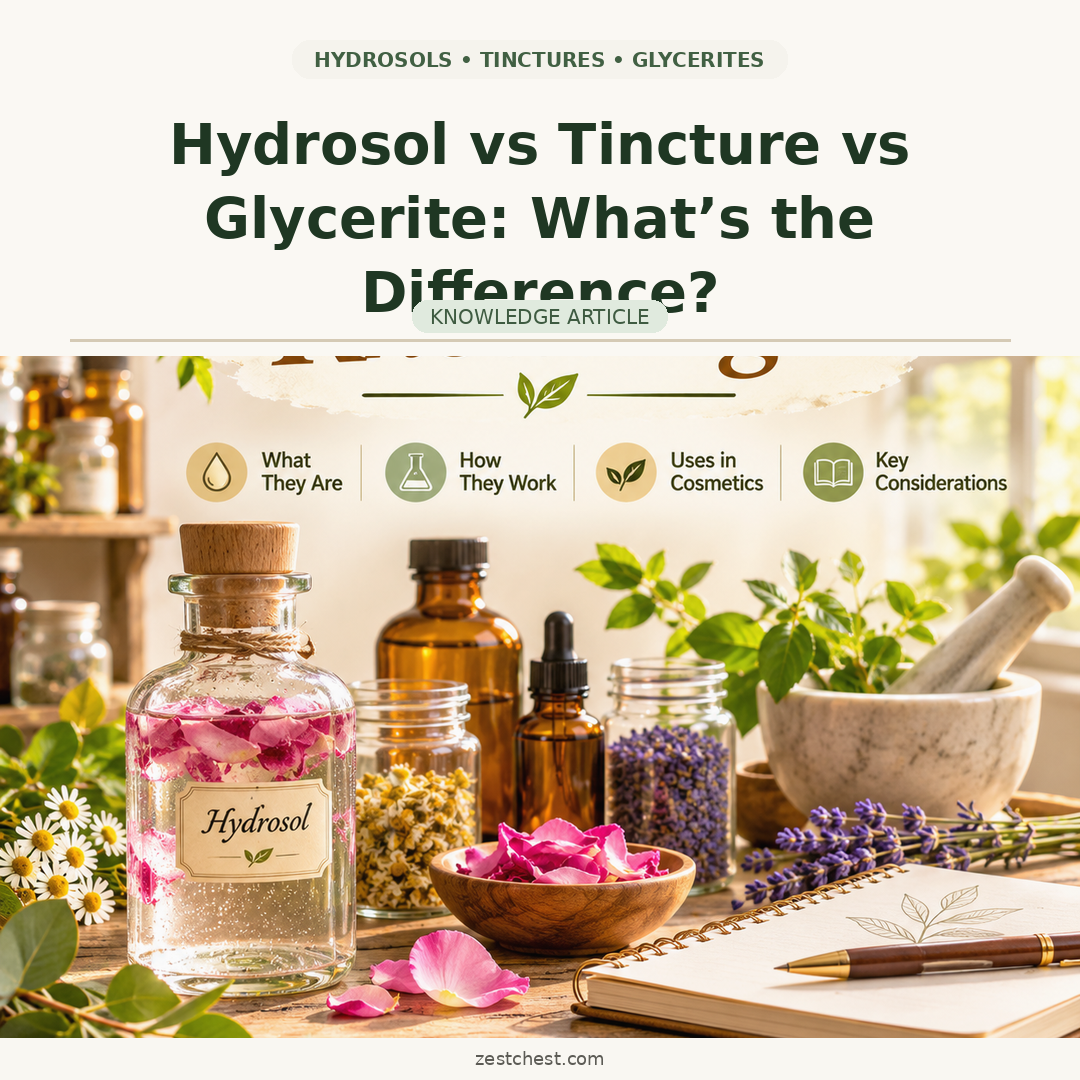
A hydrosol, tincture and glycerite can all carry botanical material, but they are made with different extraction media and behave differently in cosmetic products.
A hydrosol is a mild distilled botanical water.
A tincture is an alcohol-based botanical extract and is treated as the most concentrated of these three forms.
A glycerite is a botanical extract made in vegetable glycerin and combines the botanical extract with the moisturizing character of glycerin.
None is automatically better than the others.
The best choice depends on the final product.
What Makes a Hydrosol Different?
A hydrosol is produced through distillation.
The botanical material is heated with water, steam rises and is then condensed into a separate liquid.
Hydrosols are the mildest extraction form in the system taught here.
Because they are mild, they can be used very differently from concentrated extracts.
A hydrosol can form a substantial portion of the water part of a cosmetic and can also be used directly as a facial or scalp mist.
Typical applications discussed include toners, mists, creams, lotions, shampoos, conditioners and water-based serums.
What Makes a Tincture Different?
A tincture is an alcohol extract.
Alcohol is treated as the strongest extraction medium in this workshop because of its ability to macerate plant material and pull a concentrated amount of botanical material into the liquid.
That means a tincture is used as a concentrated botanical ingredient rather than like a large-volume botanical water.
The important principle is:
More concentrated does not mean you simply use more of it.
It means the ingredient performs its role at a much lower level than a mild hydrosol.
What Makes a Glycerite Different?
A glycerite uses vegetable glycerin as its extraction medium.
It is also concentrated, but the extraction medium itself contributes something to the finished cosmetic.
Glycerin is discussed as moisturizing and humectant in character.
That means adding a glycerite does two things simultaneously:
- it introduces the botanical extract;
- it introduces additional glycerin.
This is useful in many water-containing products, but it also means the texture of the final cosmetic must be considered.
Too much glycerin can create a sticky feel.
So a glycerite cannot be chosen only by asking which herb it contains. You also have to consider what the glycerin will do to the finished product.
Which Is the Most Concentrated?
Between these three, the workshop positions them as follows:
Tincture → strongest
Glycerite → concentrated, but below tincture
Hydrosol → mildest
This should not be confused with a ranking of quality.
A mild hydrosol may be used in a large part of a formulation, while only a small amount of a concentrated tincture may be required.
A student asked whether a rose tincture or glycerite is “better” than a rose hydrosol.
The useful answer is that they cannot be compared only by concentration.
A small quantity of concentrated extract and a much larger amount of mild hydrosol can both make meaningful botanical contributions depending on how the finished product is designed.
Where Does Each One Fit?
Hydrosols naturally belong in water-based products.
Glycerites also fit well into products containing water, including creams, lotions, shampoos, conditioners, toners and water-based serums.
Tinctures are more flexible in the way they are discussed in the workshop because the alcohol medium can evaporate after incorporation.
Even so, the final product should still determine which extraction form makes the most sense.
For a straightforward botanical mist, a hydrosol may be convenient.
For a concentrated botanical addition, a tincture or glycerite may be more practical.
Can the Same Herb Exist in All Three Forms?
Yes.
Rose, for example, can be made as a hydrosol, tincture or glycerite.
Licorice is also discussed as an ingredient that may be prepared in different forms.
The herb itself does not dictate one compulsory extraction method.
The intended final cosmetic helps determine which form is more useful.
Common Misunderstanding: Stronger Means Better
This is the main misconception to avoid.
If tincture is more concentrated than hydrosol, it is tempting to conclude that tincture is automatically the superior ingredient.
That misses the point.
Think about salt in cooking.
A concentrated ingredient is not automatically better because you can use more of it. Its concentration simply changes how it should be used.
The same principle applies here.
The form of botanical extract should match the job it needs to perform.
Practical Takeaway
Choose based on the product, not on which extract sounds strongest.
Use a hydrosol when you want a mild botanical water.
Use a tincture when you want a concentrated alcohol extract.
Use a glycerite when you want a concentrated botanical extract in glycerin and the moisturizing character of glycerin fits the formulation.
The best extraction form is the one that belongs naturally in the product you are trying to create.
Related Topics
What Is a Hydrosol and How Is It Different From Rose Water?

