
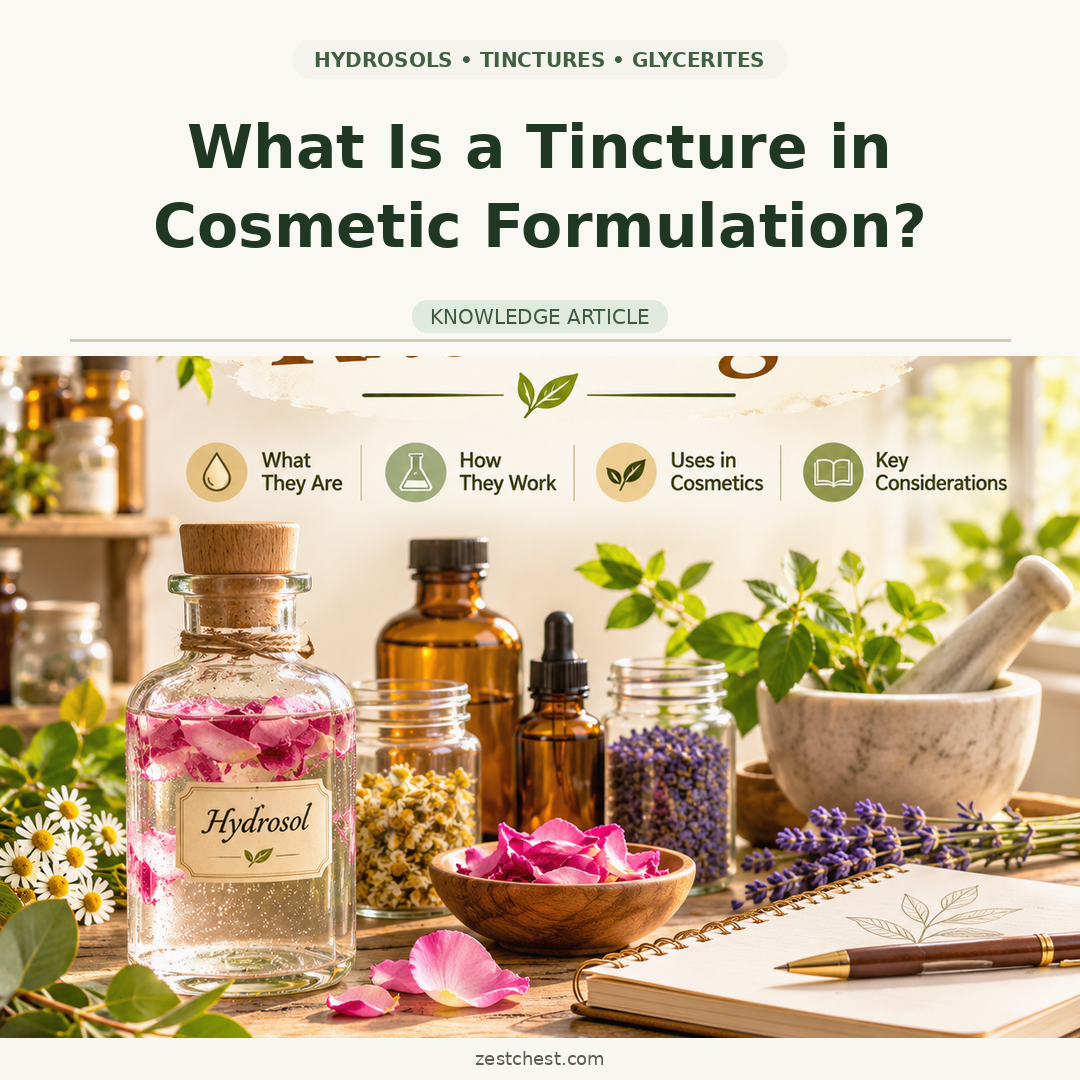
A tincture is a concentrated botanical extract made using alcohol as the extraction medium.
In this system of herbal extraction, tinctures are treated as the most concentrated extract type because alcohol is described as the strongest and fastest medium for macerating plant material and drawing botanical components into the liquid.
That makes a tincture very different from a mild hydrosol.
What Does the Alcohol Do?
The alcohol is the menstruum, which is the technical term for the liquid used to extract the herb.
Plant material contains cells. For extraction to take place, those cells need to soften or break down enough for their botanical material to move into the surrounding liquid.
This process is called maceration.
Alcohol is treated as particularly effective at this job.
Because it produces a concentrated extract, a tincture is used as a concentrated botanical addition rather than as the bulk water portion of a cosmetic.
What Kind of Botanical Materials Can Be Used?
The workshop discusses tinctures made from many different botanical forms, including:
- dried herbs;
- roots and bark;
- powdered herbs;
- leaves;
- flowers;
- fruit material;
- aloe vera;
- other plant ingredients.
The important principle is that hard, large pieces should expose enough surface area to the extraction medium.
A thick piece of bark, for example, will not behave the same way as that material broken into smaller pieces.
The more practical question is not simply “Can this herb become a tincture?”
It is also “Has the plant material been prepared so the extraction medium can reach it effectively?”
Tincture vs Hydrosol
A tincture and hydrosol are very different botanical ingredients.
A hydrosol is mild and distilled.
A tincture is concentrated and alcohol-based.
Because a hydrosol is mild, it can be used as a large part of a water-based product or even as a mist by itself.
Because a tincture is concentrated, much less is needed.
This is why comparing them only by asking which is stronger can be misleading.
They serve different purposes.
Tincture vs Glycerite
Both tinctures and glycerites are concentrated extracts.
The main difference is the extraction medium.
Tinctures use alcohol.
Glycerites use vegetable glycerin.
Glycerin brings its own moisturizing and sometimes sticky character into a cosmetic. A tincture does not behave the same way because its extraction medium is alcohol.
This can affect which one is more convenient for a particular formulation.
Can Tinctures Be Used in Oil-Based Products?
The workshop discusses tinctures as being more flexible than ordinary water-based extracts because the alcohol medium can evaporate after incorporation, leaving the extracted material behind.
That makes tinctures possible in some applications where a glycerite or direct water extract would not mix naturally.
However, if the final product is fundamentally an oil product, an oil-soluble botanical extract is still the most obvious match.
The extraction type should always be chosen according to the finished product.
What Is the Difference Between Ethanol and Other Alcohols?
The tincture medium discussed in the workshop is ethanol.
Vodka is discussed as a diluted alcohol option for personal or DIY preparations.
Isopropyl alcohol, by contrast, is discussed for sterilization rather than as the tincture medium used for this type of botanical extract.
The important distinction is that the word “alcohol” can refer to different materials with different uses.
They should not be treated as interchangeable simply because they all carry the word alcohol.
Does a Tincture Have to Contain Only One Herb?
No.
The workshop discusses both single-ingredient and combined extracts.
But from a practical formulation point of view, single extracts can make customization easier because you know exactly which botanical you are adding.
A formulator can then choose different botanical extracts for different final products rather than having every herb permanently combined in one extract.
Why Are Tinctures Useful?
The biggest advantage is concentration.
A tincture allows useful plant material to be captured in a compact extract rather than requiring the raw herb itself to be added to every cosmetic.
That can make it easier to work with botanical ingredients across different product types.
It also connects to the idea of an apothecary: a working collection of prepared botanical extracts that can be selected according to the product being formulated.
Practical Takeaway
A tincture is best understood as a concentrated alcohol-based botanical extract.
Its value is not simply that it is “strong.”
Its value is that it provides a concentrated botanical form that can be selected and incorporated according to the needs of a finished cosmetic.
The right question is not, “How strong can I make my tincture?”
It is, “Does a tincture make sense for the product I am creating?”
Related Topics
Hydrosol vs Tincture vs Glycerite: What’s the Difference?
Which Herbal Extraction Method Is the Most Concentrated?
What Is Maceration in Herbal Extraction and Why Does It Matter?

