
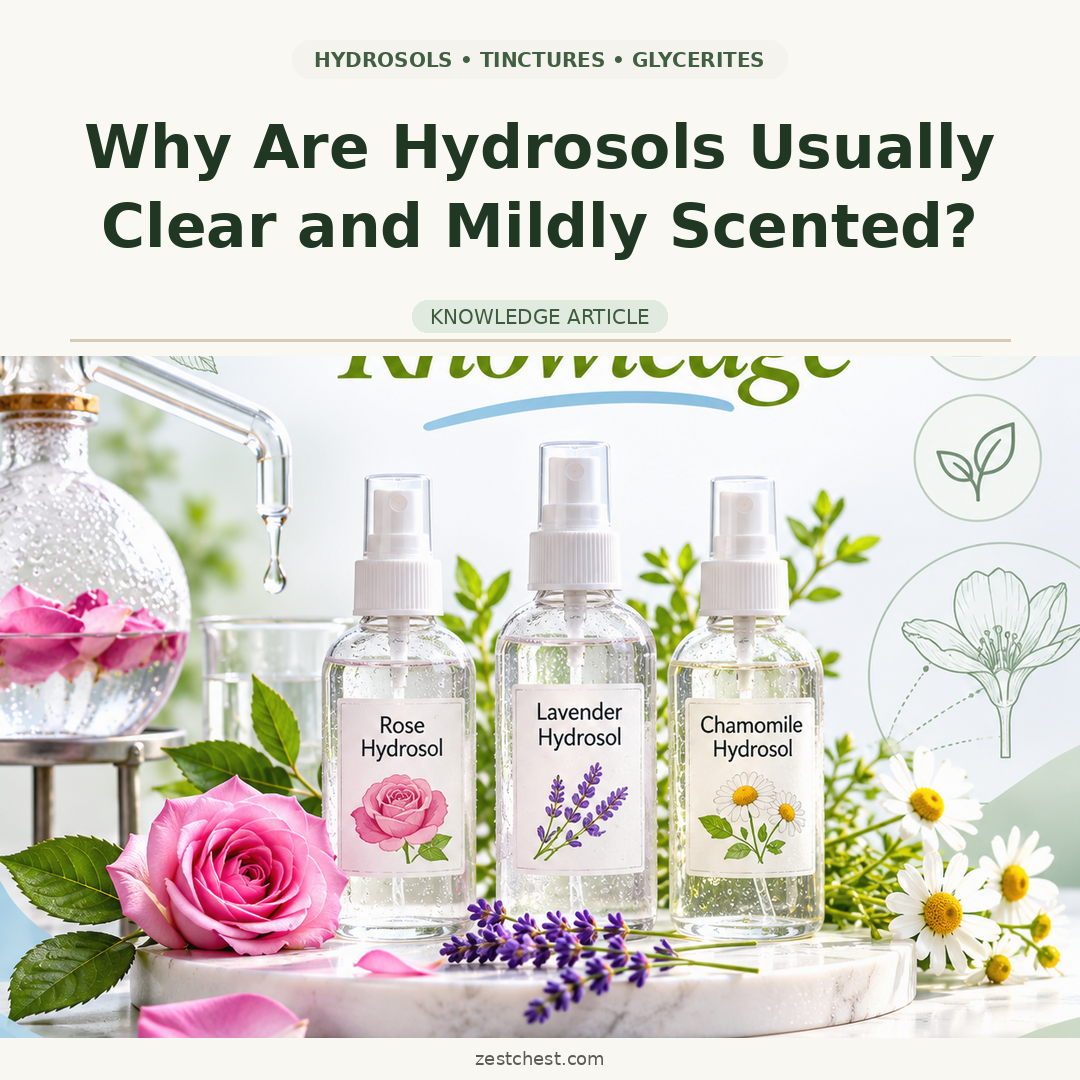
Hydrosols are usually clear because they are distilled liquids, not coloured infusions of the original plant material.
The pigments that make a rose red, a leaf green or another botanical brightly coloured do not necessarily travel with the steam that becomes the hydrosol.
That is why a genuine hydrosol can look almost exactly like plain water.
Why Doesn’t the Plant Colour Appear in the Hydrosol?
During distillation, the botanical material is heated and steam rises.
Some botanical material travels with that steam.
The steam is then cooled and collected as liquid.
The visible pigments of the original botanical do not transfer in the same way through this process.
So the colour of the original herb is not a reliable guide to the colour of the finished hydrosol.
A red flower does not require a red hydrosol.
A green herb does not require a green hydrosol.
The distilled liquid may remain completely clear.
Is a Colourless Hydrosol Weak?
Not simply because it is colourless.
The lack of colour is connected to the distillation method.
It should not automatically be interpreted as proof that nothing from the botanical is present.
Hydrosols are intentionally mild botanical waters.
Their usefulness comes partly from that mild character.
They can be used in larger amounts in water-based cosmetics and can also be used directly as products such as facial or scalp mists.
Why Do Hydrosols Often Have Only a Faint Smell?
The fragrance of a hydrosol is also usually much milder than people expect.
A rose or lavender hydrosol may retain a subtle botanical smell when smelled closely.
Fruit, vegetable and many herbal hydrosols may have even less obvious odour.
A hydrosol should therefore not be judged as poor quality just because it does not smell like an essential oil or perfume.
The hydrosol and essential oil are different materials.
Does Strong Fragrance Prove Better Quality?
No.
A strong smell is not a reliable test for authenticity.
This is especially important when buying hydrosols.
A consumer may assume:
“If I can strongly smell rose, this must be genuine rose hydrosol.”
But the workshop specifically warns against judging a hydrosol only by fragrance.
A genuine hydrosol may smell very mild.
Why Does This Make Buying Hydrosols Difficult?
Hydrosols can be difficult to verify visually because many of them look alike.
A genuine lavender hydrosol, another clear hydrosol and ordinary distilled water may all appear similar in a bottle.
This is one reason I pay attention to supplier reliability.
Pricing can also make me ask questions.
Different flowers and botanicals have different raw-material costs. Rose may be readily available, while another flower may be more expensive or difficult to source.
If every type of hydrosol is sold at almost exactly the same price regardless of the raw material, it may be worth asking how the products are being produced.
That alone does not prove a product is incorrect.
It is simply a practical purchasing observation.
What About Coloured “Hydrosols”?
The main principle taught here is that a distilled hydrosol should not be expected to retain the strong pigment of the starting plant.
If a product has a strong colour, do not automatically assume that the colour proves it contains more botanical material.
Appearance alone is not enough to establish quality.
Hydrosol vs Direct Herbal Water
This becomes easier to understand when you compare a hydrosol with a direct water extract.
If rose petals are directly soaked or heated in the water that becomes the finished preparation, colour can transfer into that water.
A hydrosol is different because the final product is condensed steam.
This is why the two botanical waters can look very different even when they begin with the same plant.
Practical Takeaway
A hydrosol that looks like water and smells only faintly of the original plant is not automatically defective.
Those characteristics are part of the distilled form.
Do not judge hydrosol quality from colour or perfume strength alone.
The extraction method and reliability of the source matter more than whether the bottle looks dramatically herbal.

