
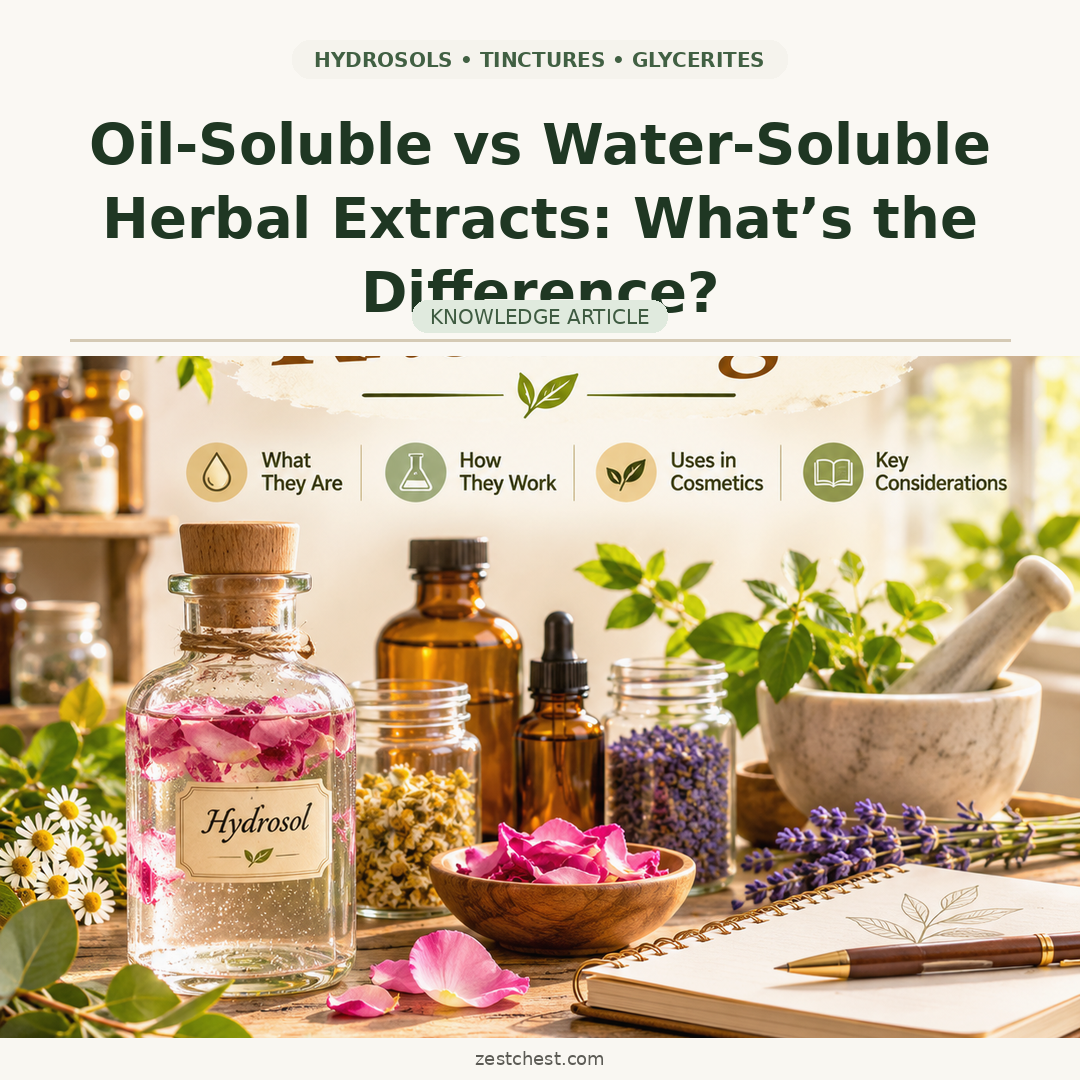
The difference between oil-soluble and water-soluble herbal extracts is mainly about which type of product they belong in.
An oil-soluble extract is naturally suited to the oil side of a formulation.
A water-soluble extract belongs in the water side.
This sounds simple, but it is one of the most important principles in herbal cosmetic formulation.
What Is an Oil-Soluble Herbal Extract?
An oil-soluble extract is botanical material infused into oil.
The oil becomes the carrier for the botanical extract.
That makes this form useful in products such as:
- face oils;
- body oils;
- hair oils;
- the oil portion of creams and similar emulsions.
The exact herb can change, but the principle remains the same: the extract is being carried in an oil medium.
What Is a Water-Soluble Herbal Extract?
A water-soluble extract is made using water as the extraction medium.
The botanical material is in direct contact with the water that becomes the extract.
The workshop compares this concept with making tea.
The botanical material releases colour and other material into the water, and the plant solids can later be removed.
This type of extract naturally fits into the water side of cosmetics.
Is a Hydrosol Also Water-Based?
Yes, but a hydrosol and direct water extract are not the same preparation.
A direct water extract is created through contact between the plant and the water.
A hydrosol is produced through distillation, where botanical steam is condensed and collected separately.
Both are water-based botanical ingredients, but their extraction methods and strength are different.
Why Can’t You Just Add Any Extract to Any Cosmetic?
Because the extraction medium remains part of the ingredient.
A glycerite contains glycerin.
A direct water extract contains water.
An oil infusion contains oil.
These media behave differently.
If you put a water-based ingredient directly into a pure body oil, the two do not simply become one stable oil.
Likewise, an oil-based extract behaves differently inside a water-based product.
This is why I always come back to one question:
What is the final product?
Which Extract Should Be Used in a Body or Hair Oil?
An oil-soluble extract is the most natural match.
The botanical is already carried in the same type of medium as the finished product.
Tinctures are discussed as having some additional flexibility because their alcohol medium can evaporate after incorporation.
But for a straightforward botanical oil product, choosing an oil infusion avoids unnecessary incompatibility.
What About Creams and Lotions?
Creams and lotions contain both water and oil components.
That gives the formulator more options.
A water-soluble botanical extract can belong in the water side.
An oil-soluble extract can belong in the oil side.
A glycerite can also fit because the product contains a water phase.
The fact that a cream contains both sides is one reason botanical extracts can be incorporated in several different forms.
What About Mists and Toners?
These are primarily water-based concepts.
Hydrosols, direct water extracts and suitable glycerites fit more naturally here than an ordinary oil infusion.
Again, the formulation determines the ingredient format.
Why Does This Distinction Matter for Herbal Formulators?
Suppose you love one herb and want to use it everywhere.
The mistake would be to prepare only one extract and force that same extract into every product.
Instead, the same botanical can sometimes be prepared in different extraction media.
One form may be useful for a mist.
Another may be useful for an oil.
Another may work as a concentrated botanical addition.
That gives much more flexibility.
Practical Takeaway
Do not choose an herbal extract only by the herb name.
Choose it by both the herb and the extraction medium.
If the finished product is oil-based, think oil-soluble.
If it is water-based, think water-compatible.
Matching the extract to the product is more important than forcing a favourite botanical form into a formulation where it does not naturally belong.
Related Topics
Hydrosol vs Tincture vs Glycerite: What’s the Difference?

