
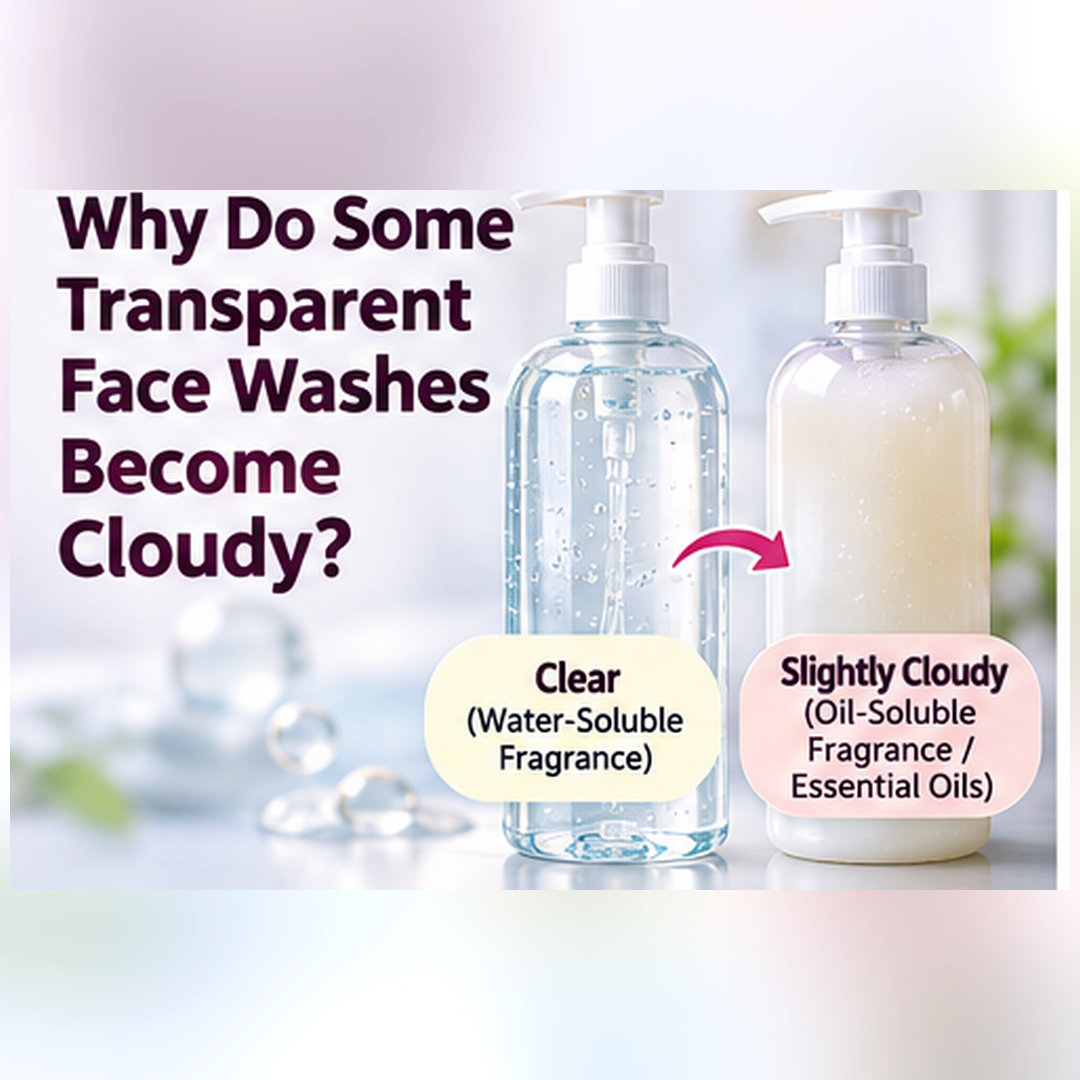
A transparent face wash can become cloudy because of ingredient choices or trapped air bubbles. One common reason discussed in Japanese Sake Face Wash is the use of oil-soluble fragrance or essential oils.
These can reduce the product’s crystal-clear appearance and create a slightly milky or hazy look.
However, cloudiness caused by fragrance is different from the temporary appearance of bubbles trapped during handling.
Understanding this distinction helps explain why a cleanser may not always look perfectly transparent.
Why Is Transparency Important in Some Face Washes?
Japanese Sake Face Wash is designed as a thick, transparent cleanser.
The clear appearance is one of its distinctive visual characteristics.
A transparent cleanser can have an attractive presentation, particularly when displayed in a bottle.
However, maintaining that appearance depends on the ingredients used in the finished product.
The type of fragrance is one important consideration.
How Can Fragrance Affect Clarity?
Fragrance contributes to the sensory experience of a cleanser.
People often enjoy using a face wash that has a pleasant scent.
However, different fragrance types can influence how the product looks.
For a face wash intended to remain crystal clear, I prefer a water-soluble fragrance.
Oil-soluble fragrances and essential oils may reduce transparency.
The resulting product can appear slightly hazy rather than perfectly clear.
This is what I describe as turbidity.
What Does Turbidity Look Like?
Turbidity does not necessarily mean that the face wash becomes completely white.
The product may simply lose some of its clarity.
A previously transparent cleanser can take on a faintly milky appearance.
The distinction is visual.
It is useful because a person may otherwise assume that every change in transparency has the same cause.
In this example, the appearance can be related to fragrance selection.
Do Essential Oils Always Produce a Crystal-Clear Product?
Essential oils are among the fragrance options discussed for facial cleansers.
Examples include tea tree, orange and lemon essential oils.
However, I point out that essential oils can make a transparent face wash slightly turbid.
This does not mean they cannot be considered as fragrance options.
It means the finished product may not retain the exact transparent appearance originally intended.
For someone who particularly wants a crystal-clear cleanser, the fragrance type becomes an important product-selection consideration.
Can Trapped Air Also Affect the Appearance?
Yes.
A transparent face wash may contain visible bubbles after being stirred, transferred or handled.
These bubbles can make the product appear less clear.
This is different from the mild cloudiness associated with fragrance.
The bubbles may gradually settle as the product rests.
I demonstrate that a thick facial cleanser can retain trapped bubbles for some time, particularly after vigorous handling.
The viscosity of the cleanser makes those bubbles more noticeable.
Does Cloudiness Mean the Face Wash Cleans Less Effectively?
Cloudiness alone does not establish whether a face wash has good or poor cleansing performance.
The product’s appearance and its cleansing function are different characteristics.
A cleanser may be visually clear because of its ingredient selection.
Another may look slightly cloudy because of the fragrance.
That visual difference should not automatically be interpreted as a difference in cleaning ability.
However, visible changes should still be understood in the context of the particular product rather than dismissed without knowing the cause.
What Should You Look for in a Transparent Face Wash?
If clear appearance is important to you, consider whether the cleanser is intended to be transparent and what type of fragrance it contains.
Also distinguish temporary bubbles from a product that is uniformly cloudy.
The key takeaway is that transparency is a product characteristic influenced by formulation choices and handling, not a direct measurement of cleansing quality.

