
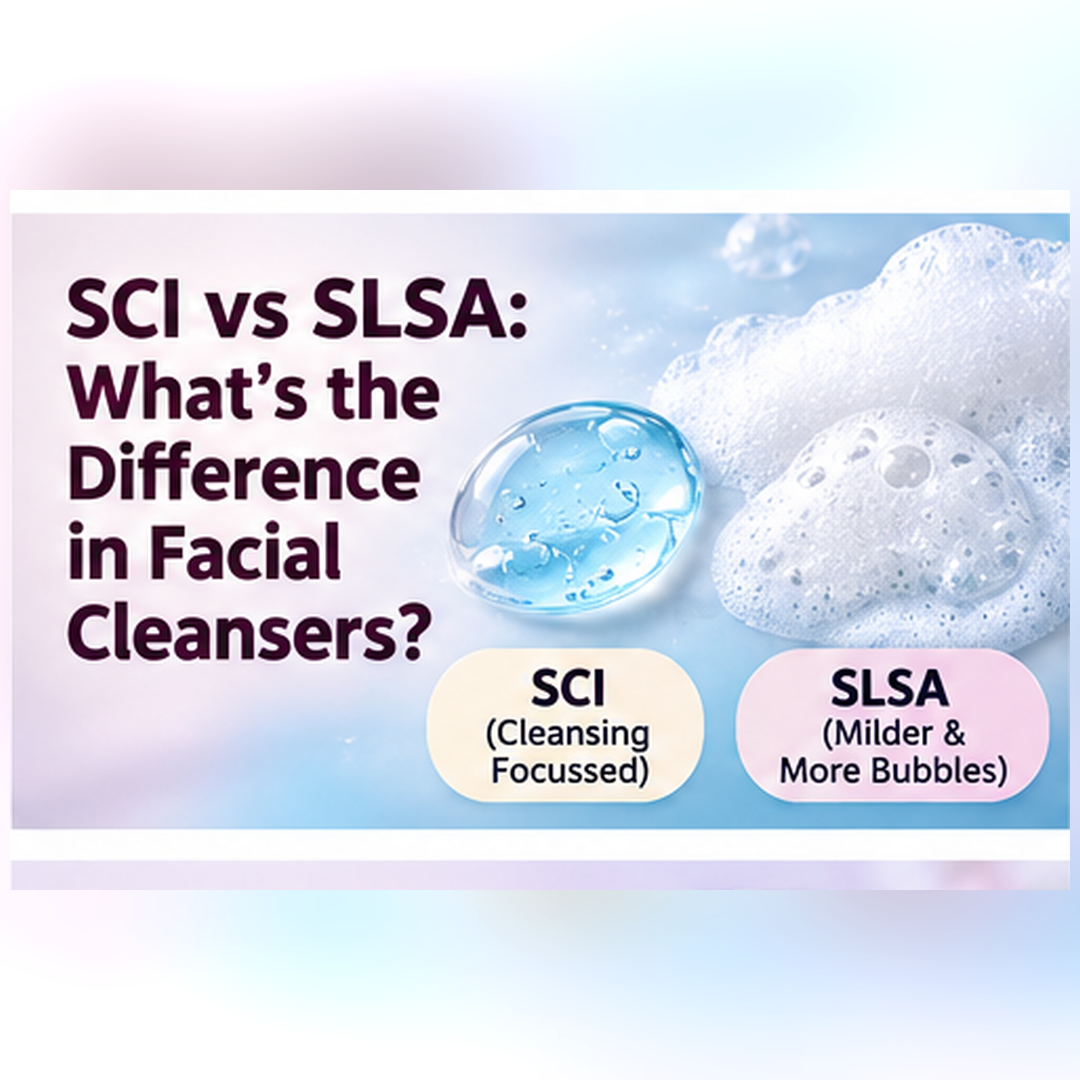
Sodium cocoyl isethionate (SCI) and sodium lauryl sulfoacetate (SLSA) are surfactants used in cleansing products, but they contribute different characteristics.
In the facial cleanser discussed here, SCI is valued primarily for its cleansing ability, while SLSA contributes a milder cleansing action and richer bubbles.
Understanding this distinction helps explain why a cleanser’s lather and actual cleansing performance are not exactly the same thing.
What Is SCI?
SCI stands for sodium cocoyl isethionate.
It is described as a coconut-derived surfactant used for cleansing.
Its main purpose in the Japanese Sake Face Wash concept is to help remove dirt and impurities from the skin.
I describe SCI as an effective cleanser capable of providing a strong cleansing action.
However, stronger cleansing is not automatically preferable in every situation.
If a cleansing ingredient is used without sufficient consideration for the finished product’s skin feel, the cleanser may leave the skin dry.
This is why cleansing strength must be balanced with the comfort expected from a facial product.
What Is SLSA?
SLSA stands for sodium lauryl sulfoacetate.
It is another naturally derived surfactant discussed in the face-wash workshop.
Its distinguishing characteristic is its ability to produce abundant bubbles.
I describe SLSA as a milder cleanser that contributes to a rich, satisfying lather.
Although it also has a cleansing role, the comparison focuses on its usefulness for creating the bubbling experience customers expect.
Why Does the Difference Matter?
A face wash needs to clean the skin.
But people also judge a cleanser by how it feels while they are using it.
Imagine washing your face with a product that removes impurities but hardly produces any lather.
The product may still have a cleansing function, yet the user may not enjoy the experience.
Now imagine a product that produces plenty of bubbles.
The experience may feel more satisfying, but the amount of foam alone does not tell you everything about its cleansing performance.
This is why I separate the two functions when discussing SCI and SLSA.
SCI is described as contributing effective cleansing, while SLSA is particularly useful for the rich bubbles.
Does SCI Produce Foam Too?
Yes.
SCI is not described as an ingredient that cleans without producing any bubbles.
It also contributes lather.
The distinction is about its main role in this cleanser.
SLSA is discussed as providing additional richness to the lather, rather than replacing the cleansing contribution of SCI.
This is an important difference because readers sometimes assume every surfactant is included for exactly the same reason.
Are Chemical-Sounding Ingredient Names a Problem?
A technical ingredient name does not, by itself, tell you whether an ingredient is derived from a natural source.
I often use a simple example when explaining this.
Common salt is called sodium chloride.
That is its chemical name, but most people recognise it as an everyday ingredient.
Similarly, SCI and SLSA have technical names, even though they are discussed here as naturally derived surfactants.
The useful approach is to understand the function of an ingredient rather than judging it only by how unfamiliar its name sounds.
Is More Cleansing Power Always Better?
Not for the type of facial cleansing experience we are discussing.
The face wash is intended to remove dirt and excess oil while remaining comfortable on the skin.
Excessive cleansing strength can work against that objective if it leaves the skin feeling dry.
This becomes especially relevant for people with dry or sensitive skin.
It is therefore useful to distinguish between effective cleansing and an unnecessarily harsh after-wash feeling.
What Should You Remember About SCI and SLSA?
Both are surfactants, and both contribute to the cleansing experience.
Their roles overlap, but they are not identical.
SCI is discussed primarily for effective cleansing.
SLSA is discussed for its mildness and rich bubbling characteristics.
The broader principle is that a well-designed facial cleanser must balance removal of impurities with the feel and experience of washing the skin.

