
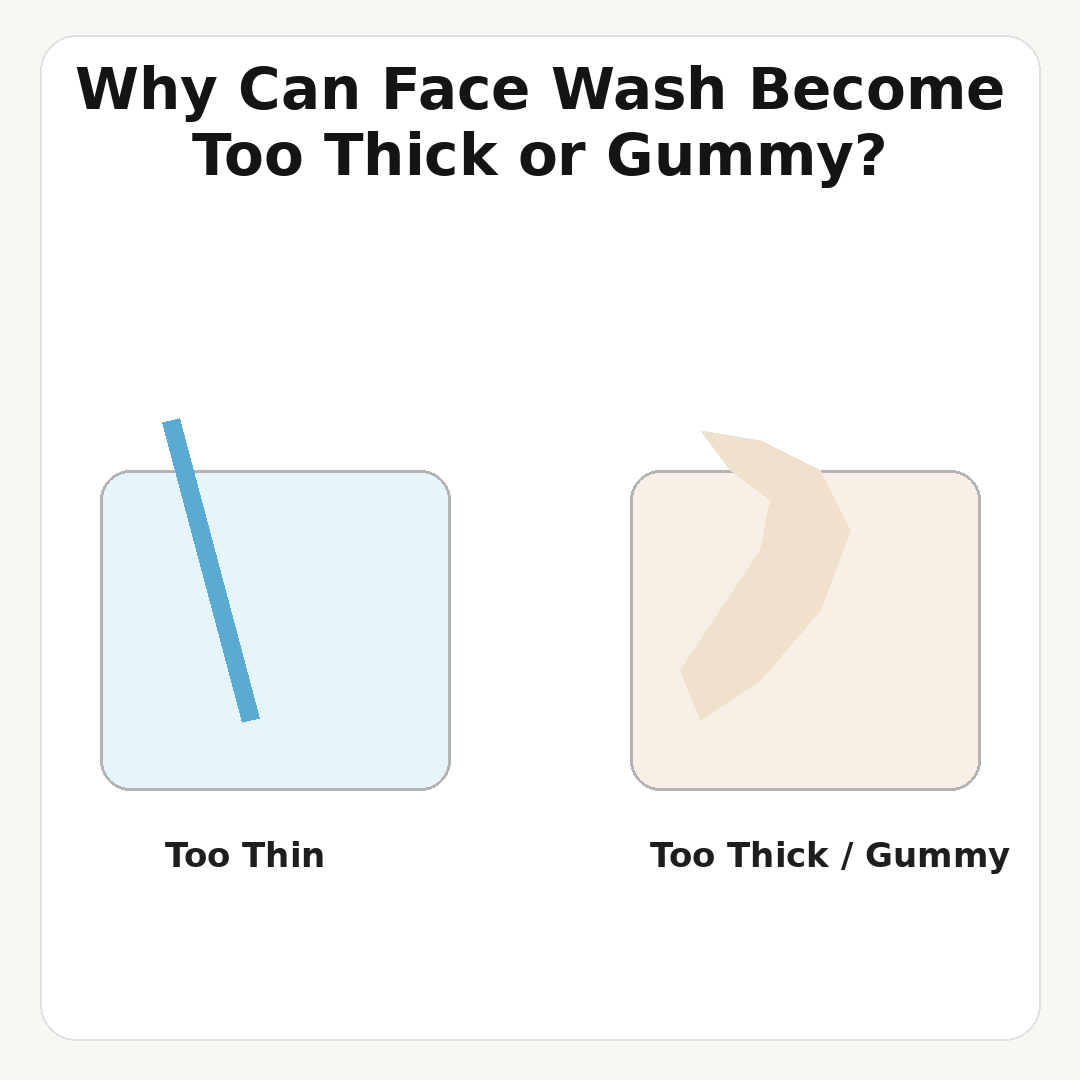
A face wash can become too thick or gummy when too much thickening material is added before the product has had enough time to develop and settle into its final consistency.
This is one of the most practical troubleshooting lessons from the workshop.
A freshly mixed face wash may look thinner than it will later. If you keep adding thickener because you are judging it immediately, you may return to the batch and find that it has become jelly-like.
Why Does Face Wash Need Thickening?
Consumers generally expect a face wash to have some body.
An extremely thin liquid can be difficult to dispense and may not create the sensory experience people associate with a facial cleanser.
Sulfate-free systems can also be naturally thinner than some sulfate-based cleansers.
For that reason, additional thickening may be used to create the desired texture.
Which Thickeners Are Discussed?
PEG-150 Distearate is discussed as an effective thickener for these face-wash systems.
Solagum AX, described as a combination of xanthan gum and gum acacia, is discussed as another option.
They do not give exactly the same degree of thickening.
The important principle, however, is the same regardless of which system you use:
do not judge the final thickness too quickly.
Why Does a Fresh Batch Look Thinner?
The product is still changing immediately after mixing.
It may still be warm.
It may contain temporary foam.
Ingredients may not yet have settled into their final texture.
So the consistency you see during active mixing is not always the consistency you will see after the cleanser has rested.
What Is the Common Mistake?
The common mistake is seeing a thin-looking face wash and immediately adding more thickener.
Then you look at it again, still decide it is thin and add more.
Later, after the product has cooled and settled, all of that thickening becomes apparent.
Instead of a smooth flowing cleanser, you may end up with something closer to a gelled mass or gum.
I encountered exactly this problem during earlier formulation work: a batch looked thin during production, so more thickener was added, only for it to become far too thick later.
Can You Fix an Over-Thickened Face Wash?
There may be some room to thin it again, but recovery is limited.
For personal use, an overly thick product may sometimes be adjusted enough to make it usable.
That does not automatically make it a good commercial batch.
Once the texture has moved into an unpleasant gummy character, it becomes difficult to recover the elegant consistency expected from a finished facial cleanser.
Prevention is much easier than correction.
Why Is Gradual Adjustment Better?
Thickness should be treated as something you fine-tune rather than force.
Make the cleanser, allow it to settle, then judge what it actually needs.
If an adjustment is necessary, a small change is easier to evaluate than a large one.
This approach is particularly useful when developing a commercial formula because once you identify the consistency you like, you can record that version and reproduce it in future batches rather than improvising each time.
Can Other Ingredients Change Face-Wash Thickness?
Yes.
When different actives, oils or botanical ingredients are added, the consistency of the complete product may change.
This is one reason an “all-in-one” face wash cannot simply be created by adding every beneficial ingredient to an existing formula without considering what those additions do to the texture.
The whole system has to remain balanced.
Why Is Foam Sometimes Mistaken for Texture?
Surfactant products naturally generate bubbles when stirred.
Fresh foam can make the surface of a batch look different from the actual cleanser beneath it.
During the workshop, some batches initially had froth on top while the product itself became clearer after settling.
So appearance immediately after mixing can be misleading in more than one way.
Does Very Thick Mean Better Quality?
No.
A face wash needs an appropriate texture, not the maximum possible thickness.
Extremely thick does not automatically mean concentrated, effective or premium.
A gummy cleanser can actually become less pleasant to dispense and use.
Texture should support the product rather than become the product’s main problem.
The Practical Takeaway
The most important rule when troubleshooting a thin face wash is simple:
Do not panic and keep adding thickener while the product is still developing.
Allow the cleanser to reach its settled consistency first.
A slightly thin product can still be adjusted. A face wash pushed into a gummy, jelly-like texture is much harder to recover.
Related Topics
Do Sulfate-Free Face Washes Still Lather?

