
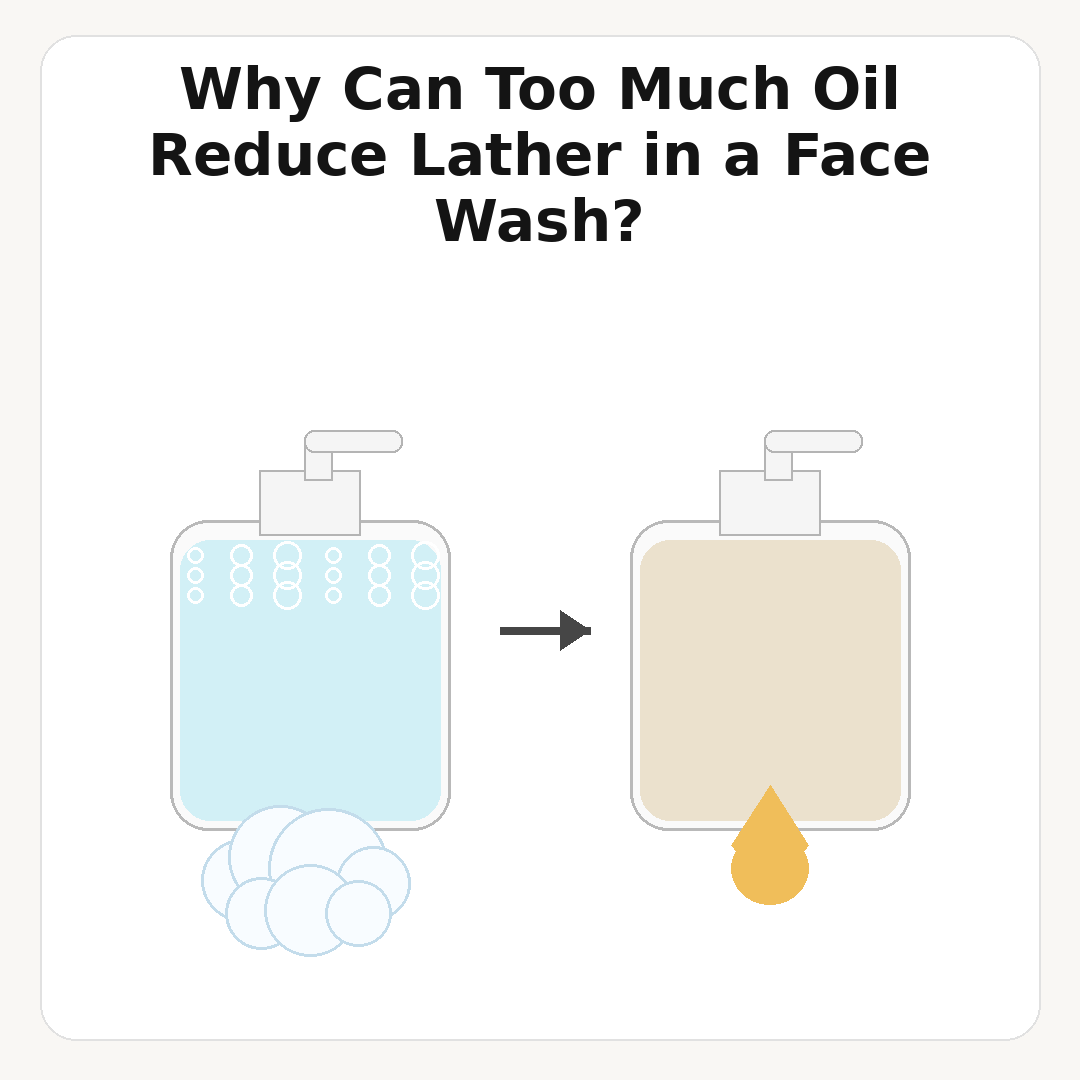
Too much oil can reduce the amount of lather a face wash produces.
This becomes particularly important when creating a moisturizing cleanser. Adding oil can contribute to a richer, more conditioning product concept, but increasing it too far can interfere with the foaming performance expected from a face wash.
The practical lesson is that moisturization and maximum lather do not always increase together.
Why Add Oil to a Face Wash at All?
A face wash is fundamentally a cleansing product.
Its main job is to remove dirt, sweat and sebum rather than behave like a leave-on moisturizer.
For dry or normal skin, however, you may want the cleanser to feel less stripping.
A moisturizing face wash can therefore include ingredients selected to improve the after-feel of the skin.
The workshop discusses a small oil component as one way of supporting that richer product concept.
Why Doesn’t More Oil Automatically Mean a Better Moisturizing Face Wash?
Because the product still has to function as a cleanser.
If you simply keep increasing rich ingredients because they sound moisturizing, the character of the wash begins to change.
One of the first effects you may notice is reduced lather.
This does not mean oil is unsuitable for a cleanser.
It means the oil needs to remain in balance with the cleansing system.
What Happened During the Workshop Demonstration?
During the moisturizing face-wash demonstration, more argan oil was accidentally added than intended.
I immediately pointed out that the batch could still be used, but the extra oil might reduce its lather.
When the product was tested later, it still foamed, but the example demonstrated the principle clearly:
adding more oil does not simply give you “more moisturization” without affecting anything else.
It changes the behaviour of the cleanser.
Can Shea Butter Be Used in a Face Wash?
The workshop discusses shea butter as another possible rich ingredient in this type of moisturizing cleanser.
But the same limitation applies.
A face wash is not a cream.
If the oil-and-butter portion becomes too large, foam is compromised.
So the ingredient may be useful, but it should not dominate the cleanser.
Why Is This Different From a Cream?
A cream is designed primarily around moisturizing and conditioning.
A face wash is designed primarily around cleansing.
The product has to be rinsed away and should still provide the cleansing and lather experience expected from a wash.
That is why an ingredient that can be used generously in a cream may need a very different approach in a cleanser.
Does a Moisturizing Face Wash Have to Contain Oil?
No.
The workshop also discusses ingredients such as glycerin and hydroxyethyl urea for moisturizing character.
Glycerin is described as a humectant rather than an oily ingredient.
This means a face wash can be designed to feel more comfortable without depending entirely on increasing oils.
That distinction is useful for oily skin as well.
A moisturizing ingredient does not automatically make a product greasy.
Is Lower Lather Always a Problem?
Not necessarily.
A creamy moisturizing cleanser may naturally have a somewhat different sensory profile from a very clear, strongly foaming cleanser.
The important question is whether it still cleans adequately and gives the intended user experience.
But if the product is supposed to behave like a conventional foaming face wash, adding so much oil that lather drops dramatically means the formula has moved away from that goal.
Why Should You Evaluate the Whole Product?
Every ingredient affects something.
An ingredient added for moisturization may influence:
- lather;
- clarity;
- texture;
- how easily the product rinses;
- how the cleanser feels during use.
This is why formulation should not become a process of simply adding every attractive ingredient.
The complete system needs to remain balanced.
The Practical Takeaway
A little oil can support the richer character of a moisturizing face wash.
Too much can reduce lather.
The useful principle is therefore not “more oil equals better moisturizing.”
It is:
Use enough richness to improve the cleansing experience without changing the product so much that it no longer behaves like the face wash you intended to create.
Related Topics
Do Sulfate-Free Face Washes Still Lather?
Why Are Some Face Washes Clear While Others Are Creamy?
Oily Skin vs Acne-Prone Skin: Do They Need the Same Face Wash?

