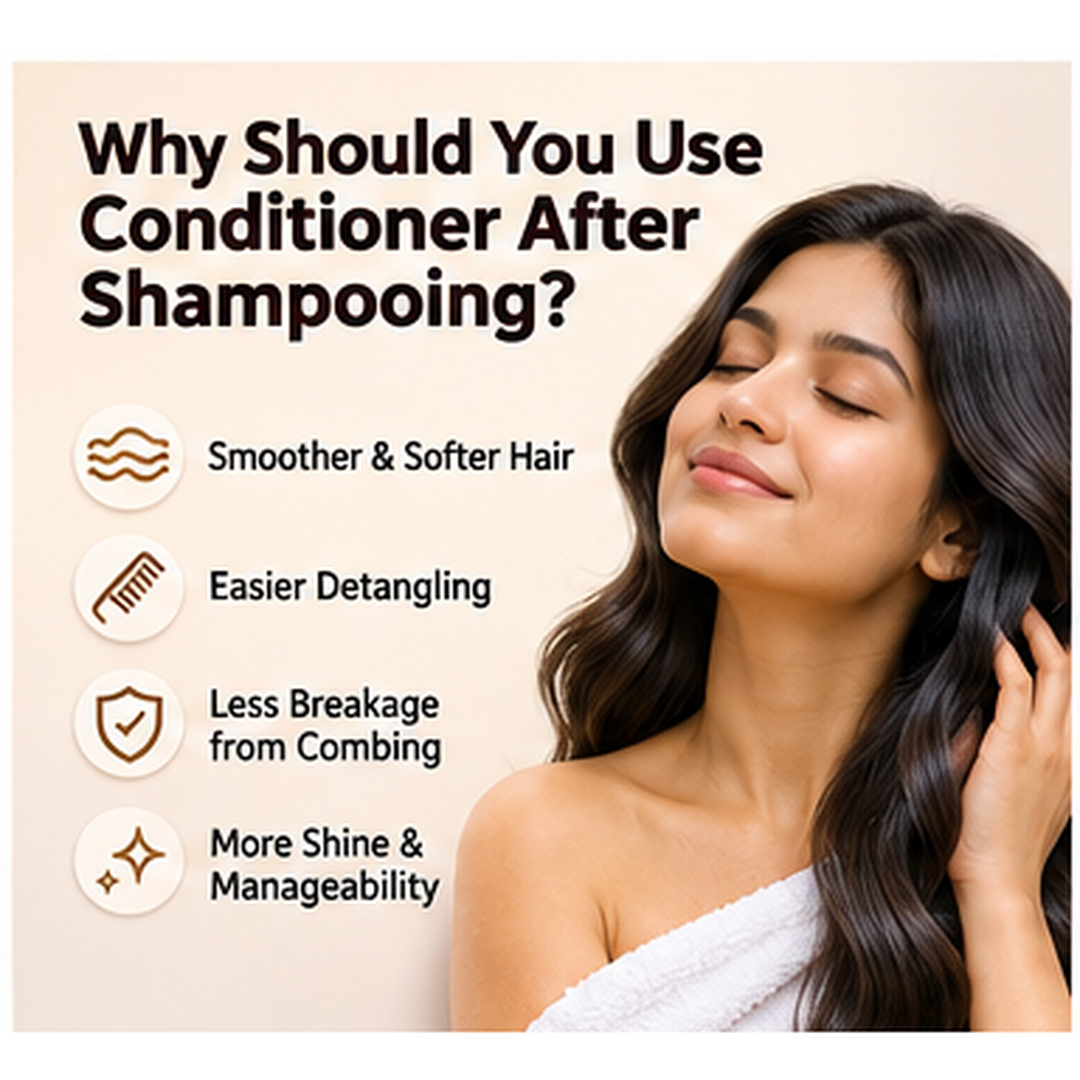
Conditioner is used after shampooing because cleansing can leave the hair feeling rough, tangled and frizzy. Shampoo performs the important job of removing dirt from the scalp and hair, while conditioner performs a different job: it helps the hair feel smoother, softer and easier to manage after cleansing.
Even if your hair is naturally soft or silky, conditioning can still be useful because the physical action of washing can cause individual strands to become tangled.
What Happens to Hair During Washing?
When you shampoo your hair, you are not cleaning only the scalp. The length of the hair is also exposed to dust, pollution, sweat and other deposits, so it needs cleansing as well.
A useful way to understand what happens after cleansing is to imagine the outer surface of the hair as having tiny structures that should lie smoothly.
Think of the fur on a teddy bear. When the fur lies neatly in one direction, it looks smooth. If you rub it in different directions, it begins to look rough and messy.
The same basic idea helps explain why freshly shampooed hair can sometimes feel rougher or look frizzier even though it is very clean.
Conditioner helps smooth this outer surface again.
Conditioner Does More Than Make Hair Feel Soft
Softness is only one reason to use conditioner.
After shampooing, strands can become tangled together. If you try to force a comb through tangled hair, you may pull at the roots or break strands along their length.
A conditioner improves slip and allows your fingers or comb to move through the hair more easily.
This can help with:
- detangling;
- easier combing;
- reducing breakage caused by pulling tangled strands;
- improving softness;
- improving shine;
- reducing a rough or frizzy feel.
Very clean hair is not necessarily pleasant hair. You can cleanse the scalp thoroughly and still dislike the result if the hair feels rough, tangled and difficult to manage.
Conditioning completes the hair-washing experience by improving how the hair feels after cleansing.
Do Naturally Silky Hair Types Still Need Conditioner?
They can.
A common misunderstanding is that conditioner is required only when someone naturally has dry, damaged or frizzy hair.
But shampooing itself involves rubbing and handling the hair. Even soft hair can become tangled during this process.
If the hair is already healthy and easy to manage, you may not need an extremely rich treatment. A mild conditioner may be enough to restore slip and make combing easier.
The purpose is not always to repair severely damaged hair. Sometimes the purpose is simply to prevent unnecessary tangling and rough handling after washing.
Why Not Just Use Hair Oil Instead?
Hair oil can make the hair appear smoother, shinier and less frizzy, but it can also make the hair look flat or greasy.
That may be useful as a treatment, but it is not always the finish you want immediately after washing your hair.
Conditioner provides a way to improve softness and manageability without necessarily creating the same heavily oiled appearance.
Can Conditioner Be Used Without Shampooing?
Sometimes.
If your hair feels sweaty but you do not want to shampoo again on consecutive days, you can rinse the hair with water and use a small amount of a suitable conditioner.
Conditioners contain emulsifying ingredients that can provide a small amount of cleansing action. However, this is not equivalent to shampooing.
For thorough cleansing, shampoo is still the stronger cleansing product.
The distinction is useful: conditioner may refresh and soften the hair, but it should not automatically be treated as a replacement for proper shampooing.
The Practical Takeaway
Shampoo and conditioner have different jobs.
Shampoo removes dirt. Conditioner helps make the freshly cleansed hair smooth, manageable and easier to comb.
If your hair feels clean after shampooing but also feels rough, tangled or frizzy, the missing step may simply be proper conditioning.
Related Articles
Hair Conditioner vs Hair Mask: What’s the Difference?