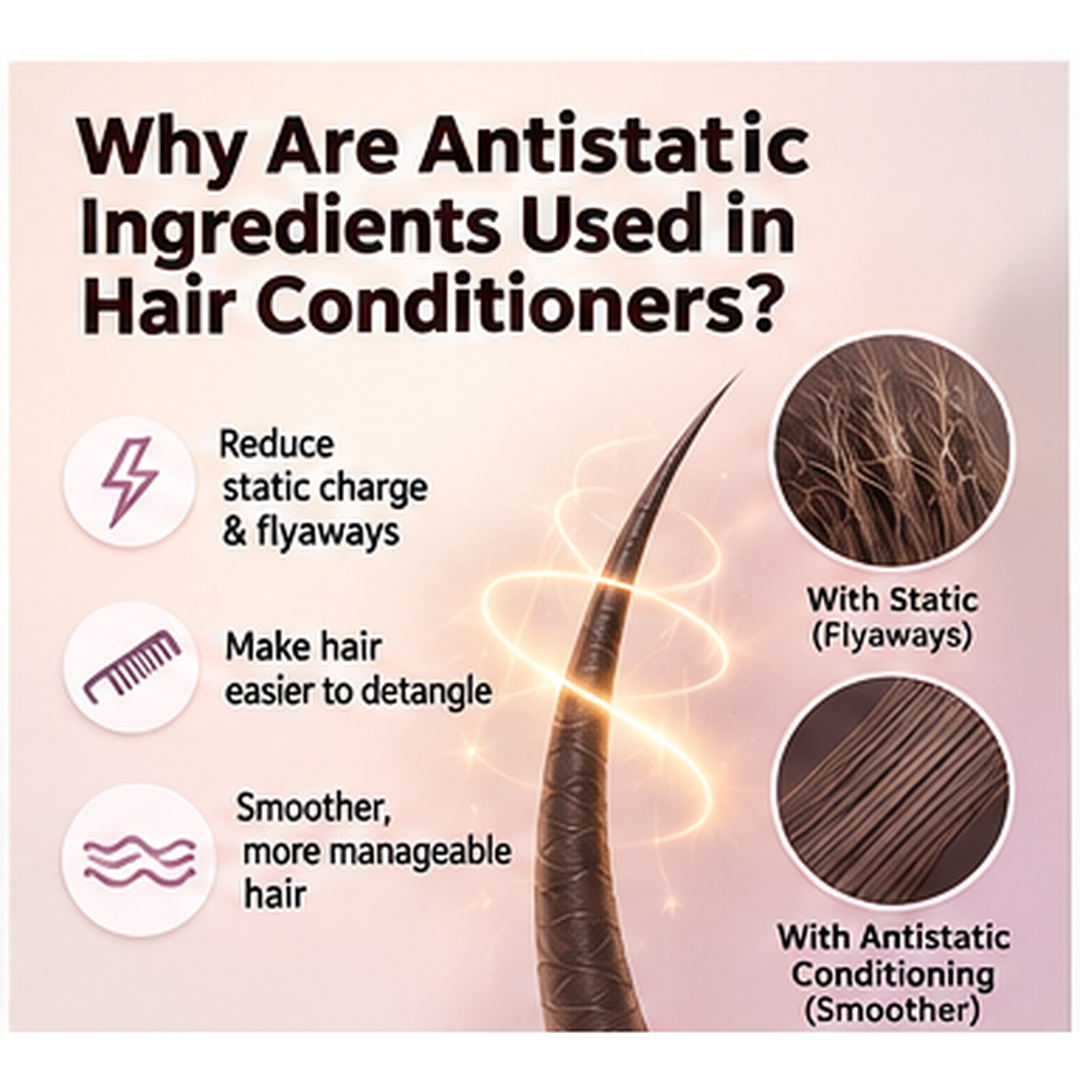
Antistatic ingredients are used in hair conditioners to help control static charge, reduce flyaway strands and improve detangling.
They contribute to the smooth, manageable feeling people expect after conditioning.
A conditioner is therefore not simply a mixture of oils, butters and moisturizing ingredients. Some of its most important functional ingredients are there specifically to improve the way individual strands behave.
What Does Static Look Like in Hair?
Think back to a simple school experiment: you run a comb repeatedly through your hair and then notice that strands become attracted to the comb.
The same type of static effect can make hair strands separate, fly around and become difficult to keep smooth.
This is particularly easy to notice when the hair appears full of flyaways.
Antistatic conditioning ingredients help reduce this charged effect so the strands settle more neatly.
How Does This Help With Detangling?
When hair strands settle and move more smoothly against one another, the hair becomes easier to comb.
This improves the practical conditioning experience.
Instead of forcing a comb through rough, tangled hair, you can move through the strands more easily. That reduces pulling and makes the hair feel softer and more manageable.
This is why antistatic action and detangling are closely connected in conditioning products.
Which Ingredients Provide This Effect?
Several conditioning ingredients discussed for this purpose include Cetrimonium Chloride, Polyquaternium-7 and Behentrimonium Chloride.
Cetrimonium Chloride is used particularly for antistatic and detangling effects.
Polyquaternium-7 also contributes to easier finger-combing, reduced roughness and improved hair feel.
Behentrimonium Chloride combines conditioning and emulsifying functions and also helps with softness and detangling.
The important point is not to reconstruct a formulation from these ingredients. It is to understand why professional conditioners contain ingredients that perform functions oils alone cannot necessarily provide.
Aren’t Natural Oils Enough?
Natural oils and butters can provide excellent nourishment and softness, but they do not necessarily give the same antistatic result.
I make this distinction because a product can feel rich and moisturizing yet still fail to give the smooth detangling performance someone expects from a conditioner.
A person may want a completely natural product, and certain conditioning ingredients can be omitted for that positioning. But the finished sensory result may not be identical.
That is an important formulation trade-off.
“Natural” and “high-performance detangling” are not automatically the same thing.
Why Does This Matter to the Consumer?
Most consumers do not describe their conditioner by saying, “I need an antistatic ingredient.”
They describe the result:
“My hair is easier to comb.”
“My hair isn’t flying everywhere.”
“My fingers move through it smoothly.”
“My hair feels less rough.”
Those experiences are exactly why antistatic and detangling ingredients matter.
The Practical Takeaway
A good conditioner is not judged only by how rich or moisturizing it feels.
It should also help individual strands behave better.
Antistatic ingredients contribute to the smoothness, detangling and manageability that make conditioned hair noticeably easier to handle.
Related Articles
Why Should You Use Conditioner After Shampooing?
Can You Apply Hair Conditioner to the Scalp?
Dry Hair vs Damaged Hair: Do They Need the Same Conditioner?