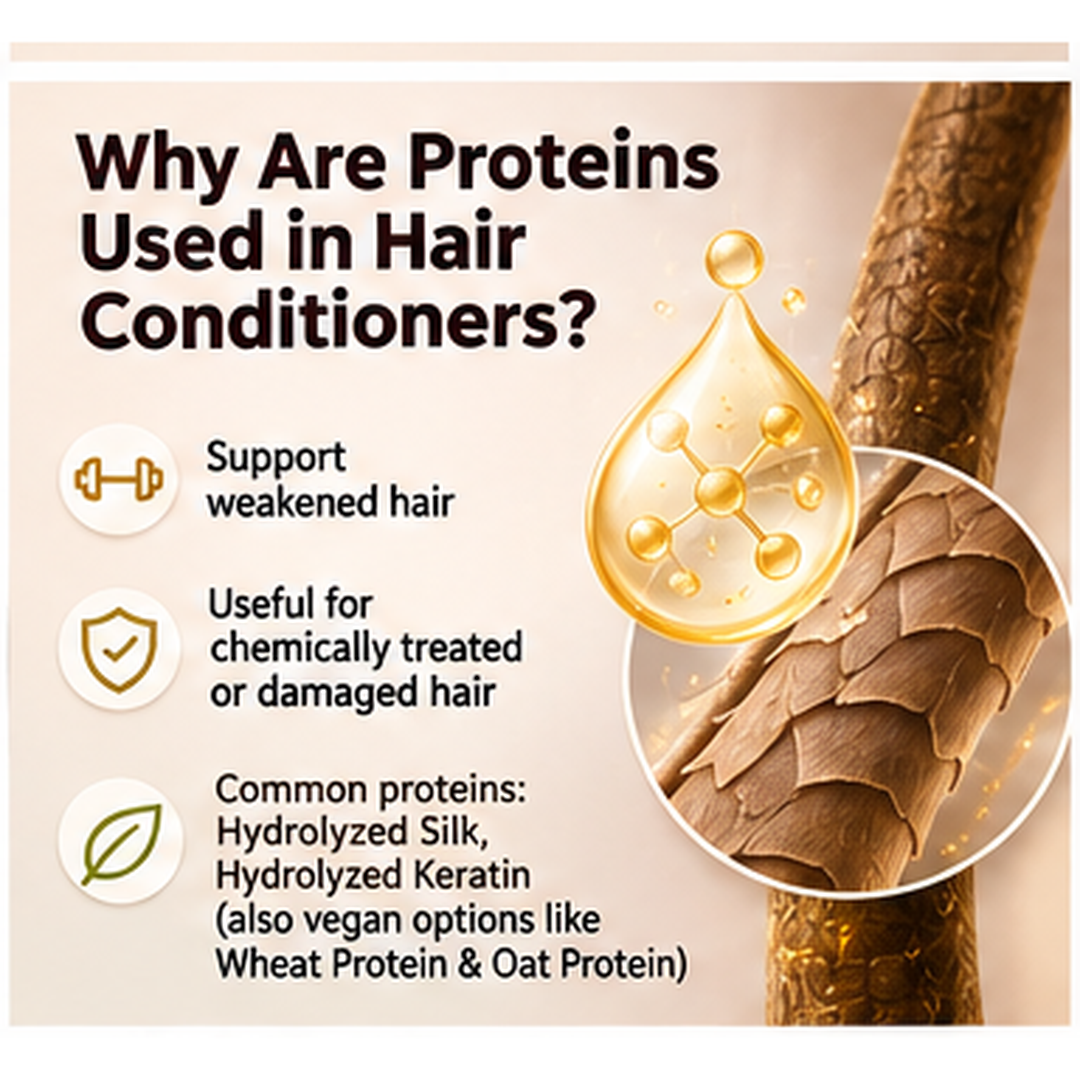
Proteins are used in certain conditioners and hair masks when the product is intended for weak, chemically treated or damaged hair.
The purpose is different from simply adding more oil or butter.
A moisturizing conditioner mainly focuses on softness and moisture, whereas a protein-focused conditioner is designed around hair that has become weak or damaged and needs a more repair-oriented treatment.
When Does Protein Conditioning Make Sense?
Protein conditioning is particularly relevant when hair has been affected by chemical treatments.
Hair that has undergone repeated processing may become:
- dull;
- rough;
- weak;
- frizzy;
- prone to breaking.
In this situation, simply making the product richer with more oils is not the only approach.
A protein conditioner adds protein-based ingredients to the conditioning system.
Which Proteins Are Used?
Hydrolyzed silk protein is used in the protein-conditioning concept discussed here.
Hydrolyzed keratin and hydrolyzed silk protein are also used together in the more intensive repair-mask concept.
These ingredients are used when the objective is to support the protein structure of damaged hair while still providing the softness and detangling expected from a conditioner.
Are There Vegan Protein Options?
Yes.
Wheat protein and oat protein are discussed as vegan alternatives to silk protein.
In the workshop approach, silk protein is considered the stronger option, while the plant proteins are alternatives for someone who wants a vegan formulation.
The important distinction is that the product’s positioning changes according to the protein selected and the type of customer the product is intended for.
Does Protein Replace Moisturizing Ingredients?
No.
Damaged hair can still need moisture.
A protein conditioner is not simply a protein solution. It is still a conditioning product.
The hair still needs softness, glide, detangling and moisture alongside the repair-focused ingredients.
This is why “protein” and “moisturizing” should not automatically be treated as opposites.
The difference is where the main treatment emphasis is placed.
Do All Hair Types Need a Protein Conditioner?
Not necessarily.
If the main concern is simply dry, rough or frizzy hair, a moisturizing conditioner or hair mask may be the more direct choice.
Protein becomes particularly relevant when the hair has been weakened by chemical treatment or is showing the type of damage and breakage discussed above.
Choose according to the condition of the hair rather than assuming that more active ingredients always mean a better conditioner.
Protein Conditioner vs Repair Hair Mask
A protein conditioner can provide repair-focused conditioning as part of a regular hair-washing routine.
A more intensive repair mask takes the concept further and is used as a longer treatment for more damaged hair.
Both still need to perform the essential jobs of conditioning: making the hair easier to handle, softer and more manageable.
The Practical Takeaway
Protein ingredients have a specific role.
They are most useful when the hair-care goal extends beyond simple moisturization and includes chemically damaged, weakened or breaking hair.
Start by identifying the actual hair concern, then decide whether you need mainly moisture, protein-focused repair, or a combination of both.
Related Articles
Dry Hair vs Damaged Hair: Do They Need the Same Conditioner?
Can You Use Conditioner After Keratin or Straightening Treatments?