
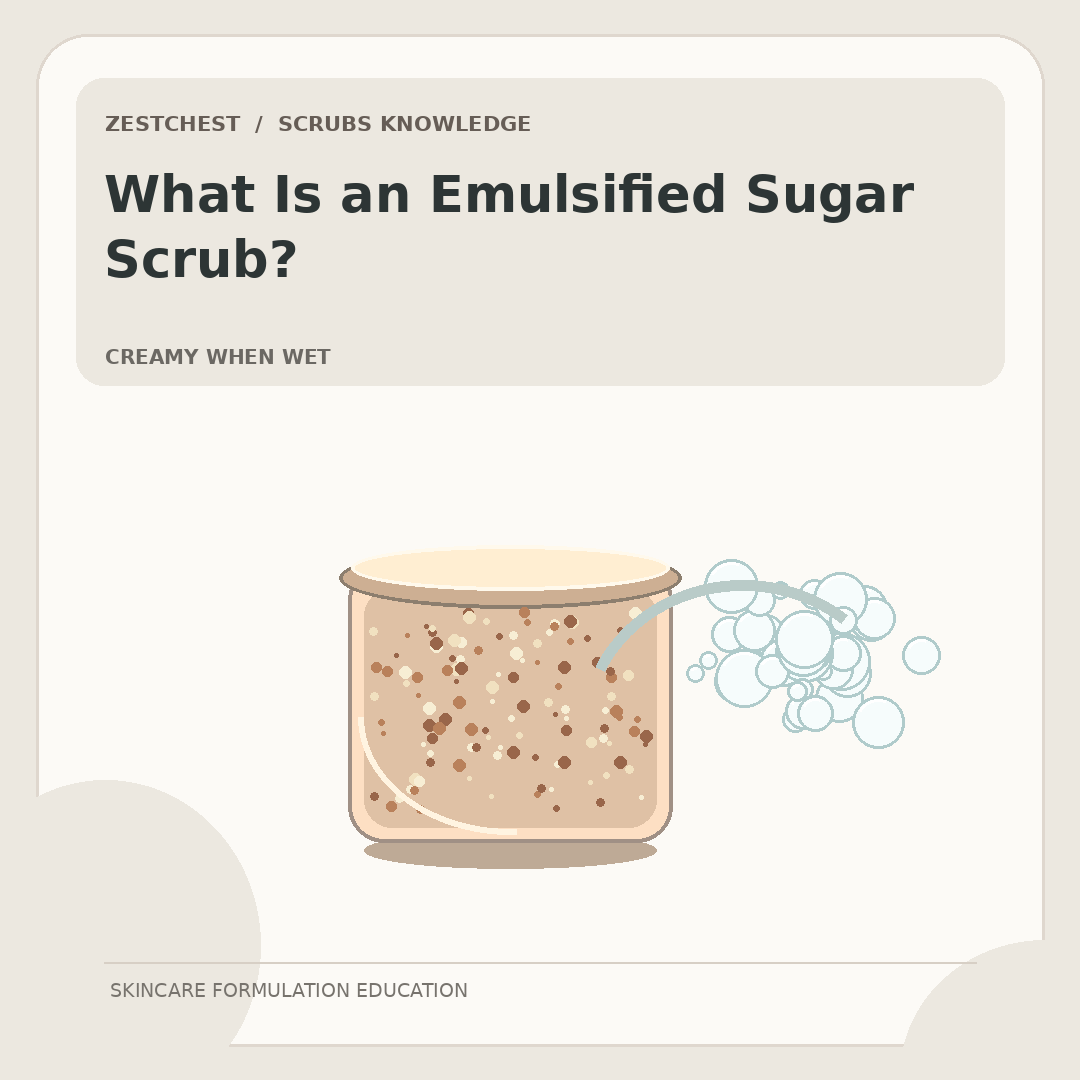
An emulsified sugar scrub is a body exfoliating product that combines sugar crystals with a base designed to become creamy when it comes into contact with water.
Unlike a conventional oil-rich scrub that may leave a greasy feeling after rinsing, an emulsified scrub creates a cream-like experience on wet skin.
It allows the user to enjoy the richness of oils and butters while making the product easier to rinse away.
What Does Emulsified Mean in a Sugar Scrub?
The word emulsified refers to the way the scrub’s base interacts with water.
An emulsified sugar scrub contains ingredients that help the oils in the product interact with water during use.
When the scrub is applied to wet skin, the base begins to feel creamy.
At the same time, the sugar crystals gradually dissolve and provide exfoliation.
These two characteristics create the distinctive experience of an emulsified sugar scrub.
Why Does an Emulsified Scrub Become Creamy?
The scrub base contains an emulsifying ingredient.
Its function is different from that of the sugar crystals.
The sugar provides the physical exfoliating action, while the emulsifying ingredient contributes to the creamy texture that develops when the product meets water.
This is especially useful in oil-rich scrubs.
Without a suitable emulsifying characteristic, a rich oil-containing product may leave a heavy sensation after rinsing.
An emulsified scrub is designed to provide a softer, moisturised feeling without the same level of greasiness.
How Is It Different From an Ordinary Sugar Scrub?
The difference becomes particularly noticeable during rinsing.
An ordinary oil-based scrub may continue to feel oily on the skin.
An emulsified scrub develops a lotion-like character when water is introduced.
During the practical demonstration, the scrub changes from a rich, grainy product into a creamier material on wet skin.
This transformation is one of its main advantages.
It combines the experience of physical exfoliation with the after-wash feel of a moisturising body-care product.
What Role Do Oils and Butters Play?
Oils and butters contribute to the richness and conditioning characteristics of the scrub.
Shea butter, cocoa butter and mango butter are examples discussed in the workshop.
Different oils may also produce different sensory characteristics.
Some feel lighter, while others create a richer sensation.
I prefer thinking about the finished skin feel rather than simply selecting the greatest number of oils or butters.
A product containing too many heavy ingredients may feel excessively greasy.
The objective is a comfortable balance between exfoliation, richness and rinsability.
Why Does the Sugar Gradually Disappear?
Sugar is water-soluble.
When an emulsified sugar scrub is massaged onto wet skin, the sugar crystals gradually dissolve.
As this happens, the grainy sensation becomes weaker.
I use this as a practical observation during scrub application.
When the sugar has dissolved, the physical scrubbing action is effectively coming to an end.
There is no need to continue rubbing aggressively.
Is an Emulsified Sugar Scrub Suitable for the Face?
Not automatically.
An emulsified scrub may feel creamy, but its sugar particles can still be too large for delicate facial skin.
The body scrub demonstrated in the workshop is intended for the body and feet because of the size of its sugar crystals.
A creamy base should never be confused with a mild exfoliating action.
The defining feature of an emulsified sugar scrub is its ability to provide grainy exfoliation during application and a creamy, more comfortable rinse afterwards.

