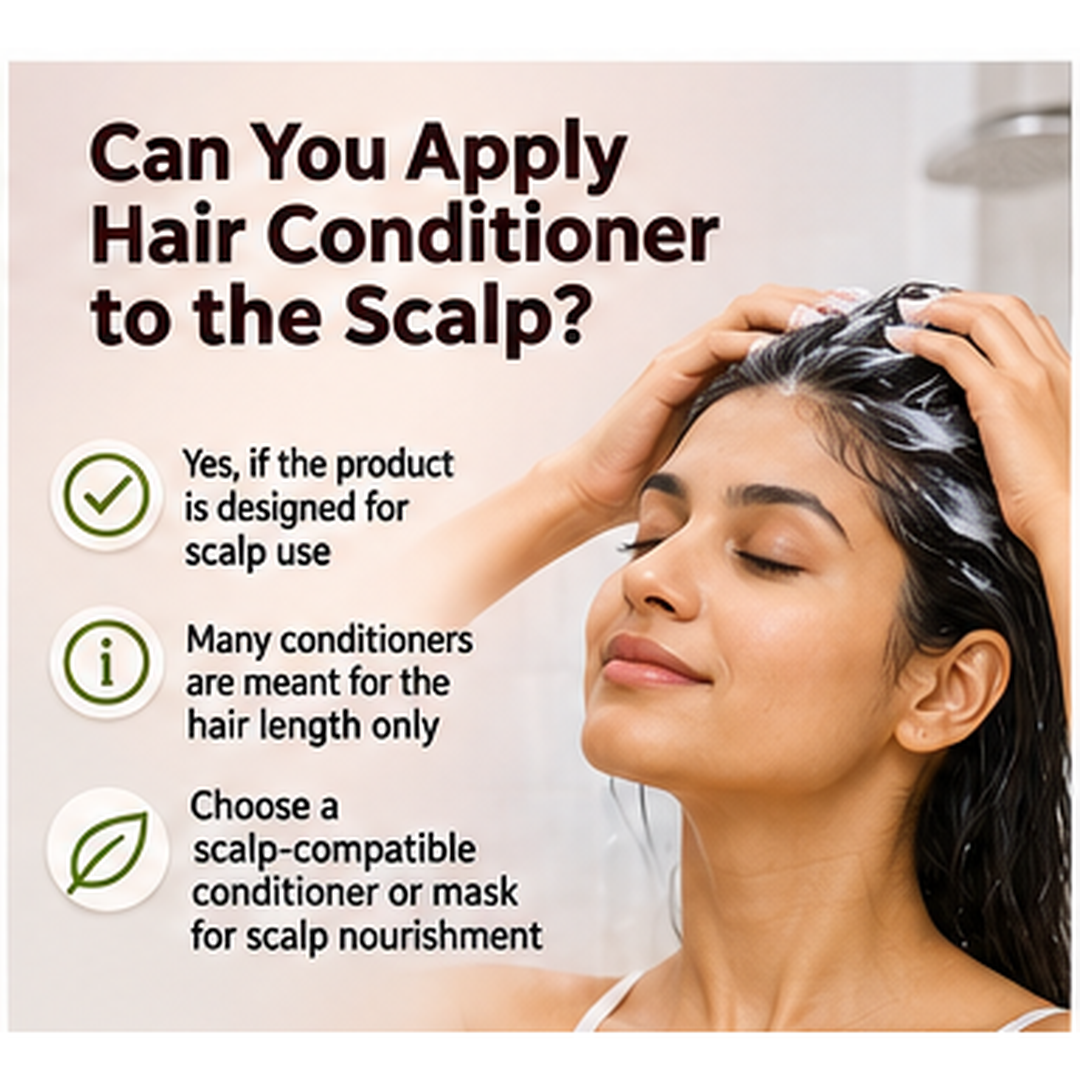
Some hair conditioners can be applied to the scalp, but not every conditioner is designed for scalp use.
Many commercial conditioners are intended mainly for the length of the hair. Other conditioning products can be designed specifically for application on both the scalp and the hair.
The important question is therefore not simply, “Can conditioner touch the scalp?” It is, “Was this particular product designed to be used there?”
Why Are Many Conditioners Applied Only to the Hair Length?
A regular conditioner is often designed primarily to improve the condition of the hair strands.
Its functions may include:
- detangling;
- reducing static;
- improving softness;
- adding shine;
- making combing easier.
These are primarily hair-length concerns.
This is why many commercial conditioner instructions tell you to concentrate the product on the mid-lengths and ends rather than massage it into the scalp.
When Does Scalp Application Make Sense?
Scalp application makes sense when the conditioning product has been intentionally designed as a scalp-and-hair treatment.
The conditioners and masks discussed here include products that can be applied to both the scalp and hair length.
A scalp-focused product may contain ingredients selected for scalp nourishment as well as ingredients used to condition the hair.
The aromatherapy hair mask is a good example of a treatment where more attention is given to the roots and scalp. A thicker layer can be applied to the scalp, massaged well and then spread along the remaining hair length.
What About Anti-Hairfall Conditioners?
If you are talking about a product intended for hair fall originating at the root, the product needs to reach the scalp.
A conventional conditioner used only on the hair length does not reach the area where that concern begins.
This is why I would distinguish between a normal detangling conditioner and a scalp-compatible conditioning treatment.
A conditioner can certainly reduce hair breaking or being pulled during combing because it makes tangled hair easier to manage. But that is different from positioning a product for root-level hair fall.
Is Scalp Conditioning the Same as Shampooing?
No.
A conditioner may contain emulsifying ingredients that provide a small amount of cleansing, but it does not provide the same thorough cleansing as shampoo.
If the scalp is dirty and requires proper washing, shampoo is still the main cleansing step.
However, on a day when the hair simply feels sweaty and you do not want another full shampoo, rinsing and using a suitable scalp-compatible conditioner may give a fresher, softer feel.
Conditioner and Hair Mask Application Are Not Always the Same
A quick conditioner may be applied briefly after shampooing and rinsed away.
A scalp-focused mask is generally treated more like a spa treatment. It can be massaged into the scalp, applied through the hair and allowed to remain for longer before rinsing.
This is why reading the intended use of the product matters.
Two products may both be called “conditioners,” yet one may have been developed mainly for hair length while another may have been designed for scalp and hair application.
The Practical Takeaway
Do not assume that every conditioner should be massaged into the scalp, and do not assume that conditioner must always stay away from the scalp.
Use the product according to its design.
If scalp nourishment is the goal, choose a conditioner or mask specifically intended for scalp application.
Related Articles
Why Should You Use Conditioner After Shampooing?
Hair Conditioner vs Hair Mask: What’s the Difference?
Can You Use Conditioner After Keratin or Straightening Treatments?