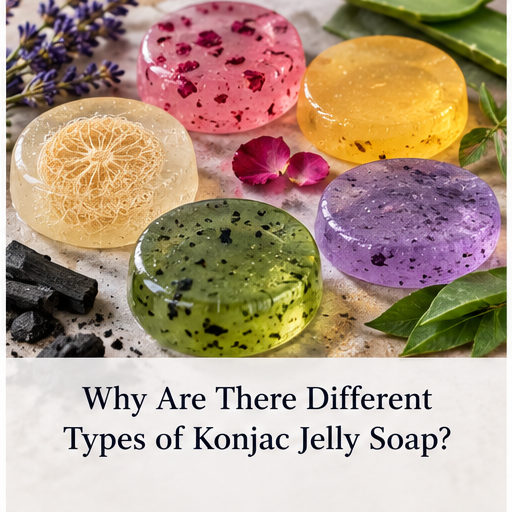
Konjac jelly soap does not have to be one fixed product.
The jelly format can be adapted for different skin-care purposes by changing the skin-focused ingredients while preserving the broader cleansing and jelly concept.
The workshop uses four examples: skin-brightening, anti-acne, de-tan/brightening and saffron jelly soaps.
The Product Purpose Determines the Skin-Focused Ingredients
A useful way to think about cosmetic ingredients is not simply to ask whether they are “good for skin.”
Ask instead:
What is this particular version of the product intended to do?
An ingredient that makes sense in an anti-acne product may not be the ingredient you choose when the main purpose is brightening or pigmentation.
The intended purpose therefore guides ingredient selection.
Brightening Jelly Soap
Niacinamide is used primarily as a skin-brightening and de-tanning ingredient.
I discuss it in relation to tan, pigmentation, freckles, dark circles and uneven darkness.
It is also associated in the workshop with moisturising, anti-ageing and acne-control benefits, but its main role in this particular product direction is brightening.
De-Tan and Pigmentation-Focused Jelly Soap
Arbutin provides another brightening approach.
Alpha arbutin is used in the demonstrated concept, although beta arbutin is also discussed.
I use arbutin in relation to pigmentation, freckles, tan, dark patches and other areas of skin darkness.
In the de-tan concept, niacinamide and alpha arbutin are selected around the same broad objective of creating a brighter-looking skin appearance.
Anti-Acne Jelly Soap
The anti-acne concept uses a different type of ingredient selection.
Neem extract is used for anti-acne and antibacterial benefits.
Activated charcoal is used for its detoxifying and deep-cleansing character and is discussed in relation to impurities, pore cleansing and the clogging associated with blackheads and whiteheads.
The important qualification is that activated charcoal is not described as removing an already tightly formed blackhead or whitehead. Its role is discussed more in relation to helping reduce the clogging that contributes to their formation.
Saffron Jelly Soap
Saffron offers another skin-brightening direction.
It is discussed in relation to brightening, the appearance of skin tone, acne, acne scars and an anti-ageing or tightening effect.
Liquorice extract is also associated with acne marks, dark spots, pigmentation and tan.
This gives the saffron version a different ingredient story from the other brightening concepts even though some of the intended benefits overlap.
The Format Can Support Other Ideas Too
The four examples are not presented as the only possible jelly soaps.
Other possibilities discussed include:
- rose;
- neem;
- green tea;
- clay-based variations;
- herbal powders;
- and other extracts.
Red clay, green clay and kaolin are examples mentioned for clay-based concepts.
The important point is not that every ingredient should be placed into one product.
The jelly format acts as a platform, while the ingredient selection should follow the intended skin-care purpose.
The Practical Takeaway
There is no single universal konjac jelly soap.
The better question is not, “Which ingredients are good for jelly soap?”
It is:
“What should this particular jelly soap do?”
Once that purpose is clear, the skin-focused ingredients can be chosen to support it.
Related Jelly Soap guides
→ Why Is Konjac Root Powder Used in Jelly Soap?
→ What Is Japanese Konjac Jelly Soap?
For a broader introduction to Japanese konjac jelly soap, its ingredients, structure, variations and formulation principles, read our complete guide: Japanese Konjac Jelly Soap: Benefits, Ingredients & How It Works.