
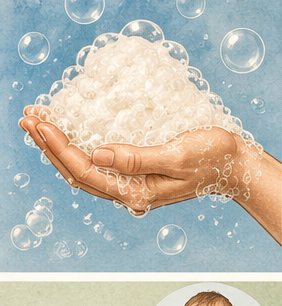
Not necessarily. Lather is an important part of how a cleanser feels to use, but the amount of visible foam should not be treated as the only measure of whether a liquid Castile soap is suitable for its job. The workshop repeatedly separates lather, cleansing and thickness as different properties.
Why people notice lather
Visible lather matters because people often expect it. A cleanser can be nourishing or otherwise acceptable, yet still feel unsatisfying if it does not create the sensory experience the user expects. This is particularly relevant when comparing different oils. Castor-oil soap, for example, is discussed as nourishing but not as a soap that produces the bubbling lather many users expect.
Coconut oil shows how dramatic lather can be
Coconut-oil Castile soap produces very high lather as well as high cleansing. It can also be extremely thin. This is a useful demonstration that a watery-looking cleanser can still foam strongly and clean effectively.
But maximum foam is not always the goal
The intended use matters. A floor cleaner is a good example. Excessive foam on a floor can be inconvenient and potentially slippery. In that situation, the goal is effective cleansing rather than producing the greatest possible amount of visible lather.
Dilution can change the experience
The workshop also discusses how dilution affects lather. Glycerin can contribute a more moisturizing feel and additional thickness, but as a soap is diluted further, whether with water or glycerin, the lather can reduce. That means the final sensory result involves balancing several properties rather than maximizing only bubbles.
A non-foaming cleanser can still be intentional
Castor-oil soap provides another useful contrast. On its own it does not give the kind of bubbling foam many people expect, but it is discussed as an option where a non-foaming face cleanser is actually desired. In that case, low foam is not automatically a defect; it is part of the intended product character.
A useful way to judge lather is therefore by context. Ask whether the foam level suits the product and the user expectation. More bubbles can be desirable in some cleansers, unnecessary in others, and actively inconvenient in certain household applications.
Related Guides
Liquid Castile Soap Explained: Oils, Uses, Lather, Thickness and Common Questions
Learn how oils influence the lather, cleansing, consistency and intended use of liquid Castile soap.
Explore the Liquid Castile Soap Learning Hub
Explore all our educational resources about liquid Castile soap.
Olive Oil vs Coconut Oil in Liquid Castile Soap: What Is the Difference?
Compare an oil associated with milder cleansing and lather with one that produces much stronger cleansing and abundant foam.
Why Is Some Liquid Castile Soap Thick While Other Castile Soap Is Thin?
Discover why a watery-looking soap can produce tremendous lather while a much thicker soap can be milder.