
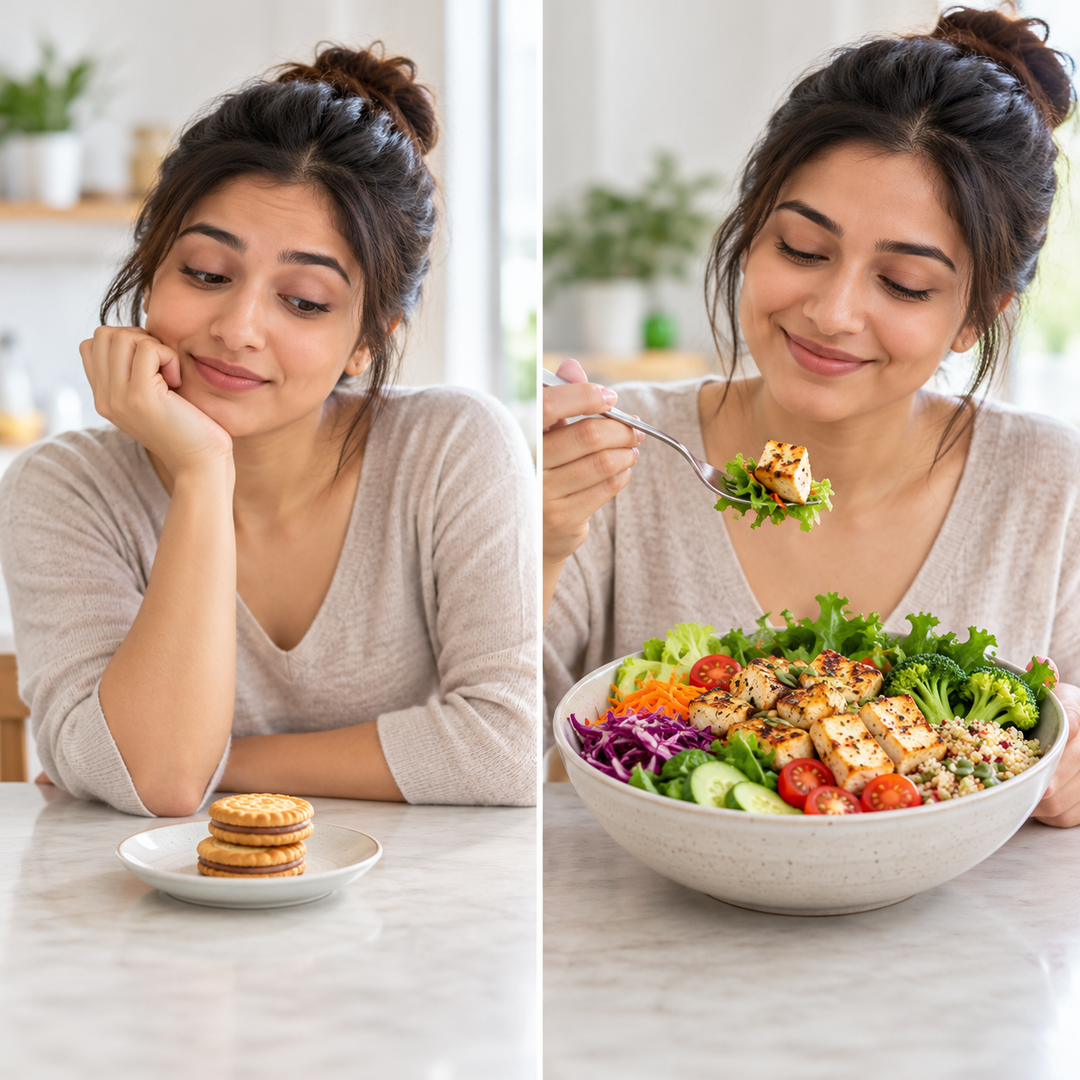
No. In the way I teach weight management, eating less food is not the same as eating for weight loss. The more useful approach is to understand how much calorie a food brings compared with how much it actually satisfies you. You can eat enough to feel full while choosing foods that are less calorie-dense.
Dieting Should Not Mean Staying Hungry. One of the older ideas of dieting was to eat very little, live on salad, and tolerate hunger. I do not recommend that approach. If you are constantly hungry and stressed about food, the routine becomes difficult to continue.
I prefer to separate two ideas: the amount of food on the plate and the calorie load of that food. A small amount of a calorie-dense food can contribute more calories than a much larger portion of vegetables or salad. That means you can sometimes eat a larger volume of food while still keeping the overall calorie intake under control.
Food Volume and Calorie Load Are Not the Same Thing. A practical example from the workshop is the comparison between a cream biscuit and a bowl of vegetables with a protein source such as paneer, tofu or chicken. The biscuit may contribute a significant calorie load without satisfying hunger for very long. A larger bowl of vegetables can physically fill the stomach much more effectively.
The same reasoning applies to snacks. Peanuts and groundnuts were discussed as calorie-dense foods. Makhana was suggested as something to compare when you want a lower-calorie snack. The point is not that one food is forbidden forever. The point is to compare your usual choices and understand which one gives you more food volume for fewer calories.
Compare Foods Instead of Following One Fixed Diet Chart. I do not like giving one identical diet chart to everybody. Some people depend on rice. Some eat chapati. Some are vegetarian and some are non-vegetarian. A useful eating plan has to work with the person’s normal cuisine.
Instead of memorizing one list of allowed and forbidden foods, compare the foods you actually eat. Look at the approximate calorie value of the portion you normally consume and then decide where a lower-calorie choice can replace a higher-calorie one.
In the workshop I used examples such as rice, breads made from grains such as bajra or jowar, quinoa, brown rice, nuts, fried foods and vegetables. The teaching point was always the same: make the choice consciously rather than simply assuming that a food is healthy or unhealthy because of its name.
Fruits Still Need to Be Considered. Fruits can be part of the diet, but I do not treat all fruit as though it contributes no calories. Sweet fruits contain sugar, so they still need to be considered when someone is trying to control calorie intake. Vegetables were discussed as especially useful because many of them allow a person to eat a satisfying amount without the same calorie density.
The Practical Way to Think About Diet Control. When you are hungry, the solution is not automatically to skip food. Ask what will satisfy you with a lower calorie load. A large vegetable-based meal may make much more sense than repeatedly eating small, calorie-dense snacks that do not actually remove hunger.
Key takeaway: Weight management should not feel like continuous deprivation. The practical goal is to eat enough to feel satisfied while becoming more aware of which foods bring a large calorie load in a small amount.

