
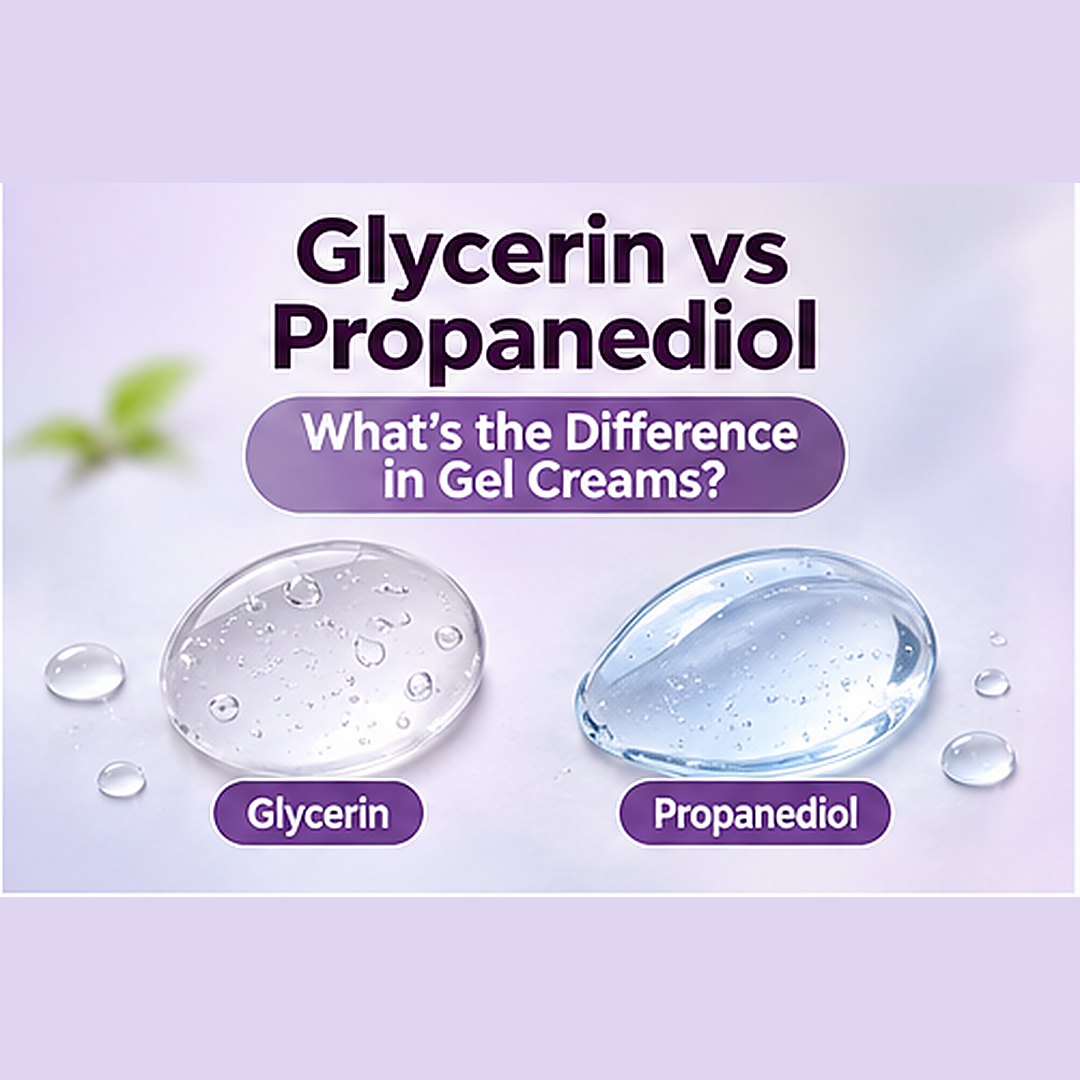
Glycerin and propanediol are both moisturising ingredients used in gel-creams, but they differ in skin feel and additional functions.
Glycerin is valued for attracting moisture and maintaining hydration. Propanediol also provides moisturisation but is described as having a lighter, less sweaty feel and an additional role as a penetration enhancer.
Both are useful, but their characteristics may influence which one is preferred in a finished skincare product.
What Does Glycerin Do in Skincare?
Glycerin is a humectant.
A humectant is an ingredient that helps attract moisture.
Glycerin is discussed as drawing moisture from the surrounding environment and helping maintain moisture at the skin.
The purpose is to reduce dryness and improve hydration.
An important advantage is that glycerin provides moisturisation without being an oil.
This is particularly useful in skincare products developed for people who dislike excessively oily textures.
Why Can Glycerin Feel Heavy or Sweaty?
Although glycerin is not an oil, some people find that products containing it create a slightly sweaty or heavier sensation.
The workshop associates this feeling with glycerin’s moisture-attracting properties.
This does not mean glycerin is a poor moisturising ingredient.
It means that a useful ingredient may still influence the product’s sensory characteristics.
Someone with dry skin may appreciate a highly moisturising product but dislike a sticky or sweaty finish.
In that case, skin feel becomes an important consideration.
What Does Propanediol Do?
Propanediol is also used for moisturisation.
It is discussed as having a lighter feeling on the skin compared with glycerin.
An additional function is its role as a penetration enhancer.
In this context, a penetration enhancer is selected to support the intended action of other ingredients used in the skincare product.
This makes propanediol relevant to products containing specialised active ingredients.
Which Ingredient Is More Moisturising?
Both ingredients are discussed as providing useful moisturisation.
The distinction is not simply that one works and the other does not.
Glycerin is associated with strong moisture-attracting properties, while propanediol is preferred when a lighter sensory feel is desired.
The choice therefore depends partly on the experience intended for the finished product.
Why Is Propanediol More Expensive?
The workshop identifies propanediol as more expensive than glycerin.
This creates a practical consideration when evaluating cosmetic ingredients.
A higher-priced ingredient may have a desirable sensory characteristic or additional function, but it does not automatically mean that the lower-priced alternative is ineffective.
The intended product experience should justify the ingredient choice.
Which Is Better for Korean Boba Cream?
Korean Boba Cream is intended to combine moisturisation with a relatively lightweight texture.
Both glycerin and propanediol are relevant to that objective.
The preferred sensory characteristics help determine which ingredient is more suitable.
For example, a product designed to minimise the feeling of heaviness may benefit from attention to humectant selection.
The practical distinction is that glycerin and propanediol both support hydration, while propanediol is also discussed for its lighter skin feel and penetration-enhancing role.

