
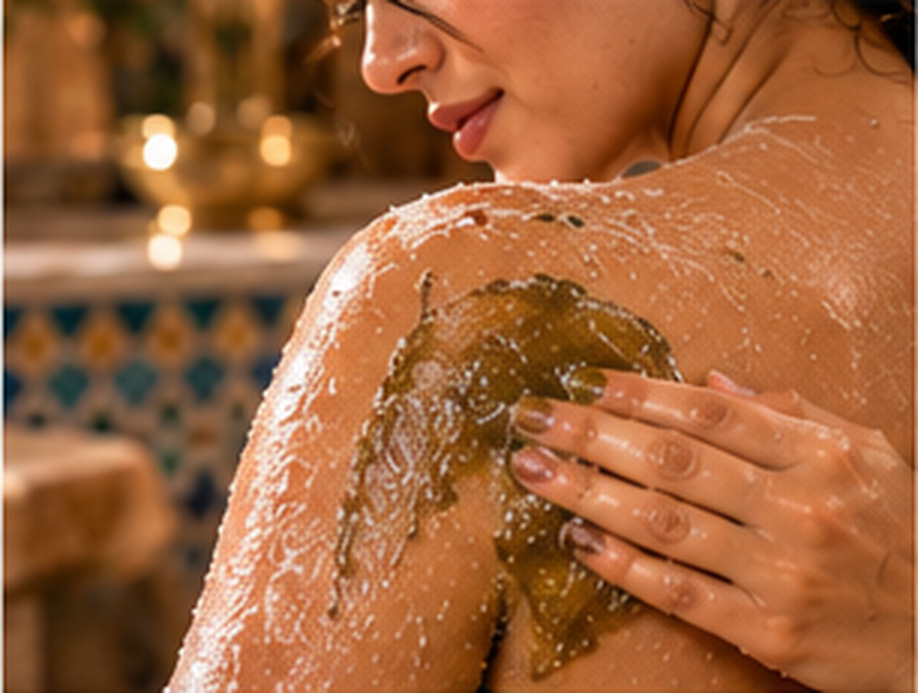
Traditional Beldi soap approaches exfoliation through massage rather than relying on rough particles. The idea is to rub the creamy soap over the skin long enough to support gentle removal of dead skin and a deeper cleansing experience.
Exfoliation is not always about a gritty texture
When we hear “scrub,” we often imagine visible grains. Traditional Beldi soap was presented as a different approach. It did not need a collection of scrub particles to give the skin an exfoliating treatment. Instead, the product was massaged and rubbed onto the skin while it became creamier.
Why the massage matters
The longer rubbing motion is central to the ritual. A cleanser that foams strongly may be rinsed away almost immediately; the traditional Beldi experience makes the massaging step more prominent. That is why a low-foam product can be intentional rather than a flaw.
What about physical scrub versions?
Beldi soap can also be adapted into a physical scrub by introducing scrub particles. The workshop discussed using these for tougher areas, such as feet and legs, where a different scrubbing experience may be wanted. However, this is a variation rather than an essential characteristic of the traditional paste.
Do you need a special glove?
A student asked whether a special glove was necessary for use. The answer was no. The traditional hammam-style ritual may use a scrubbing glove, and an ordinary loofah can also be used, but a specialised glove is not a compulsory part of applying Beldi soap. The emphasis remains on the rubbing and massage.
A product does not need visible grit or abundant foam to serve as part of an exfoliating bath. With traditional Beldi soap, the application method is a large part of the experience.