
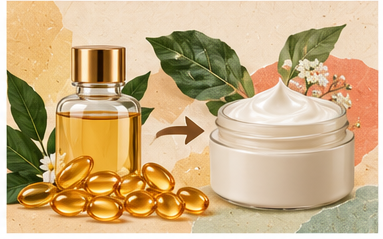
A bottle labelled “vitamin E oil” is not necessarily the same thing as concentrated vitamin E. It may be a base oil containing only a small amount of vitamin E, so the ingredient name on the front of the bottle does not by itself tell you what you are actually buying.
Why the label can be misleading
An ingredient may be supplied pure, concentrated, diluted or carried in another material. Those forms are not automatically interchangeable because the amount and behaviour of the useful ingredient can be different.
Vitamin E is the clearest example discussed. A product sold as vitamin E oil may actually be a carrier or base oil with some vitamin E in it, while concentrated vitamin E is a different material.
The same principle applies beyond vitamin E
A similar caution is raised with glutathione. An “odourless” material may not behave like the concentrated ingredient discussed in the workshop. The point is not to judge quality by smell alone, but to recognise that different supplied forms can behave differently.
What to look for when buying ingredients
Understand the material rather than relying only on the attractive ingredient name on the front label. Ask what form it is in and whether it is diluted or carried in another oil. That information changes what the material can contribute to a finished product.
Why this matters even for consumers
The same thinking helps when reading cosmetic claims. Seeing a familiar ingredient name does not tell you how central that ingredient is to the product. The useful habit is to distinguish the name of an ingredient from the actual form in which it is being used.