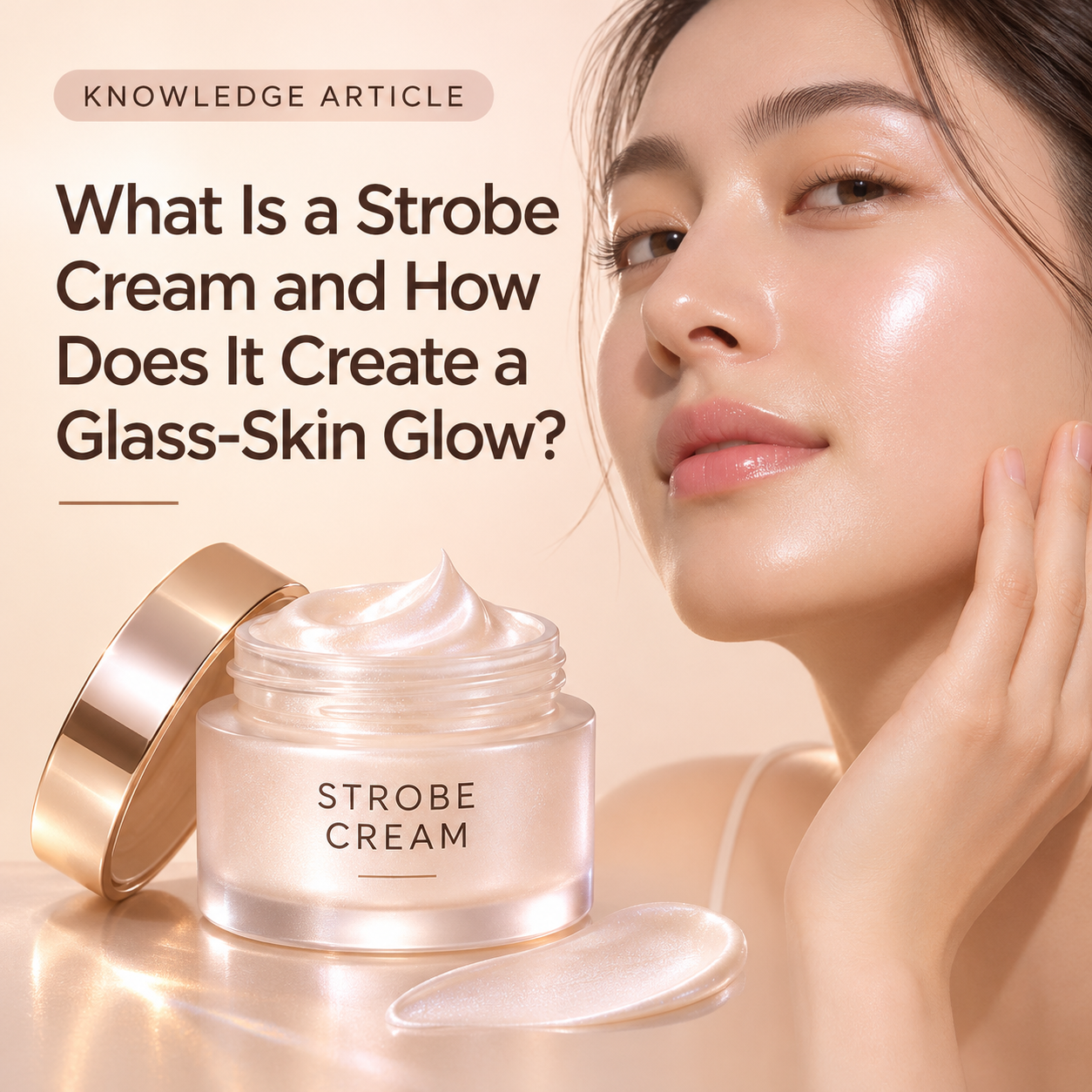
A strobe cream is a skincare-and-makeup product designed to give the skin an immediate luminous appearance. Its distinctive glow comes from light-reflecting mica on the skin surface, not from the skin literally becoming glass-like.
Why the glow looks different in different lighting
Look at the glossy appearance often seen in photographs or videos. Light catches selected areas of the face, creating a smooth, illuminated look. A strobe product can produce that effect even though the underlying skin has not changed in the moment. In a darker room the reflection becomes less visible; under a bright light it is much more noticeable. The effect is therefore partly about where light falls and how the surface reflects it.
What makes it different from an ordinary moisturiser
A moisturiser is chosen primarily for its skincare function. A strobe cream can provide moisturisation too, but adds an immediate visual effect. Ingredients such as niacinamide, alpha-arbutin and panthenol may be included for their intended skincare roles; they do not account for the instant shimmer. A conventional anti-pigmentation product may not visibly change the skin as soon as it is applied, whereas a strobe cream may appear luminous straightaway because of mica.
Where and when it can be used
A strobe cream may be applied to the face, neck or body, and can be worn for an ordinary daytime outing, work or an evening event. The amount and finish depend on whether the goal is a restrained glow or a more noticeable highlight. I prefer thinking of it as an appearance-enhancing product that can also carry skincare ingredients, rather than treating the immediate reflective effect as proof of a change in pigmentation.
The useful distinction
Visible radiance and skincare improvement are two separate things. The first depends on reflected light; the second depends on the other functional ingredients and the skin concern being addressed.