
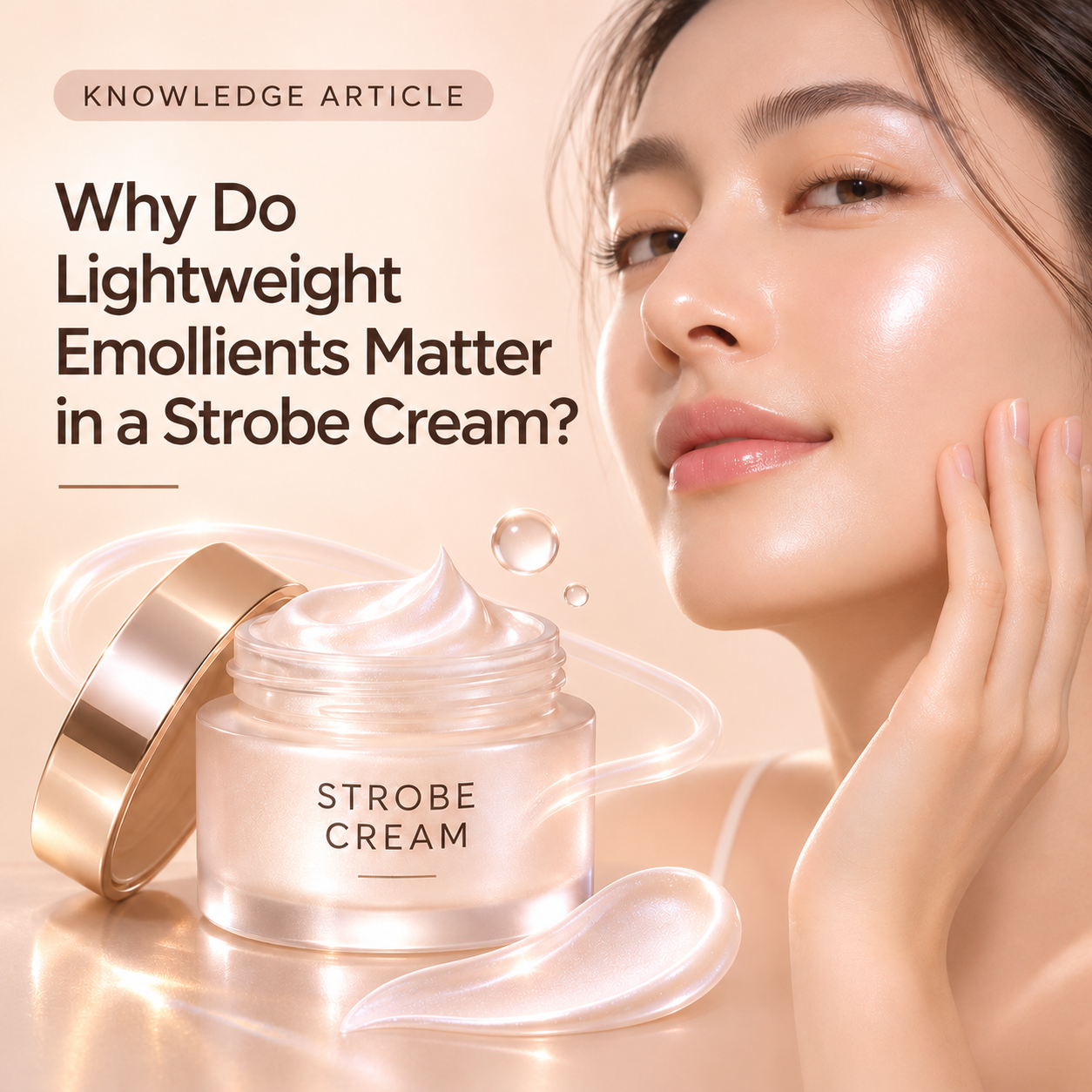
Lightweight emollients matter because a strobe cream should feel smooth and moisturising without necessarily leaving the face heavily oily. In this product category, texture affects whether a luminous finish feels comfortable for daily use.
Glow does not have to mean grease
A strobe cream reflects light because of mica. It does not have to rely on a heavy oily film to look radiant. I prefer a smooth, light finish that allows the skin to look illuminated without feeling excessively greasy. This is particularly relevant for someone who wants to wear the product to work or during normal daytime activities.
How different emollients feel
Caprylic/capric triglyceride, often called CCTG, is discussed as a coconut-derived emollient with a light, smooth feel. It lacks the characteristic coconut smell and heaviness associated with ordinary coconut oil. Olive squalene is discussed as another light option. Almond oil or argan oil may also be used in similar product concepts, but I describe them as potentially giving a heavier skin feel.
The rest of the texture matters too
Moisturising ingredients are also judged by feel. Glycerin hydrates but can feel sticky or sweaty for some users when used heavily. Propanediol is preferred in the discussion for a lighter, less sticky moisturising sensation. Aloe vera gel is associated with a smooth, somewhat matte feel even when the finished product has visible reflective shine.
How to choose
A person with a preference for lightweight everyday skincare may value a product that spreads easily and does not leave the skin feeling coated. Someone who enjoys a richer texture may choose differently. The important point is that visible shine and oily sensation are not the same characteristic.