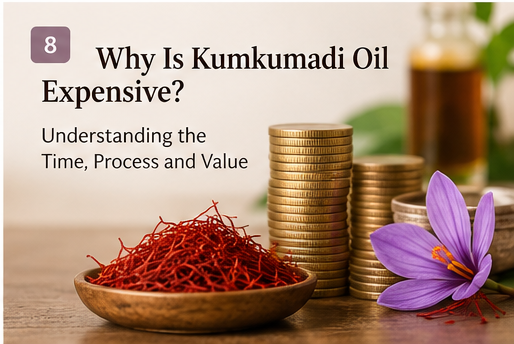
Traditional Kumkumadi oil can be expensive for two different reasons: saffron is a costly raw material, and the traditional preparation itself is time-consuming. The workshop emphasizes that process time and labour are major parts of the cost, not simply the price of the ingredients in the bottle.
Saffron is expensive because the usable yield is small
Saffron comes from a small part of the flower, and only a few strands are obtained from each flower. The workshop describes it as a low-yield material and explains that this scarcity contributes to its high price.
But most of the cost is not explained by saffron alone
Many of the other materials in Kumkumadi oil are not described as unusually expensive. What makes the traditional product demanding is the extended preparation, which involves herbal extraction, filtration, long periods of heating and waiting, followed by a later saffron infusion. The complete manufacturing sequence is not needed to understand the economic principle: it consumes time.
Why a shortcut product can be much cheaper
A simple saffron-infused carrier oil avoids much of that work. It can still contain saffron and deliver the properties attributed to saffron, but it does not require the same broader herbal preparation. This is one reason products carrying the same Kumkumadi name can differ sharply in price.
Price is not proof by itself
A high price does not by itself establish that an oil is traditionally prepared, just as a low price does not by itself tell you exactly what is in the bottle. The workshop’s useful contribution is to explain why a genuine difference in process can create a genuine difference in cost.
The useful takeaway
When a traditional Kumkumadi oil costs more than a simple facial oil, consider the process as well as the ingredients. The product is a good example of something whose commercial cost can reflect time and skilled labour as much as raw-material cost.
Related Kumkumadi Oil guides
→ How can you tell traditional Kumkumadi oil from a simple saffron-infused oil?
→ Why doesn’t traditional Kumkumadi oil have to be crystal clear?
For a broader look at its ingredients, benefits, skin uses and how to choose an authentic oil, read our complete guide to Kumkumadi oil.