
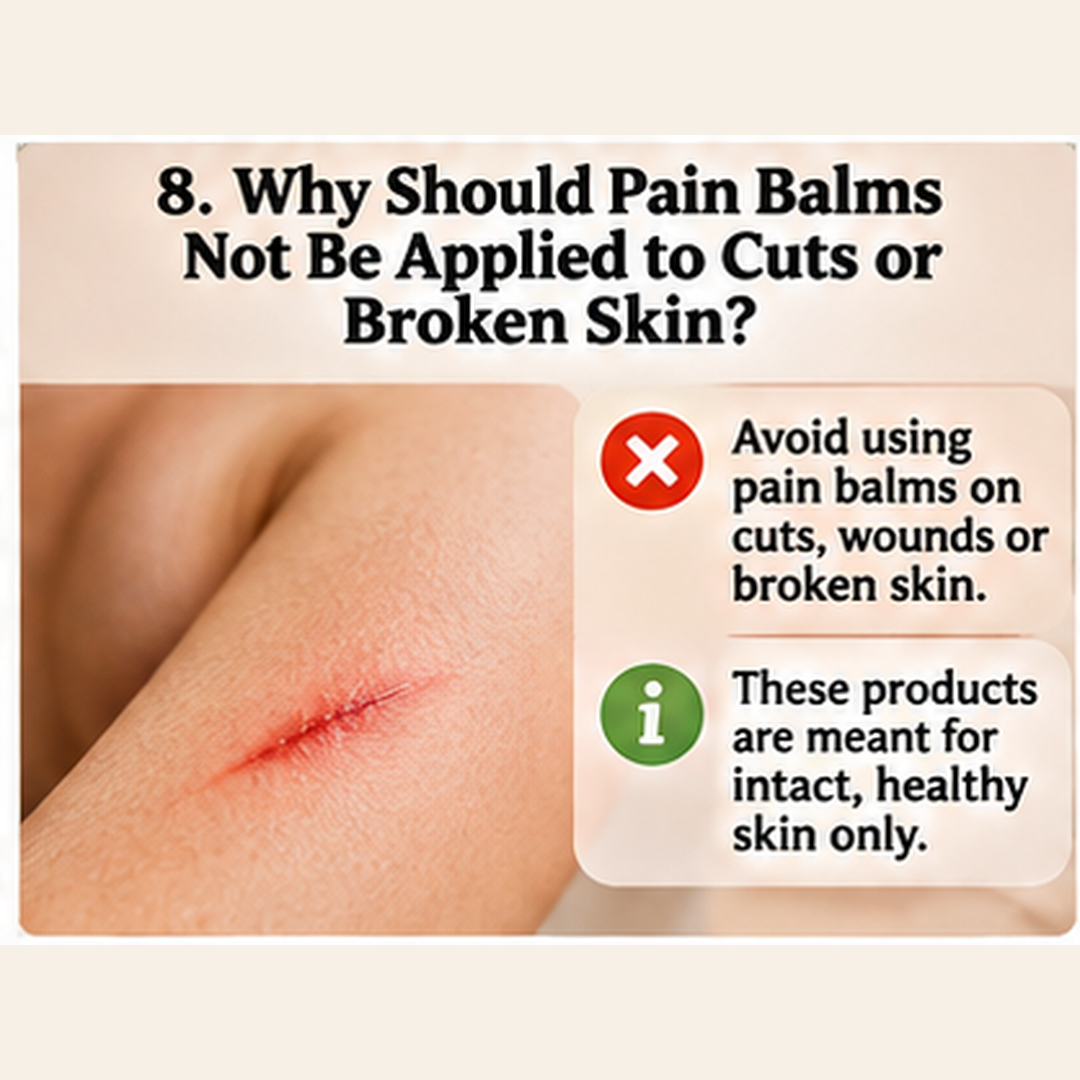
Strong pain balms should not be applied to cuts, open wounds or broken skin because their concentrated cooling and aromatic ingredients may produce severe burning and discomfort.
A product intended to provide relief on an otherwise intact painful area may become irritating when applied directly over damaged skin.
Why Can a Pain Balm Cause Burning?
Pain balms often contain ingredients selected for strong cooling, numbing or warming sensations.
These ingredients are included because of their intended pain-relieving effects.
However, they are concentrated and can become uncomfortable when applied to sensitive or damaged areas.
This is particularly important when the skin is already injured.
What Happens If There Is a Cut Over a Painful Joint?
Consider someone who falls and hurts a knee.
The person may experience joint pain and may also have a cut or abrasion on the skin.
A pain balm may be intended for joint discomfort, but applying it directly over the wound can cause severe burning.
This example demonstrates an important distinction between the location of the pain and the condition of the skin covering that area.
Even when the joint itself is painful, the skin must be considered before applying a topical preparation.
What About Pimples or Inflamed Acne?
A similar precaution applies when using pain balm for headaches.
If there is inflamed acne or a pus-filled pimple on the forehead, applying a strong balm over the affected spot may produce irritation and discomfort.
The product should not be applied over those areas simply because the person has a headache.
Why Is the Eye Area Particularly Sensitive?
Pain balms should be kept away from the eyes.
The essential oils and other concentrated ingredients can cause burning and discomfort if they enter the eyes.
For a headache, application to an appropriate area of the forehead may be considered, but contact with the eyes should be avoided.
A product intended for external application is not necessarily suitable for every part of the face.
Are Natural Pain Balms Automatically Gentle?
No.
Natural ingredients may still be highly concentrated.
Menthol, camphor and essential oils are examples of ingredients used for strong sensory effects.
Their natural origin does not eliminate the possibility of irritation.
This is why product strength and the condition of the skin both matter.
The Important Takeaway
Before applying a pain balm, consider not only where the pain is located but also the condition of the skin.
A painful joint or muscle does not justify applying a strong balm over a cut, wound or inflamed skin lesion.
Avoiding damaged and sensitive areas is essential for comfortable use.

