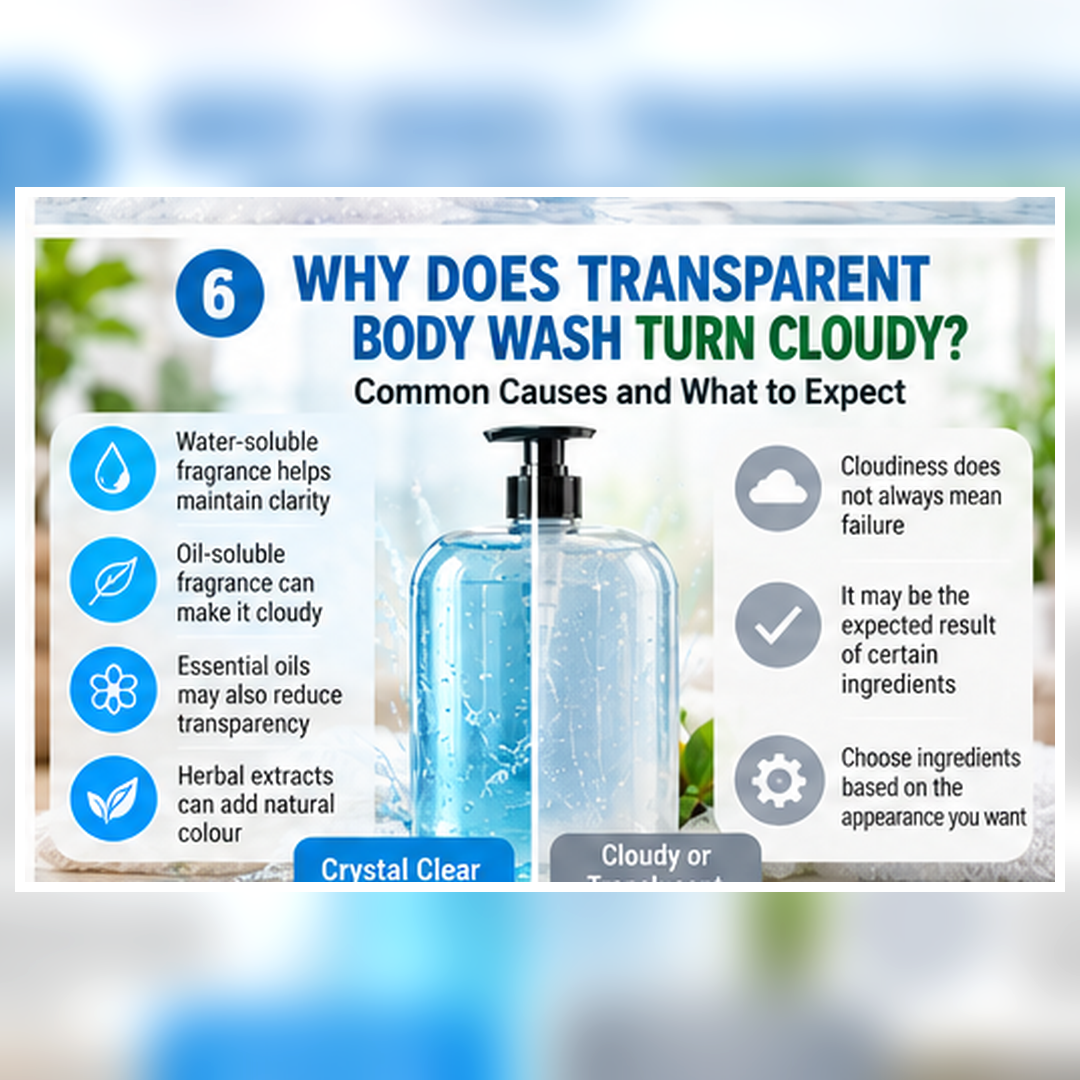
A transparent body wash can lose its crystal-clear appearance when ingredients that do not remain clear in the system are added.
One common example discussed in the workshop is fragrance.
Why Does Fragrance Affect Clarity?
If transparency is important, I prefer a water-soluble fragrance.
Oil-soluble fragrance can change the appearance of the product.
Essential oils can do the same.
Instead of remaining crystal clear, the shower gel may become more translucent or slightly turbid.
Does Cloudiness Mean the Product Has Failed?
Not necessarily.
This is an important distinction.
If the appearance changed because an oil-based fragrance or essential oil was deliberately added, the loss of transparency may simply be the expected visual result.
The product can still be usable.
The issue is whether the final appearance matches what you intended to create.
Why Is This Important for Product Design?
Imagine promising yourself a completely transparent shower gel and then choosing several ingredients that make the system cloudy.
You will spend unnecessary time trying to “fix” something that is a predictable consequence of those ingredient choices.
The better approach is to decide which matters more:
- complete transparency;
- a particular fragrance;
- an essential-oil positioning;
- a specific active or extract.
Sometimes you cannot maximize every characteristic at the same time.
Can Herbal Extracts Affect the Colour Too?
Yes.
The herbal body wash made during the workshop developed its own colour from the herbal extract.
That meant additional colour was not necessary.
The finished appearance of a transparent product is therefore influenced not only by artificial colour but also by the natural colour of the ingredients added to it.
The Practical Takeaway
Transparency is not simply achieved by starting with a clear base.
Every ingredient added afterward can influence the final appearance.
If crystal clarity is central to the product concept, choose ingredients with that goal in mind.