
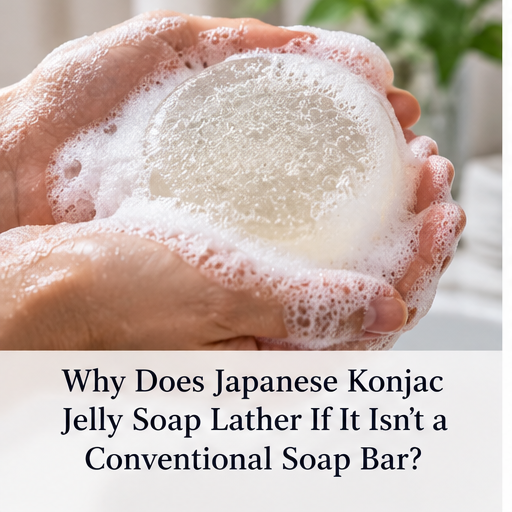
Japanese konjac jelly soap lathers because its cleansing action comes from surfactants.
The jelly structure determines the physical form of the product, while the surfactant system performs the cleansing and lathering work.
These are separate functions.
SCI Provides the Main Cleansing and Lathering Action
SCI, or sodium cocoyl isethionate, is the primary surfactant discussed for the cleansing system.
I use it as the main lathering and cleansing ingredient.
It is coconut-derived, sulfate-free and described as very mild. It produces abundant foam and creates a soft, velvety lather on the skin.
I initially referred to SCI as a soap during the workshop and then corrected that description.
SCI is better understood here as a surfactant or lathering agent, rather than as soap itself.
Cocamidopropyl Betaine Supports the Cleansing System
Cocamidopropyl betaine, usually shortened to CAPB, acts as a co-surfactant.
Its role is supportive rather than primary.
It contributes additional lather and also helps the character and thickness of the liquid cleansing system.
This illustrates an important idea: several cleansing ingredients may work together, but they do not necessarily have identical roles.
Foam and Jelly Structure Come From Different Parts of the Product
A useful way to understand jelly soap is to separate the product into functions.
The surfactants provide cleansing and foam.
Other ingredients contribute moisturisation.
Structural ingredients produce the jelly texture.
An ingredient that gives excellent lather does not automatically create a good jelly, and an ingredient that creates a strong gel does not automatically clean the skin.
That is why the product has to be designed as a complete system.
Why Fresh Product Can Look Very Foamy
A freshly prepared cleansing base can appear cloudy or frothy because a large amount of air has been incorporated.
After it rests, the appearance can change considerably.
In the workshop, the settled cleansing base became clearer and remained extremely thick.
That demonstrates an important practical point: the appearance of a freshly mixed cleanser is not necessarily the same as its final settled appearance.
The Practical Takeaway
Japanese konjac jelly soap can be soft and jelly-like while still producing substantial lather because texture and cleansing are separate functions.
The surfactant system creates the foam and cleansing action. The jelly ingredients create the unusual physical form.
Understanding that distinction makes the product much easier to understand: the wobble does not create the lather, and the lathering ingredients do not create the wobble.
Related Jelly Soap guides
→ What Is Japanese Konjac Jelly Soap?
→ What Makes Japanese Konjac Jelly Soap Jelly-Like?
For a broader introduction to Japanese konjac jelly soap, its ingredients, structure, variations and formulation principles, read our complete guide: Japanese Konjac Jelly Soap: Benefits, Ingredients & How It Works.