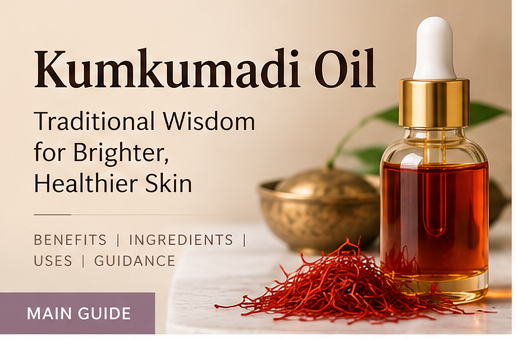
Kumkumadi oil is a traditional Ayurvedic herbal oil built around saffron and a much broader group of herbs and supporting ingredients. It is best understood not as “saffron in oil,” but as a multi-ingredient preparation in which different materials are chosen for different roles: skin brightening, pigmentation care, moisturization, exfoliation, soothing, acne care and support for aging skin.
That distinction matters because the name is now used for products that can be very different from one another. A simple saffron-infused carrier oil may still give you the benefits associated with saffron, but it is not the same thing as the more elaborate traditional preparation.
Read more: What Is Kumkumadi Oil, and Is It the Same as Saffron Oil?
What Is Kumkumadi Oil?
The name Kumkumadi is connected with kumkum, a traditional name associated with saffron. Saffron is the hero ingredient, but it is only one part of the preparation. The traditional version brings together a large group of herbs along with an oil base and milk, so each component contributes something different to the final product.
Historically, oils were an important way of moisturizing the skin before modern creams and lotions became common. Ayurvedic oils developed beyond simple moisturization by combining oils with herbs selected for particular purposes. Kumkumadi oil became an especially versatile facial oil because its ingredient profile addresses several common skin concerns at the same time.
Why Is Kumkumadi Oil Used?
I treat Kumkumadi oil as an all-rounder skincare oil. Its main cosmetic uses include skin brightening, the appearance of tanning and pigmentation, dark circles, freckles, acne and acne marks, dryness, fine lines and other signs associated with aging.
One of the useful ideas behind the formulation is that it does not depend on one ingredient doing everything. Some ingredients are included for pigmentation and brightness, some for dead-skin removal, some for soothing and healing, and others for moisturization, elasticity or antioxidant support.
Read more: Why Is Kumkumadi Oil Used for Pigmentation, Tanning and Dark Circles?
How the Ingredient Roles Fit Together
Instead of looking at Kumkumadi oil as a list of herbs, it is more useful to understand the roles those herbs play. Four broad ideas are particularly important: keeping the skin surface clear of accumulated dead cells, supporting more even-looking pigmentation, balancing and soothing problem skin, and maintaining softness and hydration.
Red Sandalwood: Dead Skin and Sebum Balance
Red sandalwood is used for its antibacterial property, its role in helping remove dead skin and its ability to balance excess sebum.
Sebum is the skin’s natural oil. It is present even in normal and dry skin, but when secretion becomes excessive the face can become greasy quite quickly, particularly around the T-zone.
The aim is not to eliminate sebum. Red sandalwood is used to help balance excess secretion. The dead-skin role is also important because accumulated surface cells can make skin look dull and feel rough. When that surface buildup is removed, the skin underneath appears smoother and brighter.
Laksha: A Non-Vegan Ingredient Used for Healing Support
Laksha, or lac, is not a plant ingredient. It is obtained from an insect secretion—the same material associated with traditional lac products.
Its presence is one reason the traditional Kumkumadi oil discussed here is not vegan; milk is another.
In skincare, laksha is used mainly for wound-healing and inflammation-related support. That becomes relevant to acne because a sore, inflamed spot can behave like a small wound on the skin.
Manjishtha and Licorice: Pigmentation-Focused Herbs
Manjishtha and licorice are both used in relation to pigmentation.
Manjishtha is associated particularly with freckles, tanning, acne marks, dark circles and other areas of uneven pigmentation. Licorice has a similar pigmentation-focused role together with an overall skin-lightening effect.
A useful way to understand this is through melanin, the pigment that contributes to skin colour. Melanin also has a protective role. The cosmetic goal is therefore not to remove melanin completely, but to reduce the appearance of excess pigmentation and control excessive pigment production.
Sandalwood and Vetiver: Exfoliation, Moisture and Aging-Skin Support
Sandalwood is another multi-purpose ingredient, used for acne, wrinkles, aging skin, dry skin, brightness and removal of dead surface cells.
Vetiver, whose root is used, has roles in dead-skin removal, antioxidant support, hydration and soothing redness, itchiness and inflammation.
The anti-aging idea here is broader than simply treating a wrinkle. It includes helping the skin remain moisturized, supporting the condition of skin cells and reducing the dullness that comes with surface buildup.
Daru Haldi and Amba Haldi: Why the Type of Turmeric Matters
There is an important distinction between ordinary cooking turmeric and Daru Haldi (wild turmeric) and Amba Haldi (mango turmeric).
All are used for healing, skin-lightening and disinfecting properties, but ordinary cooking turmeric is avoided in this cosmetic preparation because it can leave a strong yellow colour on the face.
This illustrates an important principle: two ingredients from the same broad family may be chosen differently because the appearance and user experience of the finished cosmetic also matter.
Neel Kamal: Hydration and Elasticity
Neel Kamal, or blue lotus, is included for moisturization, hydration and skin elasticity.
As skin ages, loss of elasticity and plumpness becomes more noticeable. Neel Kamal is therefore used mainly as an aging-skin ingredient, with an additional role in the appearance of brown spots associated with aging.
Dashamula: A Different Kind of Contribution
Dashamula is not a single herb but a traditional combination of ten herbs.
It is not used primarily as a brightening ingredient here. Its role is described in terms of antioxidant, anti-inflammatory and pain-relieving properties, complementing other ingredients when the skin is inflamed or acne is painful.
Saffron: The Hero Ingredient, but Not the Whole Story
Saffron is the ingredient most strongly associated with Kumkumadi oil. It is used for antifungal, soothing and skin-healing properties, and especially for skin brightening and the appearance of freckles, tanning and pigmentation.
Its cost is partly explained by how little usable saffron is obtained from each flower.
But the important point is that the value of traditional Kumkumadi oil does not come from saffron alone. If the rest of the herbal system is missing, many of the roles attributed to the complete preparation are missing as well.
The Role of the Oil Base and Milk
Traditional Kumkumadi oil is associated with sesame oil as its base. Sesame is a stable oil and is also used for its softness-promoting, antifungal and anti-inflammatory benefits.
Other oils may be used in different versions, but changing the base changes the character and cost of the product.
Goat milk is another important part of the traditional preparation. Its lactic-acid content is associated with dead-skin removal, skin glow, cell renewal and moisturization.
This also reinforces why the traditional preparation is not vegan.
Kumkumadi Oil and Acne-Prone Skin
It can sound contradictory to recommend an oil for acne-prone skin, but Kumkumadi oil is used for acne-prone skin because several of its herbs are selected for acne, inflammation and healing.
An acne-prone user may notice more acne during the first week or so of use. The teaching here is to allow a longer period before judging the result. This is treated as a temporary phase before acne gradually reduces.
Kumkumadi oil can also be applied over a fresh acne spot to support healing and reduce the later mark.
Read more: Can You Use Kumkumadi Oil on Acne-Prone Skin?
Dry Skin, Oily Skin and How Much to Apply
Kumkumadi oil is concentrated enough that you do not need to coat the face in oil. Only a few drops are needed for the whole face.
Using more is not necessarily harmful, but it can make the face look unnecessarily greasy.
For oily skin, keeping the amount small is particularly useful. For very dry skin, a little more can be used if needed. The oil can also be combined at the time of application with a cream or gel, or layered after a water-based serum.
This distinction becomes particularly important for very dry skin. A water-based product sold as Kumkumadi is not the same thing as Kumkumadi oil. A water-based Kumkumadi serum can feel drying on very dry skin, while the oil preparation is intended to be moisturizing.
Read more: Kumkumadi Oil vs Kumkumadi Serum: What’s the Difference for Dry Skin?
Ways to Use Kumkumadi Oil in a Skincare Routine
There are several ways to use Kumkumadi oil:
- Apply a few drops directly to the face and massage gently.
- Use it after a water-based serum once the serum has absorbed.
- Mix a few drops with a day cream, night cream or gel at the time of application.
- Add a small amount to a face mask or scrub when using that product.
- Use it as part of a facial massage routine.
It may be used during the day or at night.
Read more: How Should You Use Kumkumadi Oil on the Face?
How to Think About Authenticity When Buying Kumkumadi Oil
One of the most useful things to understand is that “Kumkumadi oil” can describe very different products.
A shortcut version may simply infuse saffron into a carrier oil. That can still be a saffron oil, but it does not contain the wider set of ingredients and functions found in the traditional preparation.
Appearance can also provide a clue. A simple filtered saffron infusion may look crystal clear, whereas a traditionally prepared multi-herb oil can remain slightly turbid even after filtration because traces from the herbal and milk components remain.
Do not automatically treat slight turbidity as a defect. It can be an expected visual characteristic of the more elaborate preparation.
Likewise, the finished oil may have a noticeable natural aroma rather than smelling like a highly perfumed cosmetic.
Read more: How Can You Tell Traditional Kumkumadi Oil From a Simple Saffron-Infused Oil?
Does Kumkumadi Oil Have to Be Crystal Clear?
No. Crystal clarity should not automatically be interpreted as a sign that Kumkumadi oil is more authentic or pure.
A multi-herb traditional oil may retain slight turbidity after filtration because of the herbal and milk components involved.
Read more: Why Doesn’t Traditional Kumkumadi Oil Have to Be Crystal Clear?
Why Kumkumadi Oil Can Be Expensive
There is an important distinction between ingredient cost and process cost.
Saffron is expensive, but traditional Kumkumadi oil is also costly because preparing it is time-consuming and involves multiple extraction, filtration and waiting stages.
A higher price therefore does not necessarily mean that the bottle contains only extremely expensive raw materials. It can reflect the labour and time required to produce the oil in the traditional way.
Conversely, a very inexpensive product may be worth examining more closely to understand whether it is a full multi-herb preparation or simply a saffron-infused oil.
Read more: Why Can Traditional Kumkumadi Oil Be Expensive?
Common Misunderstandings About Kumkumadi Oil
“Kumkumadi oil is just saffron oil.”
Not in the traditional version discussed here. Saffron is central, but the complete preparation relies on many other herbs, an oil base and milk, each selected for a different purpose.
“Because it is an oil, it must be unsuitable for acne.”
Kumkumadi oil is specifically used for acne-prone skin, with ingredients chosen for sebum balance, inflammation, healing and acne marks.
“A perfectly clear oil must be more pure.”
Clarity is not the main sign of authenticity. A multi-herb traditional oil may retain slight turbidity after filtration.
“More oil means more benefit.”
The face does not need a heavy layer. A few drops are normally enough; extra oil mainly increases greasiness.
Common Questions About Kumkumadi Oil
Is Kumkumadi oil suitable for very acne-prone skin?
Yes, according to the approach discussed here. It is specifically used for acne-prone skin, with the caution that some users may see an initial increase in acne before judging the longer-term result.
Can Kumkumadi oil make very dry skin feel drier?
The oil itself is intended to be moisturizing. It is important to distinguish Kumkumadi oil from water-based Kumkumadi serums, which may feel drying on very dry skin.
Is traditional Kumkumadi oil vegan?
No. The traditional version discussed here contains milk and laksha, which is obtained from an insect secretion.
Does Kumkumadi oil have to be crystal clear?
No. Traditional multi-herb Kumkumadi oil may be slightly turbid rather than perfectly crystal clear.
Can Kumkumadi oil be used with other skincare products?
Yes. It can be used on its own, layered after a water-based serum, or mixed at the time of use with creams, gels, masks or scrubs.
Understanding Kumkumadi Oil as a Complete Skincare System
The most useful way to understand Kumkumadi oil is as a system rather than a single-ingredient product.
Saffron gives the oil its identity, but the broader value comes from combining ingredients with complementary roles: pigmentation care, dead-skin removal, moisturization, soothing, acne support and aging-skin care.
For a consumer, this changes what to look for. Ask what kind of Kumkumadi oil you are actually buying, use only a small amount on the face, and judge the product by how its overall composition and intended use match your skin rather than by saffron alone or by whether the oil looks perfectly clear.
Want to Learn How to Make Kumkumadi Oil?
This guide explains the principles behind Kumkumadi oil—what it is, how its different ingredients contribute, why it is used for different skin concerns, and how to understand the differences between traditional Kumkumadi oil and simpler saffron-infused oils.
If you want to move from understanding these principles to actually learning the practical making process, explore our Kumkumadi Oil Making Course.
The course takes the subject into the practical formulation and making process that isn’t reproduced in this public guide.
Continue learning: Explore all Kumkumadi Oil guides →