No. A hair dye can contain herbs and still contain chemical colouring ingredients. “Herbal” and “100% natural” should therefore not be treated as interchangeable descriptions.
This distinction matters both for setting realistic expectations and for people who are deliberately trying to avoid particular chemical ingredients.
What makes the two product types different?
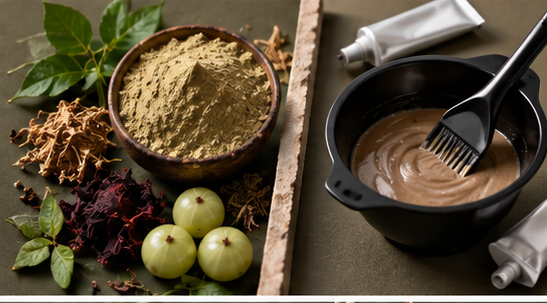
The natural system discussed here uses a two-step approach based on natural colourants such as henna and indigo.
A one-step herbal hair dye can be a different type of product. It may contain a large herbal component while relying on chemical colouring agents for the permanent colouring action.
In that case, the herbs are genuine parts of the product, but they are not solely responsible for the hair colour.
Why the label matters
If chemical colouring agents are present, the product should not be represented as 100% natural.
This is more than a wording issue. Someone may specifically seek a completely natural product because they want to avoid a particular chemical ingredient. Calling a chemical-containing product “100% natural” would therefore create the wrong expectation about what the person is buying and using.
Does PPD-free automatically mean natural?
No.
PPD, or paraphenylenediamine, is one chemical colouring agent discussed in relation to permanent hair colour. But it is not the only chemical capable of performing a colouring function.
A permanent colour can therefore be PPD-free without being a natural or temporary colour. Removing one named chemical does not by itself tell you what the entire colouring system is.
Why patch testing still matters for chemical-containing colour
For hair colours containing chemical colouring agents, patch testing is emphasised before use. The guidance given is to perform the patch test 24 hours before colouring rather than immediately before application.
That precaution matters precisely because consumers should know what kind of product they are using rather than assuming that the presence of herbs makes all other considerations irrelevant. The practical takeaway is to read “herbal” as a description of the presence and role of herbs, not as an automatic guarantee that every ingredient in the product is natural. If avoiding chemical colouring agents is important to you, the meaningful distinction is whether the product is genuinely 100% natural.
Related Herbal Hair Dye Guides
- Why Are Henna and Indigo Used as a Two-Step Natural Hair Colour?
- What Is the Difference Between Temporary, Semi-Permanent and Permanent Hair Colour?
- Why Do Herbal Hair Dye Ingredients Have Different Roles?
Main guide: Herbal Hair Dye Explained: Natural Colour, Grey Coverage, Ingredients and Common Problems
Explore the complete topic: Herbal Hair Dye Learning Hub