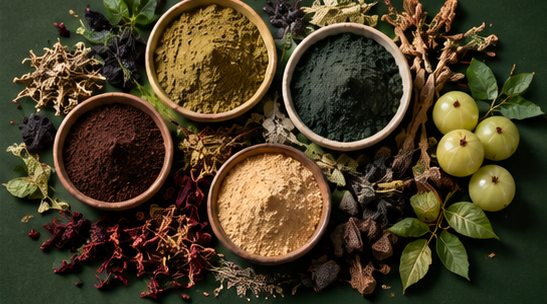
Not every herb in a herbal hair colour is there to act as the main dye. Some ingredients provide strong pigment, some modify or deepen another colour, some support penetration, and others are included for hair feel or nourishment.
Understanding those different roles is more useful than looking at a long botanical ingredient list and assuming that every herb is doing the same job.
Henna is a principal natural pigment
Henna is the major natural pigment in the system discussed here. It produces a deep orange-red colour rather than black.
It is strong enough to form the foundation of the natural colouring system, but it also has a practical drawback: it can leave the hair feeling dry. This is one reason other ingredients may have roles beyond simply adding more pigment.
Coffee and black tea are weaker colour contributors
Coffee and black tea illustrate the difference between a main dye and a supporting colour ingredient.
Neither is described as a strong pigment like henna. A useful analogy is a white cloth: coffee or tea can stain white fabric even though they are not powerful hair dyes.
Used in a hair-colour context, their role is to contribute towards a deeper, more brownish appearance rather than acting as the primary colouring mechanism.
Some herbs deepen or modify colour
Ratanjot contributes a dark brownish pigment and is used to intensify the colour associated with henna rather than replace henna as the main dye.
Amla is discussed for its darker, blackish staining tendency and for helping deepen the overall colour in the natural system.
Katechu, or katha, has a brown pigment and also supports penetration. But there is a trade-off: too much can make the hair rougher.
These examples show why “more pigment” is not the only consideration. An ingredient can affect both colour and the way the hair feels.
Some ingredients are there primarily for hair care
Shikakai is discussed more for nourishment and softening than as a principal dye. That role becomes useful in a powder system in which henna can contribute to dryness.
Bhringraj and jatamansi are discussed in connection with hair nourishment and premature greying rather than simply as primary colourants.
Loha bhasma has a functional darkening role
Loha bhasma is discussed in connection with iron and amla. Traditionally, an iron vessel may be used when preparing henna to encourage a darker effect. Loha bhasma is presented as a way of bringing that iron-related function into the product rather than requiring the user to prepare it in an iron kadhai. The useful takeaway is to think in ingredient functions rather than ingredient counts. A herbal hair colour is not automatically better because it lists more herbs, and every botanical ingredient should not be assumed to be a strong natural dye. What matters is the role each ingredient is intended to play.
Related Herbal Hair Dye Guides
- Why Are Henna and Indigo Used as a Two-Step Natural Hair Colour?
- Why Does Herbal Hair Colour Make Some Hair Feel Dry?
- Is Herbal Hair Dye the Same as 100% Natural Hair Dye?
Main guide: Herbal Hair Dye Explained: Natural Colour, Grey Coverage, Ingredients and Common Problems
Explore the complete topic: Herbal Hair Dye Learning Hub